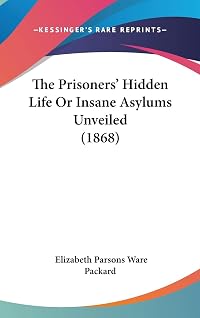
The Prisoners' Hidden Life, Or Insane Asylums Unveiled: As Demonstrated By The Report Of The Investigating Committee Of The Legislature Of Illinois, Together With Mrs. Packard's Coadjutors' Testimony
by Elizabeth Parsons Ware Packard
On This Page
Tags
Member Reviews
Like the works by Ann Titus and Robert Fuller, "The Prisoner's Hidden Life or Insane Asylums Unveiled" by E.P.W. Packard (1868, Chicago; published by author) also gives a patient's - eye view of asylums in 19th century America. Unlike them, however, her work could readily be considered a feminist treatise for women's rights. As such, it stands philosophically original and one of the early works of its kind. I have no expertise in the matter, but I would speculate that it could be the first of the women's rights genre. The relative lack of recognition as such undoubtedly stems from its dual focus on America's wretched social infrastructure built around mental illness. This latter issue initially draws the reader's attention show more faster.
Packard's own life outside of an asylum is very fascinating, but I shall stick to Packard the author. The book is frankly a very slow read - much like scripture. This, in part, is because it has a wordy, 19th century style more like Old Testament scripture than contemporary text. However, in the same vein and the best light, it contains a dense pack of wisdom. One could fill six pages of great quotes. She does not shrink from controversy. It is easy to see why numerous men feel threatened by her. One of the main theses of the book is the need to take away the absolute power of commitment a man has over his wife.
Hence the asylum serves very much as a prison rather than a hospital (where she reports getting no genuine treatment for any ill):
"It was a matter of great surprise to me to find so many in the Seventh ward, who, like myself, had never shown any insanity while there, and these were almost uniformly married women, who were put there either by strategy or by force."
In short, the hospital is a dumping ground for bothersome wives.
She makes a biting remark about the status of people with mental illness:
"The insane are permitted to be treated and regarded as having no rights that any one is bound to respect—no, not even so much as the slaves are, for they have the rights of their masters' selfish interests to shield their own rights. But the rights of the insane are not even shielded by the principle of selfishness."
Unlike the slave, people with mental illness are considered to have no value to be protected even indirectly as her analogy suggests.
She is troubled over and over by loss of contact with the outside world during her confinement. She even elaborates on “post office rights”, and a right of communication, as I have written of, myself, seems worthy of special status. This is particularly true for someone with a mental illness, especially when the person is suspected of being a threat to themselves or to others.
She greatly worries over her children and their well being in the custody of her despicable husband. To further drive home the point that women declared insane are the lowest rung of human status, she makes the mind-stopping observation which typically nobody ever would:
"The mother of the illegitimate child is protected by the law, in the right to her own offspring, while the lawfully married wife is not. Thus the only shield maternity has under the laws, is in prostitution."
One is left speechless at the truth of it!
I could go on for many pages about the wealth of philosophical wisdom in the book. However, I should note that her commentary about life in the Jacksonville Insane Asylum is what one would expect, rather harsh. I recommend the book as much or more as an important work of feminist literature as medical for that is what separates it the most from other writings about asylums. show less
Packard's own life outside of an asylum is very fascinating, but I shall stick to Packard the author. The book is frankly a very slow read - much like scripture. This, in part, is because it has a wordy, 19th century style more like Old Testament scripture than contemporary text. However, in the same vein and the best light, it contains a dense pack of wisdom. One could fill six pages of great quotes. She does not shrink from controversy. It is easy to see why numerous men feel threatened by her. One of the main theses of the book is the need to take away the absolute power of commitment a man has over his wife.
Hence the asylum serves very much as a prison rather than a hospital (where she reports getting no genuine treatment for any ill):
"It was a matter of great surprise to me to find so many in the Seventh ward, who, like myself, had never shown any insanity while there, and these were almost uniformly married women, who were put there either by strategy or by force."
In short, the hospital is a dumping ground for bothersome wives.
She makes a biting remark about the status of people with mental illness:
"The insane are permitted to be treated and regarded as having no rights that any one is bound to respect—no, not even so much as the slaves are, for they have the rights of their masters' selfish interests to shield their own rights. But the rights of the insane are not even shielded by the principle of selfishness."
Unlike the slave, people with mental illness are considered to have no value to be protected even indirectly as her analogy suggests.
She is troubled over and over by loss of contact with the outside world during her confinement. She even elaborates on “post office rights”, and a right of communication, as I have written of, myself, seems worthy of special status. This is particularly true for someone with a mental illness, especially when the person is suspected of being a threat to themselves or to others.
She greatly worries over her children and their well being in the custody of her despicable husband. To further drive home the point that women declared insane are the lowest rung of human status, she makes the mind-stopping observation which typically nobody ever would:
"The mother of the illegitimate child is protected by the law, in the right to her own offspring, while the lawfully married wife is not. Thus the only shield maternity has under the laws, is in prostitution."
One is left speechless at the truth of it!
I could go on for many pages about the wealth of philosophical wisdom in the book. However, I should note that her commentary about life in the Jacksonville Insane Asylum is what one would expect, rather harsh. I recommend the book as much or more as an important work of feminist literature as medical for that is what separates it the most from other writings about asylums. show less
Members
- Recently Added By
Author Information
2 Works 6 Members
Classifications
- Genre
- History
- BISAC
Statistics
- Members
- 3
- Popularity
- 4,736,292
- Reviews
- 1
- Rating
- (5.00)
- Languages
- English
- Media
- Paper
- ISBNs
- 3