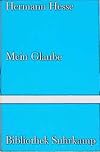
My Belief: Essays on Life and Art
by Hermann Hesse
On This Page
Description
"Arrays the opposing forces in over one hundred maps, pictures and orders of battle--the historical backgrounds, the terrain and armaments, the personalities, the weaknesses of the leaders on both sides--then pauses at crucial stages to explain the options open to each commander"--Dust jacket.Tags
Recommendations




















Member Reviews
There are those writers who spin tales and tell imaginary stories and there are those who document their lives. These essays fall into the latter category within the oeuvre of Hermann Hesse. Each is a delight whether of personal detail, literary criticism, philosophy, or meditation on the meaning of life. Hesse had to write and most often he had to write about himself. There is little that he wrote that is not confessional in aspect and therapeutic in function. These essays provide milestones and assessments of his life and reading. They are a joy to read and consider alongside his fiction and other writings.
Here is an especially moving excerpt from his essay "The Magic of the Book":
For every thinking person each verse of each poet show more will show a new and different face to the reader every few years, will awaken a different resonance in him. When as a youth I read for the first time, only partially understanding it, Goethe's Elective Affinities, that was a completely different book from the Elective Affinities that I have now read perhaps for the fifth time! The great and mysterious thing about this reading experience is this: the more discriminatingly, the more sensitively, and the more associatively we learn to read, the more clearly we see every thought and every poem in its uniqueness, its individuality, in its precise limitations and see that all beauty, all charm depend on this individuality and uniqueness--at the same time we come to realize ever more clearly how all these hundred thousand voices of nations strive toward the same goals, call upon the same gods by different names, dream the same wishes, suffer the same sorrows. Out of the thousandfold fabric of countless languages and books of several thousand years, in ecstatic instants there stares at the reader a marvelously noble and transcendent chimera: the countenance of humanity, charmed into unity from a thousand contradictory features." (pp 161-62) show less
Here is an especially moving excerpt from his essay "The Magic of the Book":
For every thinking person each verse of each poet show more will show a new and different face to the reader every few years, will awaken a different resonance in him. When as a youth I read for the first time, only partially understanding it, Goethe's Elective Affinities, that was a completely different book from the Elective Affinities that I have now read perhaps for the fifth time! The great and mysterious thing about this reading experience is this: the more discriminatingly, the more sensitively, and the more associatively we learn to read, the more clearly we see every thought and every poem in its uniqueness, its individuality, in its precise limitations and see that all beauty, all charm depend on this individuality and uniqueness--at the same time we come to realize ever more clearly how all these hundred thousand voices of nations strive toward the same goals, call upon the same gods by different names, dream the same wishes, suffer the same sorrows. Out of the thousandfold fabric of countless languages and books of several thousand years, in ecstatic instants there stares at the reader a marvelously noble and transcendent chimera: the countenance of humanity, charmed into unity from a thousand contradictory features." (pp 161-62) show less
Impure and distorting is the gaze of the will. Only when we desire nothing, only when our seeing becomes pure contemplation, does the soul of things open up. Hesse’s legacy is pietistic Protestantism, his parents were missionaries in India. The mixture of Christianity and Buddhism resounds in Hesse to a new, positively tuned melody that enchants. He developed the legacy of his parents into a mystical Christianity that sought the unity of religions. Only with this book one understands the books of Hesse in its depth.
"I believe that despite the obvious nonsense of life, there is a purpose to life, I resign myself to not being able to grasp that ultimate purpose in my mind, but I am willing to serve it, even if it means sacrificing show more myself."
Deutsch/German
Unrein und verzerrend ist der Blick des Willens. Erst wenn wir nichts begehren, nur wenn unser Sehen zur reinen Betrachtung wird, öffnet sich die Seele der Dinge. Hesses Erbe ist der pietistische Protestantismus, seine Eltern waren Missionare in Indien. Die Mischung aus Christentum und Buddhismus erklingt in Hessen zu einer neuen, positiv gestimmten Melodie, die verzaubert. Er entwickelte das Erbe seiner Eltern zu einem mystischen Christentum, das die Einheit der Religionen anstrebte. Nur mit diesem Buch versteht man die hessischen Bücher in ihrer Tiefe.
"Ich glaube, dass trotz des offensichtlichen Unsinns das Leben doch einen Sinn hat, ich ergehe mich darein, diesen letzten Sinn nicht mit dem Verstand erfassen zu können, bin aber bereit, ihm zu dienen, auch wenn ich mich dabei opfern muss." show less
"I believe that despite the obvious nonsense of life, there is a purpose to life, I resign myself to not being able to grasp that ultimate purpose in my mind, but I am willing to serve it, even if it means sacrificing show more myself."
Deutsch/German
Unrein und verzerrend ist der Blick des Willens. Erst wenn wir nichts begehren, nur wenn unser Sehen zur reinen Betrachtung wird, öffnet sich die Seele der Dinge. Hesses Erbe ist der pietistische Protestantismus, seine Eltern waren Missionare in Indien. Die Mischung aus Christentum und Buddhismus erklingt in Hessen zu einer neuen, positiv gestimmten Melodie, die verzaubert. Er entwickelte das Erbe seiner Eltern zu einem mystischen Christentum, das die Einheit der Religionen anstrebte. Nur mit diesem Buch versteht man die hessischen Bücher in ihrer Tiefe.
"Ich glaube, dass trotz des offensichtlichen Unsinns das Leben doch einen Sinn hat, ich ergehe mich darein, diesen letzten Sinn nicht mit dem Verstand erfassen zu können, bin aber bereit, ihm zu dienen, auch wenn ich mich dabei opfern muss." show less
Apr 4, 2023German
M-2
Oct 5, 2020Catalan
Ratings
Members
- Recently Added By
Published Reviews
"Ja verujem u ljude. Verujem u zakone čovečanstva koji su hiljadugodišnji", pisao je Hese. "Verujem da uprkos očiglednom besmislu život ipak ima neki smisao... Glas tog smisla čujem u sebi samom... Ono što život traži od mene u ovom trenutku želim da ostvarim čak i ako je pretiv uobičajene mode i zakona."
Time je odslikana osnova ove zbirke.
Čitavog života Hese je težio ka show more samoostvarenju "takođe i protiv uobičajene mode i zakona." Iz toga se sastojalo njegovo verovanje u ljude. "Ljubi bližnjeg svog kao sebe samog" za njega je bila zapovest. "Greška pri našim pitanjima i optužbama verovatno je u tome", pisao je Hese, "da želimo dobiti spolja kao poklon ono što mi sami, predavanjem sebe, od nas možemo tražiti..." Svi odgovori svode se na isto: život ima smisao jedino kroz ljubav. To znači: što više volimo i što smo više sposobni za predavanje time je smisaoniji naš život. S verovanjem u to "što Sidarta naziva ljubav" može se živeti.
Ova zbirka teži ka tome da dokumentuje Heseove predstave o verovanju. Prvi deo sadrži tekstove iz 20-tih godina. Drugi deo obuhvata period od 1931-1935. godine kada se Hese s velikim intenzitetom posvetio pitanjima verovanja. Treći deo daje aforistički mozaik iz pisanja i razmatranja od 1910-1961. godine i prozni tekst "Tajne" iz 1947. godine u kome se Hese ponovo bavi pitanjem smisla života. show less
Time je odslikana osnova ove zbirke.
Čitavog života Hese je težio ka show more samoostvarenju "takođe i protiv uobičajene mode i zakona." Iz toga se sastojalo njegovo verovanje u ljude. "Ljubi bližnjeg svog kao sebe samog" za njega je bila zapovest. "Greška pri našim pitanjima i optužbama verovatno je u tome", pisao je Hese, "da želimo dobiti spolja kao poklon ono što mi sami, predavanjem sebe, od nas možemo tražiti..." Svi odgovori svode se na isto: život ima smisao jedino kroz ljubav. To znači: što više volimo i što smo više sposobni za predavanje time je smisaoniji naš život. S verovanjem u to "što Sidarta naziva ljubav" može se živeti.
Ova zbirka teži ka tome da dokumentuje Heseove predstave o verovanju. Prvi deo sadrži tekstove iz 20-tih godina. Drugi deo obuhvata period od 1931-1935. godine kada se Hese s velikim intenzitetom posvetio pitanjima verovanja. Treći deo daje aforistički mozaik iz pisanja i razmatranja od 1910-1961. godine i prozni tekst "Tajne" iz 1947. godine u kome se Hese ponovo bavi pitanjem smisla života. show less
added by Sensei-CRS
Author Information

1,013+ Works 93,623 Members
Hermann Hesse (July 2, 1877 -- August 9, 1962) was a German poet, novelist, essayist and painter. His best-known works included Steppenwolf, Siddhartha, and The Glass Bead Game, each of which explores an individual's search for authenticity, self-knowledge and spirituality. In 1946, he received the Nobel Prize in Literature. Hess publicly show more announced his views on the savagery of World War I, and was considered a traitor. He moved to Switzerland where he eventually became a naturalized citizen. He warned of the advent of World War II, predicting that cultureless efficiency would destroy the modern world. His theme was usually the conflict between the elements of a person's dual nature and the problem of spiritual loneliness. His first novel, Peter Camenzind, was published in 1904. His masterpiece, Death and the Lover (1930), contrasts a scholarly abbot and his beloved pupil, who leaves the monastery for the adventurous world. Steppenwolf (1927), a European bestseller, was published when defeated Germany had begun to plan for another war. It is the story of Haller, who recognizes in himself the blend of the human and wolfish traits of the completely sterile scholarly project. During the 1960s Hesse became a favorite writer of the counter culture, especially in the United States, though his critical reputation has never equaled his popularity. Hermann Hesse died in 1962. (Bowker Author Biography) show less
Series
Belongs to Publisher Series
Common Knowledge
- Canonical title*
- Mein Glaube
- Original title
- Mein Glaube
*Some information comes from Common Knowledge in other languages. Click "Edit" for more information.
Classifications
- Genres
- Nonfiction, Literature Studies and Criticism, Fiction and Literature
- DDC/MDS
- 834.9 — Literature & rhetoric German & related literatures German essays 1900-
- LCC
- PT2617 .E85 .A6 — Language and Literature German, Dutch and Scandinavian literatures German literature Individual authors or works 1860/70-1960
- BISAC
Statistics
- Members
- 301
- Popularity
- 106,233
- Reviews
- 3
- Rating
- (3.95)
- Languages
- 7 — Dutch, English, Finnish, German, Italian, Serbian, Spanish
- Media
- Paper
- ISBNs
- 15
- ASINs
- 2