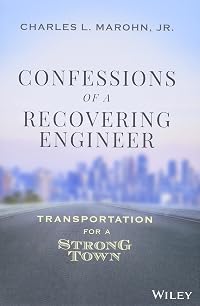
Confessions of a Recovering Engineer: Transportation for a Strong Town
by Charles L. Marohn, Jr.
On This Page
Description
In Confessions of a Recovering Engineer, renowned speaker and author of Strong Towns Charles L. Marohn, Jr., delivers an accessible and engaging exploration of America's transportation system, laying bare the reasons why it no longer works as it once did, and how to modernize transportation to better serve local communities. You'll discover real-world examples of poor design choices and how those choices have dramatic and tragic effects on the lives of the people who use them. You'll also show more find case studies and examples of design improvements that have revitalized communities and improved safety. This important book shows you: the values of the transportation professions, how they are applied in the design process, and how those priorities differ from those of the public; how the standard approach to transportation ensures the maximum amount of traffic congestion possible is created each day, and how to fight that congestion on a budget; and bottom-up techniques for spending less and getting higher returns on transportation projects, all while improving quality of life for residents. Perfect for anyone interested in why transportation systems work-and fail to work-the way they do, Confessions of a Recovering Engineer is a fascinating insider's peek behind the scenes of America's transportation systems. show lessTags
Recommendations


Member Reviews
I thought this book was an interesting introduction to the road/street/stroad discussion, and how stroads are hostile to non-automobile forms of transportation (and frankly, hostile to automobiles as well). I thought there was a lot of overlap with the book "There Are No Accidents."
Some loose threads included exactly how this would work in suburban environments and gentrification. On the first point, the author just seems to conclude that suburbs should not exist. But they do. Does the road/street solution help solve the issues with them? That is unclear to me. On the second point, the author seems to be pretty confident that gentrification will not occur if roads/streets are redesigned, but just kind of uses "trust me it won't happen" show more as his rationale. I'm not convinced.
A nitpicky thing that grated on me was the author's use of the term "positive feedback loop" to mean "feedback loop with positive (good) effects" and "negative feedback loop" to mean "feedback loop with negative (bad) effects." Which is not the same as what a positive/negative feedback loop is in actual engineering. A positive feedback loop is a BAD THING in engineering (example: a microphone placed next to a speaker is a positive feedback loop). A negative feedback loop is a GOOD THING in engineering (example: the cruise control in your car uses negative feedback to determine how much to spin the motor to speed you up or slow you down to get to your desired speed and keep that speed as constant as possible).
Finally, while I more or less enjoyed this book, I found the author to be rather insufferable in the concluding chapter. While in previous chapters I believe he did a good job centering the engineering and traffic design, the last chapter centered the author himself. I found it unnecessary. What really rubbed me the wrong way was the author centering HIMSELF around the death of Destiny Gonzalez, which I found distasteful. His comment "some years I say a prayer" to be infuriating. Some years. He says a prayer. Okay. I skimmed the rest of the concluding chapter and called it a day. show less
Some loose threads included exactly how this would work in suburban environments and gentrification. On the first point, the author just seems to conclude that suburbs should not exist. But they do. Does the road/street solution help solve the issues with them? That is unclear to me. On the second point, the author seems to be pretty confident that gentrification will not occur if roads/streets are redesigned, but just kind of uses "trust me it won't happen" show more as his rationale. I'm not convinced.
A nitpicky thing that grated on me was the author's use of the term "positive feedback loop" to mean "feedback loop with positive (good) effects" and "negative feedback loop" to mean "feedback loop with negative (bad) effects." Which is not the same as what a positive/negative feedback loop is in actual engineering. A positive feedback loop is a BAD THING in engineering (example: a microphone placed next to a speaker is a positive feedback loop). A negative feedback loop is a GOOD THING in engineering (example: the cruise control in your car uses negative feedback to determine how much to spin the motor to speed you up or slow you down to get to your desired speed and keep that speed as constant as possible).
Finally, while I more or less enjoyed this book, I found the author to be rather insufferable in the concluding chapter. While in previous chapters I believe he did a good job centering the engineering and traffic design, the last chapter centered the author himself. I found it unnecessary. What really rubbed me the wrong way was the author centering HIMSELF around the death of Destiny Gonzalez, which I found distasteful. His comment "some years I say a prayer" to be infuriating. Some years. He says a prayer. Okay. I skimmed the rest of the concluding chapter and called it a day. show less
Interesting book by someone who doesn’t believe in Big Highway or Big Transit. His main argument is that we’ve killed a lot of people by developing stroads—things that are neither roads, which are wide and optimized for cars and have few entrances and exits and no way for people to cross on foot, nor streets, which are narrow and clearly signal by their design that drivers need to go slow and that people will be crossing on foot. Because of midcentury design standards, we instead have roads/stroads marked at 30 mph that are designed for 50 or 60, and drivers naturally go that fast, but people are crossing and drivers are entering/making lefts across traffic too, with tragic results. I’m not really sure this is a reasonable show more diagnosis—I don’t really see where you should put a school in this framework—but it’s provocative and I appreciated his focus on helping people by starting with the smallest thing you can do from them and going from there, and not assuming that transit is a solution to poverty. You get healthy communities, he argues, by building places that people want to be—not parking lots or roads. show less
This book felt somehow more focused than his previous book, "Strongtowns", and also a bit more scatterbrained.
I think the parts of the book that were focused on how engineering design standards value speed and throughput of traffic, over safety, wealth creation, and return on investment were really good. I thought this was what the whole book was going to be about.
Other parts, I'm not so sure about. I think much of the book was spent either re-explaining ideas that were in "Strongtowns" or were creating an assumption that you have read it. I think there was a bit too much overlap, and felt pretty redundant at times.
Some of the topics had way too much time spent on them as well, such as the section on policing. I actually agree with show more many of his takeaways on policing reform, however it felt a little hamfisted and I'm not sure this was the right medium to tackle the topic. What does policing have to do with engineering? Isn't this book supposed to be about how he's had to shift his paradigm from "engineer thinking" to "Strongtowns thinking?"
I also have some troubles with his logic sometimes. Sometimes I think governments need to spend on providing public services to people, even if it "loses money". I understand his premise is that unless municipalities start focusing on revenue positive projects, cities will become insolvent. However with things like mass transit, sometimes you need to keep investing in it, in order to create a system that encourages ridership. Other times I think he used some examples that were really unconvincing to prove his point that something is a waste of money, and something that people don't value.
Overall, I definitely still enjoyed the book, and will definitely read anything more he decides to write. show less
I think the parts of the book that were focused on how engineering design standards value speed and throughput of traffic, over safety, wealth creation, and return on investment were really good. I thought this was what the whole book was going to be about.
Other parts, I'm not so sure about. I think much of the book was spent either re-explaining ideas that were in "Strongtowns" or were creating an assumption that you have read it. I think there was a bit too much overlap, and felt pretty redundant at times.
Some of the topics had way too much time spent on them as well, such as the section on policing. I actually agree with show more many of his takeaways on policing reform, however it felt a little hamfisted and I'm not sure this was the right medium to tackle the topic. What does policing have to do with engineering? Isn't this book supposed to be about how he's had to shift his paradigm from "engineer thinking" to "Strongtowns thinking?"
I also have some troubles with his logic sometimes. Sometimes I think governments need to spend on providing public services to people, even if it "loses money". I understand his premise is that unless municipalities start focusing on revenue positive projects, cities will become insolvent. However with things like mass transit, sometimes you need to keep investing in it, in order to create a system that encourages ridership. Other times I think he used some examples that were really unconvincing to prove his point that something is a waste of money, and something that people don't value.
Overall, I definitely still enjoyed the book, and will definitely read anything more he decides to write. show less
Ratings
Members
- Recently Added By
Lists

Urban Planning (Michelle TBR)
39 works; 3 members

John Wiley & Sons
34 works; 1 member

The War on Cars podcast
108 works; 1 member
Author Information

8 Works 335 Members
Classifications
- Genres
- Nonfiction, General Nonfiction, Politics and Government
- DDC/MDS
- 388.40973 — Society, government, & culture Commerce, communications & transportation regulations Transportation Local transportation History, geographic treatment, biography North America United States
- LCC
- HE308 .M37 — Social sciences Transportation and communications Transportation and communications Urban transportation
- BISAC
Statistics
- Members
- 89
- Popularity
- 356,488
- Reviews
- 4
- Rating
- (4.00)
- Languages
- English
- Media
- Paper, Audiobook, Ebook
- ISBNs
- 4
- ASINs
- 3