
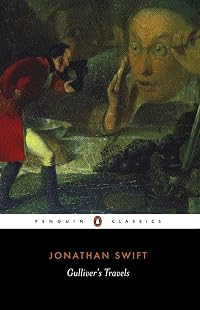
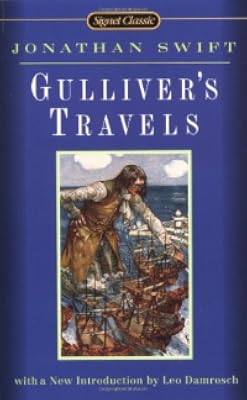
Gulliver's Travels (Penguin Classics)
by Jonathan Swift
On This Page
Description
The unusual voyages of Englishman Lemuel Gulliver carry him to such strange locales as Lilliput, where the inhabitants are six inches tall; Brobdingnag, a land of giants; an island of sorcerers; and a nation ruled by horses.Tags
Recommendations











Member Reviews
I can hardly believe I'm giving this four stars, given I found it such a challenge to get into. It is written as more travel log than novel, and while I can't fault it for this (style of the time), it kept me at emotional arm's length. Had the book started with the Houyhnhnms and ended with one of the other countries, I might have settled on three. But this last voyage was my favorite, the deepest in terms of probing human behavior, and the most affecting as Gulliver grew to love and admire the Houyhnhnms and grieve the end of his time there. All around thought-provoking, sardonic, clever. A challenge for my modern attention span but well worth the time.
It is difficult to describe what Swift's masterpiece means to me. Gulliver's Travels is a book that I will probably be grappling with for the rest of my life, and I mean that in a good way. It is a savage jeu d'esprit, a book about religion with no mention of God, a philosophical end-game written in unadorned prose, a deeply pessimistic statement on human nature, a lacerating attack on the primacy of Reason in Englightenment thought, a pacifist tract, and, yes, one of the funniest books ever written. An earlier Penguin edition had a foreword by British critic (and MP!) Michael Foot that is one of the most penetrating pieces of literary analysis I have ever read.
Sweeping entertainment. Popular from the year it was published, among adults as well as (duly expurgated) with children. Whether Swift intended to create one of the earliest English novels, a pioneering work of science-fiction or fantasy, a travel narrative, or a sour satire of British politics - he achieved it all. This quirky example of what we mean when we say "work of genius" was years before its time. In closing the Baroque century for good, it announced the coming Age of Enlightenment.
Still more important is the vast, new scope conquered for human imagination with those impossible tales of High-Heel Lilliputians, lascivious Brobdingnag ladies & Baconian scientism reduced to parody. Not to forget the chilling Houyhnhnms & their show more wretchedly humanoid underlings, the Yahoos.
A treasure of civilization which, a century from now, may still read like science-fiction. show less
Still more important is the vast, new scope conquered for human imagination with those impossible tales of High-Heel Lilliputians, lascivious Brobdingnag ladies & Baconian scientism reduced to parody. Not to forget the chilling Houyhnhnms & their show more wretchedly humanoid underlings, the Yahoos.
A treasure of civilization which, a century from now, may still read like science-fiction. show less
In 2015 The Guardian published a list of the 100 best novels published in English, listed in chronological order of publication. Under Covid inspired lockdown, I have taken up the challenge. Gulliver's Travels is book 3 in the list.
While I have always been aware of the book, and can visualise illustrations of Gulliver tied down by the Lilliputians, I don't think I have ever read the full text.
This is not some early sci-fi/fantasy volume of imagined travels in a different world. It is intended as a commentary on contemporary society by creating different norms in the different worlds and contrasting them with the world at home.In the first part of the book, Lilliput, the compare-and-contrast is quite subtle, but becomes more pointed as show more the book moves to other worlds.
I'm glad I never read this as a child, as I'm sure I would have missed the point. Reading as an adult is a much more satisfying experience.
Swift is smart (Dean of St Patrick's, Dublin) and incisive. He shines a strong light on the perceived vanities and stupidities of his age.
As an aside, it is interesting how much more earthy his writing is, compared to that of the Victorian era a 100 years later. Even as a churchman, he is able to be explicit about bodies and bodily functions, topics that would have given rise to the vapours in the later era. show less
While I have always been aware of the book, and can visualise illustrations of Gulliver tied down by the Lilliputians, I don't think I have ever read the full text.
This is not some early sci-fi/fantasy volume of imagined travels in a different world. It is intended as a commentary on contemporary society by creating different norms in the different worlds and contrasting them with the world at home.In the first part of the book, Lilliput, the compare-and-contrast is quite subtle, but becomes more pointed as show more the book moves to other worlds.
I'm glad I never read this as a child, as I'm sure I would have missed the point. Reading as an adult is a much more satisfying experience.
Swift is smart (Dean of St Patrick's, Dublin) and incisive. He shines a strong light on the perceived vanities and stupidities of his age.
As an aside, it is interesting how much more earthy his writing is, compared to that of the Victorian era a 100 years later. Even as a churchman, he is able to be explicit about bodies and bodily functions, topics that would have given rise to the vapours in the later era. show less
Ok, now I can mostly claim that I read it. I read the Townsend Library edition, a simplified Literacy Reader ,ISBN 1591940214. Still for adults, still rich and complex, not for children, not censored, inclusive of rich back matter... but shorter, and, I can safely assume, missing some material that other readers deem valuable.
But I got through it! I know of his three voyages! I got some interesting ideas about the satirical aspects, and was charmed by some of the adventurous details!
Below I will quote passages I liked. But remember that these are not likely to be nearly exact to what Swift wrote in the original; instead, consider them as 'translations' of a sort:
In Lilliput, Lady Justice is "better prepared than to punish." And the show more people there "believe that a mistake committed in ignorance by someone with good intentions never does as much damage as what a corrupt man does on purpose" and select their civil servants and political leaders accordingly.
As an aside, Gulliver declaims: "So many authors [of travelogues] do not bother with the truth. They write whatever they imagine will entertain ignorant readers. My story, I insisted, would not...."
To the Horse master he admits "'Government ministers never experience joy and grief, love and hatred, or pity and anger. The only emotion they ever feel is a violent desire for wealth, power, and titles....'"
The Horse notes: "half of England's natives are only good for bringing children into the world. Trusting the care of children to such useless animals... was a tragedy."
"Every word spoken between the Houyhnhnms was educational for me. Every conversation I overheard meant a chance to learn something that would make me a better man. ... Houyhnhnms believe that short silences improve conversation.... During these little pauses, the participants would develop new ideas."
Gulliver was hesitant to help locate the lands he visited. "The natives are driven out or destroyed. Their leaders are tortured to reveal the location of their gold. The occupiers have free license to commit acts of inhumanity and lust. The earth reeks with the blood of its inhabitants. And we claim that these butchers are involved in a holy undertaking, to convert and civilize a pagan, cruel people!"
(Note this book published 1726. Europeans had been doing this to Natives in the Americas since at least 1492. And, even more tragically, 'Americans' would continue to do it for a couple more centuries, not fully atoning or even halting even now. Certainly he who said "give me Liberty or Give Me Death" could have read this book and learned from it. And so could Laura Ingalls Wilder and her father (and herself, and her daughter Rose).
(Note too that Swift was probably familiar with [b:The Tempest|73008|The Tempest (Signet Classics)|William Shakespeare|https://i.gr-assets.com/images/S/compressed.photo.goodreads.com/books/1626133104l/73008._SY75_.jpg|1359590], written a century earlier, with its shipwreck, Ariel, Caliban, and the line "O Brave new world that has such people in it." Englishmen, and all humans, are slow learners.)
Speaking of slow learners, Gulliver compares Englishmen to the Yahoos, the almost-human brutes of the Horses' world. As the adapter of this edition, [a:David Kleiner|6150652|David Kleiner|https://s.gr-assets.com/assets/nophoto/user/u_50x66-632230dc9882b4352d753eedf9396530.png], points out, humans' "refusal to use their ability to reason makes them worse than the Yahoos."
Kleiner also points out that the Houyhnhnms lives are boring. And also that Swift didn't settle on any specific recommendations for a particular philosophy, how to run human societies, what kind of government to adopt (I wonder what he would have thought of the young United States' democracy). Kleiner says: "Perhaps we need, instead, to rely more on the very thing the Houyhnhnms lack: our ability to feel joy, love, and compassion for others."
I am delighted to have discovered Literacy Readers. So far I know about the lines from Gemma Open Door and from Townsend Press. I will look for more in my libraries from both, see if I can find even more, and recommend them widely.
Especially for those of us who really want to catch up some classics!
------
Finally made a good faith effort, but it would have been better if I'd tried when I was younger and more clever & patient. Might work as a buddy, classroom, or group read if we were all ready to discuss everything with care, such as justice in L. being as much (or more) about rewards as about punishment.
July 2023 show less
But I got through it! I know of his three voyages! I got some interesting ideas about the satirical aspects, and was charmed by some of the adventurous details!
Below I will quote passages I liked. But remember that these are not likely to be nearly exact to what Swift wrote in the original; instead, consider them as 'translations' of a sort:
In Lilliput, Lady Justice is "better prepared than to punish." And the show more people there "believe that a mistake committed in ignorance by someone with good intentions never does as much damage as what a corrupt man does on purpose" and select their civil servants and political leaders accordingly.
As an aside, Gulliver declaims: "So many authors [of travelogues] do not bother with the truth. They write whatever they imagine will entertain ignorant readers. My story, I insisted, would not...."
To the Horse master he admits "'Government ministers never experience joy and grief, love and hatred, or pity and anger. The only emotion they ever feel is a violent desire for wealth, power, and titles....'"
The Horse notes: "half of England's natives are only good for bringing children into the world. Trusting the care of children to such useless animals... was a tragedy."
"Every word spoken between the Houyhnhnms was educational for me. Every conversation I overheard meant a chance to learn something that would make me a better man. ... Houyhnhnms believe that short silences improve conversation.... During these little pauses, the participants would develop new ideas."
Gulliver was hesitant to help locate the lands he visited. "The natives are driven out or destroyed. Their leaders are tortured to reveal the location of their gold. The occupiers have free license to commit acts of inhumanity and lust. The earth reeks with the blood of its inhabitants. And we claim that these butchers are involved in a holy undertaking, to convert and civilize a pagan, cruel people!"
(Note this book published 1726. Europeans had been doing this to Natives in the Americas since at least 1492. And, even more tragically, 'Americans' would continue to do it for a couple more centuries, not fully atoning or even halting even now. Certainly he who said "give me Liberty or Give Me Death" could have read this book and learned from it. And so could Laura Ingalls Wilder and her father (and herself, and her daughter Rose).
(Note too that Swift was probably familiar with [b:The Tempest|73008|The Tempest (Signet Classics)|William Shakespeare|https://i.gr-assets.com/images/S/compressed.photo.goodreads.com/books/1626133104l/73008._SY75_.jpg|1359590], written a century earlier, with its shipwreck, Ariel, Caliban, and the line "O Brave new world that has such people in it." Englishmen, and all humans, are slow learners.)
Speaking of slow learners, Gulliver compares Englishmen to the Yahoos, the almost-human brutes of the Horses' world. As the adapter of this edition, [a:David Kleiner|6150652|David Kleiner|https://s.gr-assets.com/assets/nophoto/user/u_50x66-632230dc9882b4352d753eedf9396530.png], points out, humans' "refusal to use their ability to reason makes them worse than the Yahoos."
Kleiner also points out that the Houyhnhnms lives are boring. And also that Swift didn't settle on any specific recommendations for a particular philosophy, how to run human societies, what kind of government to adopt (I wonder what he would have thought of the young United States' democracy). Kleiner says: "Perhaps we need, instead, to rely more on the very thing the Houyhnhnms lack: our ability to feel joy, love, and compassion for others."
I am delighted to have discovered Literacy Readers. So far I know about the lines from Gemma Open Door and from Townsend Press. I will look for more in my libraries from both, see if I can find even more, and recommend them widely.
Especially for those of us who really want to catch up some classics!
------
Finally made a good faith effort, but it would have been better if I'd tried when I was younger and more clever & patient. Might work as a buddy, classroom, or group read if we were all ready to discuss everything with care, such as justice in L. being as much (or more) about rewards as about punishment.
July 2023 show less
I had no idea what to expect when I first started reading this book. I didn't even know it was a satire. Needless to say, once I did know this it became a lot more interesting, and it's quite a clever story. The political content became a bit tedious at times, but I enjoyed the different lands Gulliver visited, the author had a great imagination. Some of the commentary lost me a little bit though. I appreciated the story a lot more after I'd finished, and read an analysis of it online that explained a lot of the things I'd missed. I've only given it three stars as it was quite heavy going.
I have always viewed this book as a something for children however i was greatly mistaken, a bitingly satirical story pointing out the many flaws of human and especially victorian society. But the most fun i had was at the end when its very easy to see what gulliver must look like to normal people. he really comes across as completely insane when he finally makes it home and its quite funny and moving. Much better than i expected well worth a look.
Members
- Recently Added By
Lists

1001 Books You Must Read Before You Die
1,448 works; 1,131 members

The College Board: 101 Great Books Recommended for College-Bound Readers
111 works; 7 members

el
1,139 works; 1 member

1001 Children's Books You Must Read Before You Grow Up
774 works; 100 members
Author Information

1,102+ Works 45,549 Members
Apparently doomed to an obscure Anglican parsonage in Laracor, Ireland, even after he had written his anonymous masterpiece, A Tale of a Tub (c.1696), Swift turned a political mission to England from the Irish Protestant clergy into an avenue to prominence as the chief propagandist for the Tory government. His exhilaration at achieving importance show more in his forties appears engagingly in his Journal to Stella (1710--13), addressed to Esther Johnson, a young protegee for whom Swift felt more warmth than for anyone else in his long life. At the death of Queen Anne and the fall of the Tories in 1714, Swift became dean of St. Patrick's Cathedral, Dublin. In Ireland, which he considered exile from a life of power and intellectual activity in London, Swift found time to defend his oppressed compatriots, sometimes in such contraband essays as his Drapier's Letters (1724), and sometimes in such short mordant pieces as the famous A Modest Proposal (1729); and there he wrote perhaps the greatest work of his time, Gulliver's Travels (1726). Using his characteristic device of the persona (a developed and sometimes satirized narrator, such as the anonymous hack writer of A Tale of a Tub or Isaac Bickerstaff in Predictions for the Ensuing Year, who exposes an astrologer), Swift created the hero Gulliver, who in the first instance stands for the bluff, decent, average Englishman and in the second, humanity in general. Gulliver is a full and powerful vision of a human being in a world in which violent passions, intellectual pride, and external chaos can degrade him or her---to animalism, in Swift's most horrifying images---but in which humans do have scope to act, guided by the Classical-Christian tradition. Gulliver's Travels has been an immensely successful children's book (although Swift did not care much for children), so widely popular through the world for its imagination, wit, fun, freshness, vigor, and narrative skill that its hero is in many languages a common proper noun. Perhaps as a consequence, its meaning has been the subject of continuing dispute, and its author has been called everything from sentimental to mad. Swift died in Dublin and was buried next to his beloved "Stella." (Bowker Author Biography) show less
Classifications
Statistics
- Members
- 4,555
- Popularity
- 3,196
- Reviews
- 66
- Rating
- (3.54)
- Languages
- English, German
- Media
- Paper, Ebook
- ISBNs
- 1
- ASINs
- 3