Gordo
by Jaime Cortez
On This Page
Description
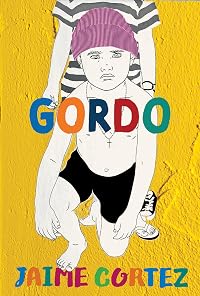
"His first-ever collection of stories, Jaime Cortez's Gordo is set in a migrant workers camp near Watsonville, California, in the 1970s. A young boy named Gordo fights back tears underneath a wrestler's mask as he is forced to fight other boys and grow into his father's expectations of manhood. As he comes of age, Gordo learns about sex, poverty, and discovers the wrenching divides between documented and undocumented immigrants. Fat Cookie, high schooler and resident artist, uses tiny show more library pencils to draw murals of graffiti flowers along the camp's blank walls, the words CHICANO POWER boldly lettered across, before she runs away from home one day with her mother's boyfriend. Los Tigres, the perfect pair of twins who show up to Gyrich Farms every season without fail, are champion drinkers until one of them is rushed to the emergency room after a brawl, bloody and slumped in a tattered easy chair on the back of a pick-up truck. These scenes from Steinbeck Country seen so intimately from within are full of humor, family drama, and a sweet frankness about serious matters-who belongs to America and how are they treated? Written with balance and poise, Cortez braids together elegantly tragicomic and inviting stories about life on a California camp, in essence redefining what all-American means"-- show lessTags
Recommendations






Member Reviews
I owe Jaime Cortez for this one. These stories are set not all that far from where I live in Santa Cruz, California, first in a farm worker camp in San Juan Bautista and then in Watsonville. But Gordo and everything in this book is a world away.
Cortez has said the stories are “semi-autobiographical.” That certainly rings true. They are stories of growing up. Gordo is a kid, growing into his independence in that farm labor camp, Gyrich Farms Worker Camp.
Gordo and his friends are adventurous, sorting out social relationships, the world of grown-ups, sexuality, the whole works — like kids do. The fact that they are poor, that even as kids they are pressed into farm work when it’s harvest time — those things certainly matter to show more the quality of their lives, but we can all find commonality with what Gordo experiences and learns.
One aspect of Gordo’s community that stands out is the role of nicknames. “Gordo” is itself a nickname, relating to Gordo’s chubbiness. Other kids and grownups have their own nicknames, names that relate and communicate their personalities within the community — my favorites are “Pati the Mouth” (a talker, obviously) and “El Cerebro” (named for his large head). I kind of miss that in our own vanilla white community — names you acquire by your personality and your behavior, not by your birth certificate.
Despite the setting and the poverty, this is not Grapes of Wrath. This is a kid growing up. In fact it’s Jaime Cortez growing up, finding his place and finding where he does and doesn’t fit in.
As a kid, we see Gordo realizing he is not so boy-like as his friends. They call him a “sissy” (and Chicano terms that I had to look up). As he grows older, and actually in a couple of later stories, the protagonist becomes “Raymundo,” grown now into his sexual identity and into a settled place in the community of Watsonville, where Gordo’s family (and Jaime Cortez’s family) moved during his childhood.
But it’s not a book about sexual identity either. It’s just about a kid growing up and finding his place in the world.
That’s its appeal, to me anyway — experiencing through Cortez’s eyes what that universal is like for that community so seemingly distant and foreign. Cortez tells it well, engaging and affecting. show less
Cortez has said the stories are “semi-autobiographical.” That certainly rings true. They are stories of growing up. Gordo is a kid, growing into his independence in that farm labor camp, Gyrich Farms Worker Camp.
Gordo and his friends are adventurous, sorting out social relationships, the world of grown-ups, sexuality, the whole works — like kids do. The fact that they are poor, that even as kids they are pressed into farm work when it’s harvest time — those things certainly matter to show more the quality of their lives, but we can all find commonality with what Gordo experiences and learns.
One aspect of Gordo’s community that stands out is the role of nicknames. “Gordo” is itself a nickname, relating to Gordo’s chubbiness. Other kids and grownups have their own nicknames, names that relate and communicate their personalities within the community — my favorites are “Pati the Mouth” (a talker, obviously) and “El Cerebro” (named for his large head). I kind of miss that in our own vanilla white community — names you acquire by your personality and your behavior, not by your birth certificate.
Despite the setting and the poverty, this is not Grapes of Wrath. This is a kid growing up. In fact it’s Jaime Cortez growing up, finding his place and finding where he does and doesn’t fit in.
As a kid, we see Gordo realizing he is not so boy-like as his friends. They call him a “sissy” (and Chicano terms that I had to look up). As he grows older, and actually in a couple of later stories, the protagonist becomes “Raymundo,” grown now into his sexual identity and into a settled place in the community of Watsonville, where Gordo’s family (and Jaime Cortez’s family) moved during his childhood.
But it’s not a book about sexual identity either. It’s just about a kid growing up and finding his place in the world.
That’s its appeal, to me anyway — experiencing through Cortez’s eyes what that universal is like for that community so seemingly distant and foreign. Cortez tells it well, engaging and affecting. show less
Jaime Cortez's Gordo is one of those titles that keeps providing more rewards as readers work their way through it. The individual stories are varied, engaging, distressing, hopeful. But these stories add up to something larger. In a sense, these stories are a novel—one that takes readers through many shifts of perspective and that requires readers' assistance in pulling it into a whole. And I mean this in a good way.
Imagine a photo of a place. Cut that photo into pieces, discarding a few, but keeping most. Then use those pieces to create a mobile. Watch the pieces as they move in relation to one another, as different bits come into proximity. Ask yourself questions about the handful of pieces that are missing. That's what reading show more Gordo is like. And I mean that in a very good way.
The characters in Gordo are residents of the agricultural lands that make up California's Central Coast: agricultural workers and their children; documented and undocumented; kind and unkind; gay, straight, and questioning. Each story offers exactly the sort of detail and precision that readers need. Cortez creates complex characters and situations without every writing with unnecessary complexity. And, as I said above, the rewards keep coming as the stories inform one another. The further I got in Gordo, the harder it was to put the book down and the more I had to fight to keep myself from racing through stories to see what was still to come.
I received a free electronic review copy of this title from the publisher via NetGalley; the opinions are my own. show less
Imagine a photo of a place. Cut that photo into pieces, discarding a few, but keeping most. Then use those pieces to create a mobile. Watch the pieces as they move in relation to one another, as different bits come into proximity. Ask yourself questions about the handful of pieces that are missing. That's what reading show more Gordo is like. And I mean that in a very good way.
The characters in Gordo are residents of the agricultural lands that make up California's Central Coast: agricultural workers and their children; documented and undocumented; kind and unkind; gay, straight, and questioning. Each story offers exactly the sort of detail and precision that readers need. Cortez creates complex characters and situations without every writing with unnecessary complexity. And, as I said above, the rewards keep coming as the stories inform one another. The further I got in Gordo, the harder it was to put the book down and the more I had to fight to keep myself from racing through stories to see what was still to come.
I received a free electronic review copy of this title from the publisher via NetGalley; the opinions are my own. show less
This wonderful collection of stories, set in a migrant work camp in California, circa 1975, was a joy to read. Gordo, an over-weight Mexican boy, possibly gay is at the center of most of these tales. He is smart and curious but is also taunted and bullied, as he struggles to find his place in the world. A great look at immigrant life in Steinbeck country. This is Cortez’s first shot at fiction and he really nails it.
Sweet, sad, hopeful, moving short stories, mostly narrated by the young probably gay boy known as Gordo. From a worker's camp near San Juan Bautista to a house in Watsonville. Gordo narrates stories of Latino workers, immigrants and Americans, legal and illegal, c1980s.
Gordo tells stories of his life with his older sister Sylvie, their mother, and their father--as he tries to live up to his father's expectations of boyhood, his mother can't help but help others, and all just want to blend in to general society.
Excellent narration.
Gordo tells stories of his life with his older sister Sylvie, their mother, and their father--as he tries to live up to his father's expectations of boyhood, his mother can't help but help others, and all just want to blend in to general society.
Excellent narration.
Ratings
Members
- Recently Added By
Lists

2022 Notable Books for Adults
25 works; 3 members

Looking Forward to 2021
14 works; 2 members
Author Information
11+ Works 168 Members
Awards and Honors
Awards
Distinctions
Notable Lists
Common Knowledge
- Original publication date
- 2021
Classifications
Statistics
- Members
- 91
- Popularity
- 352,972
- Reviews
- 4
- Rating
- (4.18)
- Languages
- English
- Media
- Paper, Audiobook, Ebook
- ISBNs
- 3
- ASINs
- 2