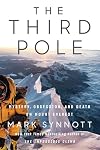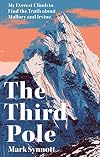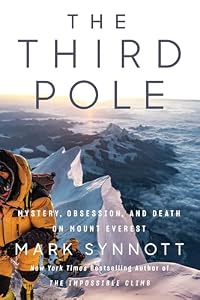
The Third Pole: Mystery, Obsession, and Death on Mount Everest
by Mark Synnott
On This Page
Description
"Veteran climber Mark Synnott never planned on climbing Mount Everest, but a hundred-year mystery lured him into an expedition--and an awesome history of passionate adventure, chilling tragedy, and human aspiration unfolded"--Tags
Recommendations









Member Reviews
This is definitely a page-turner of a book, especially as I sit in my cozy warm house and wonder how anyone can possibly withstand what happens in an effort to climb Mt. Everest, even with a different purpose in mind that just the effort to reach the summit. Synnott becomes part of a major search for the 1924 British attempt in 1924---did Mallory and Irvine ever actually reach the top? The historical descriptions along with Synnott's current day ones make for a more than exciting...or should I say terrifying--tale! Of course we know Synnott made it back home in order to write this book but it is quite something to read the all the details of such an endeavor.
Held my interest throughout, even though mountain climbing is not really an interest. The “mystery “ at the center, with the frequent references back to earlier climbing days were interspersed with the author’s current climb. The imperialistic underpinning of Everest climbs taints his narrative as well, somehow I didn’t believe his protestations about caring wether or not he ruined the sherpas livelihoods.
I have a mild obsession with Mount Everest history and the 1924 expedition in particular, so I was excited to read this book. The author clearly has plenty of interest in this subject as well, with his narrative of preparing for and then climbing Everest in 2019 interspersed with historical details about early Everest expeditions and the science of mountaineering. Of course, the later half of the book deals with the now-famous 2019 Everest season when crowding possibly contributed to multiple deaths on the mountain. I appreciated the author's attempt to place these more recent events in the context of Mount Everest history and climbing - important context I often feel is missing from news coverage. I also found the author's thoughts and show more insights into the long-standing Mallory and Irvine mystery interesting, but by no means is this mystery laid to rest. show less
This was a very interesting book that deserves a solid 3.5 stars. It kept me interested and is probably about as "beach read" as I get (easy to read, lots of intrigue, long waiting list at the library).
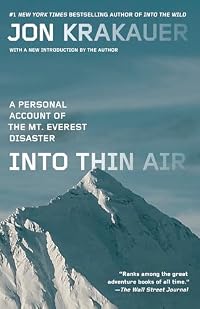
I had read Into Thin Air several years ago, and I agree with other commenters that this book makes a good "sequel" if you will. There are a lot of poignant discussions in this book that weighed on me, especially on the topic of humans dying, being left for dead, being walked around, being passed by, and then remaining on the mountain as corpses after they pass away. Wow.
I thought about a lot of parallels with flying. We are trained to go through risk management checklists before flying. One of the indirect causes of many accidents and show more incidents in aviation is "get-there-itis." When pilots are so obsessed with getting to their destination that they fly through terrible weather, they don't think about other alternatives, and sometimes die as a result. I think a lot of the climbers who are so focused on the summit similarly suffer from "get-there-itis."
Why this book doesn't get more stars is because of the narrative structure. Yes it was interesting, but I thought that EVERY chapter being: lead-up to something interesting -> completely change topics to explore something historical until you've completely forgotten the lead-up you just read -> pivot again and discuss the lead-up, whose resolution is invariably anti-climatic. It was really kind of an exhausting way to read a book and I literally rolled my eyes every time the author did it, which was often.
By the end of the book, you're not surprised that the author and his expedition comes up empty-handed. (I mean, if they'd found the camera, those pictures for sure would have been in the glossy photo inset, right?) The whole expedition came off, to me, as an indulgence of a bunch of relatively well-off and well-connected white men. show less
I had read Into Thin Air several years ago, and I agree with other commenters that this book makes a good "sequel" if you will. There are a lot of poignant discussions in this book that weighed on me, especially on the topic of humans dying, being left for dead, being walked around, being passed by, and then remaining on the mountain as corpses after they pass away. Wow.
I thought about a lot of parallels with flying. We are trained to go through risk management checklists before flying. One of the indirect causes of many accidents and show more incidents in aviation is "get-there-itis." When pilots are so obsessed with getting to their destination that they fly through terrible weather, they don't think about other alternatives, and sometimes die as a result. I think a lot of the climbers who are so focused on the summit similarly suffer from "get-there-itis."
Why this book doesn't get more stars is because of the narrative structure. Yes it was interesting, but I thought that EVERY chapter being: lead-up to something interesting -> completely change topics to explore something historical until you've completely forgotten the lead-up you just read -> pivot again and discuss the lead-up, whose resolution is invariably anti-climatic. It was really kind of an exhausting way to read a book and I literally rolled my eyes every time the author did it, which was often.
This is both a first person account of an Everest expedition and a recounting of the first attempts to climb Everest which were made by the British in the 1920’s, culminating in the death of George Mallory and Andrew Irving somewhere near the peak in 1924. Synnott is a gifted writer and vividly conveys his own experience as well as even handedly describing the mystery about whether Mallory and Irving reached the summit before their deaths in 1924, possibly becoming the first to climb Everest.
I’m a sucker for adventure stories, especially to nearly inaccessible places. That’s why this book interested me.The story of Sandy Irvine and the attempt to find him and his camera were also intriguing. Irvine’s camera would, presumably, have proven that he and fellow Brit George Mallory were the first to reach the peak of the highest point on earth in 1924. As it is, the Chinese expedition in 1960 claims that feat, although there is no photographic or other proof of that. The purpose of this expedition, mostly funded by National Geographic, was to once and for all prove that the two British mountain climbers were, in fact, the first to reach the peak. I won’t ruin the story for anyone reading this by revealing what was found show more and what it proved. Although there is much to be said about Everest and the history of the climbs up its peak, I do think this book was probably 100 pages longer than it needed to be.That said, it’s only fair to point out that many of those pages are devoted to copious notes and an excellent index for anyone interested in using either. I wish footnotes were placed as links in the text to take the reader directly to notes as he or she reads. By the end of the book there isn’t much incentive to explore the notes when they are grouped at the end of the book as they were. Overall, this was a well written and interesting story. show less
Interesting and informative
Not really on the same level as "Into Thin Air" but still a well written and interesting account about Everest's North Side routes, camps and history.
Not really on the same level as "Into Thin Air" but still a well written and interesting account about Everest's North Side routes, camps and history.
Members
- Recently Added By
Published Reviews
In 1924, no one had ever set foot atop Mount Everest, the highest spot on Earth. By then, America had reached the North Pole. Norway had won a bitter race to the South Pole. Everest was “the Third Pole,” and the first person who reached the top would win fame for himself and glory for his nation....the author and adventurer Mark Synnott skillfully describes early-20th-century exploration, show more then dives into a story about Everest that merges mystery, adventure and history into a single tragic bundle....Synnott knows how to keep readers turning the pages, and they will speed their way to his mystery’s resolution. But any Everest story today has an unavoidable dark side. Mallory’s team had a towering mountain and a vast landscape nearly to themselves. Synnott’s team encountered crowds and one site that “looked more like a third world landfill than the staging point below the most glorious summit in the world.” show less
added by Lemeritus
Synnott, weaves back and forth between the early climbing pioneers’ experiences and his 2019 expedition, harrowing in its own right. A gifted storyteller, he proves firsthand the irresistible lure and perilous dangers of climbing Mount Everest.
added by Lemeritus
Professional climber and journalist Synnott chronicles his climb of Mount Everest in hopes of finding the remains, and an all-important camera, of George Mallory’s climbing partner, Andrew Irvine. In 1924, Mallory made an ill-fated attempt to be the first known human to summit Everest. Irvine joined Mallory for the final push, and neither man returned. If found, Irvine’s camera might show more provide evidence that the men attained the summit, or didn’t.... he populates the harrowing text with excellent background material to convey a rich sense of what summiting the great peaks entails. Synnott offers important pocket-sized biographies of Mallory and Irvine, of course, but there are also discerning forays into British colonial geopolitics, the ongoing disputes between China and Nepal, Tibet’s tortured relations with China, and the many vested Chinese political interests in the history of Everest mountaineering....A fine tale of adventure and exploration sure to please any fan of climbing and Everest lore. show less
added by Lemeritus
Lists

Penguin Random House
458 works; 4 members

Tibet & Tibetan Buddhism
96 works; 1 member

Non-fiction
55 works; 1 member

Recreation
93 works; 1 member
Author Information

5+ Works 426 Members
Mark Synnott is a twenty-four-year member of the North Face Global Athlete Team. He is also an internationally certified mountain guide and a trainer for the Pararescuemen of the United States Air Force. A frequent contributor to National Geographic magazine and a writer for Outside, Men's Journal, Rock and Ice, and Climbing, he is the author of show more The Impossible Climb. He lives in the Mt. Washington Valley of New Hampshire. show less
Some Editions
Awards and Honors
Distinctions
Common Knowledge
- Dedication
- For Tommy, Lilla, Matt, Will, and Hampton
- First words
- It must have been a little after 2 a.m. The wind had been building steadily through the night, and the tent fabric was flapping so violently that I thought it would tear apart The noise made communication with my climbing par... (show all)tners impossible, even though the three of us were tightly pressed against each other in the darkness. There was nothing to say anyway. -Prologue
The body lay facedown and partly embedded in the gravel, as if it can fallen into a slab of wet concrete. -Chapter One, Among the Dead - Canonical DDC/MDS
- 796.522092
- Canonical LCC
- GV199.E85
Classifications
- Genres
- Sports and Leisure, Nonfiction, General Nonfiction, History, Travel
- DDC/MDS
- 796.522092 — Arts & recreation Recreation, sports, and performing arts Sports Outdoor leisure Walking and exploring by kind of terrain Mountains, hills and rocks standard subdivisions History, geographic treatment, biography
- LCC
- GV199 .E85 — Geography, Anthropology and Recreation Recreation. Leisure Recreation. Leisure Outdoor life. Outdoor recreation Mountaineering
- BISAC
Statistics
- Members
- 200
- Popularity
- 163,038
- Reviews
- 8
- Rating
- (3.83)
- Languages
- English
- Media
- Paper, Audiobook, Ebook
- ISBNs
- 9
- ASINs
- 1