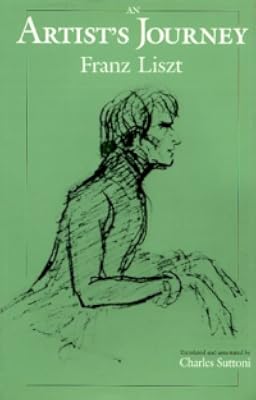
An Artist's Journey: Lettres d'un bachelier es musique, 1835-1841
by Franz Liszt
On This Page
Description
In these eloquent and intensely personal writings, Franz Liszt sketches the cities, people, and scenes of his travels in the 1830s and explores ideas about art and its ideal place in the world. During six years of wandering through Switzerland, France, Italy, Austria, and Germany (four of them together with Countess Marie d'Agoult), the composer saw the greatest art and most fabulous landscapes of Europe and crossed paths with celebrated singers and artists, renowned intellectuals, infamous show more socialites, and both reigning and deposed aristocracy. The article/essays that emerged from this period are both public and private: though written for the Paris press, they are the closest that Liszt came to autobiography. Some of these writings are travel articles; some are essentially reports of a music correspondent; still others are personal and confessional; and some are really essays on the nature of art. All offer precious insight into the musical, social, and intellectual life in the major European capitals seen through the eyes of one of the most well-read and influential musical personalities of the period. show lessTags
Members
- Recently Added By
Author Information
1,620 Works 3,059 Members
A Hungarian composer, conductor, and pianist, Franz Liszt was a child prodigy who began studying piano with his father at the age of 6. At the age of 9, he gave his first public performance and a year later went to Vienna, where he studied with Karl Czerny and Antonio Salieri. By the end of Liszt's life, he was acknowledged as the greatest pianist show more of his time. One of the foremost musicians of the romantic period, Liszt enthralled audiences with his expressive interpretations and dramatic gestures in a style of playing that greatly influenced the advancement of pianistic techniques. From about 1822 to 1848, Liszt lived in Paris, where he came under the influence of Niccolo Paganini. Paganini's virtuosity inspired him to accomplish unheard of feats in piano technique and expression. Between 1848 and 1861, Liszt was musical director for the court at Weimar in Germany, where he conducted performances of many important works, including those of Richard Wagner. After 1861, Liszt spent much time in Rome, where he became a friend of the Pope and took minor orders in the Catholic church. The rest of Liszt's life was divided among Rome, Weimar, and Budapest. Liszt's compositions had an important impact on musical history. Avoiding traditional musical forms, he concentrated on program music. In this vein, "Liebestraume" (c.1850), is perhaps one of his most popular works. Also important are his 19 published "Hungarian Rhapsodies" and the "Sonata in B Minor" (1853). Not to be overlooked in historical importance are Liszt's transcriptions of other composers' works. These transcriptions familiarized a wide audience with major musical works and also demonstrated the piano's potential for interpreting orchestral music. Liszt also wrote books and essays on music, in many ways anticipating the music of the twentieth century. (Bowker Author Biography) show less
Classifications
Statistics
- Members
- 14
- Popularity
- 1,680,631
- Languages
- English
- Media
- Paper
- ISBNs
- 1