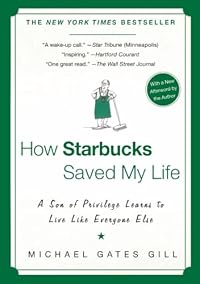
How Starbucks Saved My Life
by Michael Gates Gill
On This Page
Description
When Michael Gates Gill lost his job that provided him with a six-figure salary, he lost his house and his family. He took a job at Starbuck's and learned that the job wasn't as easy as it looks.Tags
Recommendations










Member Recommendations
Member Reviews
[This was also published at my website, the Chicago Center for Literature and Photography.]
So let's make no mistake, the only reason Michael Gill's 2007 memoir How Starbucks Saved My Life is even readable in the first place at all is that he is so relentlessly hard on himself throughout; the very definition of a white upper-class corporate-executive douchebag, he plainly admits here that he was essentially a human monster for reacting to getting laid off in his fifties from his cushy ad-agency job (one he got in the early '60s literally because drinking buddies at Yale pulled some strings for him) by having an affair behind his wife's back, accidentally getting his mistress pregnant, then determining that he's going to "do right" by the show more child, despite having a 100-percent track record of fucking up the relationships with the three existing grown children he already has, and oh yes, not actually having any health insurance and being essentially homeless.
That's a lot to swallow in the first 20 pages of a supposed feel-good memoir; and to his credit, writing veteran Gill (son of famed New Yorker writer Brendan Gill) pulls it off, basically by being ceaselessly harsh and unusually clear-eyed about his "pre-barista" life as a neolib one-percenter, the same kind of brutal honesty that inspired him to take a coffee-slinging job at the age of 64 at a Starbucks near Harlem where he was the only white employee (after accidentally attending a hiring fair by the company at one of their Manhattan stores without realizing it, having a young manager ask him as a joke, "I don't suppose you're looking for a job, are you?" and he after a moment admitting with candor, "Actually, I am").
It's what tips this book over into minimal readability, his zeal to not cut himself any breaks for his entitled childhood, his handshake-based former career, and the cavalier way he used to treat everyone in life who wasn't a senior corporate executive like him, best seen in his observations about how he himself immediately became invisible to his former co-workers, literally on the sidewalk sometimes when they would walk by him, the moment he put on a polo shirt and a green apron. Unfortunately, though, that still leaves the book with plenty of problems, among the more major being that he sometimes devotes entire chapters to nothing but a detailed, log-like, minute-by-minute breakdown of what a typical day at Starbucks is actually like for an employee, which is the literary equivalent of watching paint dry and had me skipping over huge portions of the manuscript out of pure tedium. (Also, Gill's infinitely upbeat enthusiasm for the empty StarbucksSpeak handed down from faceless marketing employees at the corporate headquarters ["Partners!" "Guests!" "Venti!"] was enough to make me want to claw out my own eyeballs by about two-thirds of the way through.)
It all adds up to an admittedly interesting but still trouble-filled book, one you have to sort of force yourself to like despite the circumstances surrounding the true story, not because of them; and a tale that gets interrupted every time it starts getting good by another reminder of just what a inherent good ol' boy in a good ol' boy network Gill is in, despite him taking a slave-wage job in the service industry. (If you're anything like me, you'll throw your hands in the air in bitter frustration when learning on the last page that Gill managed to get this book optioned to Hollywood for a million dollars, precisely because of all his personal friends from his ad-agency days, and that it currently has Tom Hanks and Gun Van Sant attached to it.) An insightful book but not nearly as insightful as I had hoped it would be, your own mileage with it will profoundly vary based on who you are, your own age and race, and how much tolerance you have for SVP assholes who shrug their shoulders after a disaster and say, "Sowwwwy!" show less
So let's make no mistake, the only reason Michael Gill's 2007 memoir How Starbucks Saved My Life is even readable in the first place at all is that he is so relentlessly hard on himself throughout; the very definition of a white upper-class corporate-executive douchebag, he plainly admits here that he was essentially a human monster for reacting to getting laid off in his fifties from his cushy ad-agency job (one he got in the early '60s literally because drinking buddies at Yale pulled some strings for him) by having an affair behind his wife's back, accidentally getting his mistress pregnant, then determining that he's going to "do right" by the show more child, despite having a 100-percent track record of fucking up the relationships with the three existing grown children he already has, and oh yes, not actually having any health insurance and being essentially homeless.
That's a lot to swallow in the first 20 pages of a supposed feel-good memoir; and to his credit, writing veteran Gill (son of famed New Yorker writer Brendan Gill) pulls it off, basically by being ceaselessly harsh and unusually clear-eyed about his "pre-barista" life as a neolib one-percenter, the same kind of brutal honesty that inspired him to take a coffee-slinging job at the age of 64 at a Starbucks near Harlem where he was the only white employee (after accidentally attending a hiring fair by the company at one of their Manhattan stores without realizing it, having a young manager ask him as a joke, "I don't suppose you're looking for a job, are you?" and he after a moment admitting with candor, "Actually, I am").
It's what tips this book over into minimal readability, his zeal to not cut himself any breaks for his entitled childhood, his handshake-based former career, and the cavalier way he used to treat everyone in life who wasn't a senior corporate executive like him, best seen in his observations about how he himself immediately became invisible to his former co-workers, literally on the sidewalk sometimes when they would walk by him, the moment he put on a polo shirt and a green apron. Unfortunately, though, that still leaves the book with plenty of problems, among the more major being that he sometimes devotes entire chapters to nothing but a detailed, log-like, minute-by-minute breakdown of what a typical day at Starbucks is actually like for an employee, which is the literary equivalent of watching paint dry and had me skipping over huge portions of the manuscript out of pure tedium. (Also, Gill's infinitely upbeat enthusiasm for the empty StarbucksSpeak handed down from faceless marketing employees at the corporate headquarters ["Partners!" "Guests!" "Venti!"] was enough to make me want to claw out my own eyeballs by about two-thirds of the way through.)
It all adds up to an admittedly interesting but still trouble-filled book, one you have to sort of force yourself to like despite the circumstances surrounding the true story, not because of them; and a tale that gets interrupted every time it starts getting good by another reminder of just what a inherent good ol' boy in a good ol' boy network Gill is in, despite him taking a slave-wage job in the service industry. (If you're anything like me, you'll throw your hands in the air in bitter frustration when learning on the last page that Gill managed to get this book optioned to Hollywood for a million dollars, precisely because of all his personal friends from his ad-agency days, and that it currently has Tom Hanks and Gun Van Sant attached to it.) An insightful book but not nearly as insightful as I had hoped it would be, your own mileage with it will profoundly vary based on who you are, your own age and race, and how much tolerance you have for SVP assholes who shrug their shoulders after a disaster and say, "Sowwwwy!" show less
I thought this book would be right up my alley. I love Starbucks, and for two reasons: their mugs (which I collect because I think they are pretty), and their Cinnamon Dolce syrup. But really, I just love coffee, and Chai lattes make my world go round. Whoever serves them has a loyal customer in the form of me.
Michael Gates Gill, a man born into wealth and privilege, is a Starbucks man through and through. He knows all the stores in New York City. Being over sixty years old, divorced, without a steady job but with a brain tumor, his one comfort in life is Starbucks. One day, he goes into one of NY's stores to have a latte, and walks out of the store with a job, offered to him by a young, female African-American store manager. Crystal is show more his polar opposite, but she gives Michael a chance, which Michael grabs eagerly - the health insurance will cover his brain surgery; Starbucks will literally save his life.
Finding a job below his usual standards humbles a 64-year old privileged man into appreciating what he has instead of what he has lost... That's a riches-to-rags formula with the potential for inspiration, while getting to know a favorite coffee place better. Yes, it could have been good.
It wasn't. So much is wrong with this book, I seriously couldn't keep this review shorter than it is now.
I'm just not buying it. Gill doesn't get the emotional impact behind his big life change across. In his book, the former advertising man is too busy namedropping and selling Starbucks to us, readers.
While sweeping floors and cleaning toilets of this GREAT (!) store, where dignity and respect come first and foremost and Guests are happy when Partners are happy (oh everyone just loves each other), he reminisces in length about Jackie Onassis and her adoring eyes and voice soft as a whisper (Jackie this, Jackie that, oh Jackie Jackie Jackie), or Muhammed Ali and how he made up a poem for Gill (how endearing) after Gill was not just at any of his matches, but the first professional match (and this is actually italicized in the book so as to make extra sure us readers understand that Gill is in fact bragging his ASS off).*
The namedropping is irritating right from the start, because these memories are irrelevant to the story or his 'change' and recalled at random times (he hears the word 'Master' being used. Enter his memory of Frank Lloyd Wright, dubbed 'Master' by his apprentices).
[sarcasm] Yes, all of this tells me you're definitely a changed man to whom his life of privilige is nothing compared to his life as a Starbucks barista. I'm wholly convinced, by your knowing 'Jackie' and 'Papa' and having been to Ali's first professional match, that you've moved on from your entitled past and your attitude of superiority. Comparing the opening of a store is so similar to running in front of the bulls in Pamplona to impress Ernest Hemingway. I can totally see the relevance and don't see this as another opportunity at all to impress me, the simpleton, with the people you know, the places you've been, the things you've accomplished. [/end sarcasm for now]
Why do this? What point is he making here? Does he want to show how important he is via all the people he's met? Wasn't he was supposed to be satisfied with his current life as a barista? Doesn't sound like it to me. (The man keeps contradicting himself.)
[sarcasm returns] Your skills as a Yale Art History major are just so helpful in placing the pastries in their trays correctly, what a challenge you are facing once again! We should be so, so proud of you for overcoming your next obstacle - for managing, all by yourself, with all your knowledge and connections, to open up the bagel packaging. I'm moved to tears by the inspiration. [/sarcasm overload - warning - evacuate!]
This book just seems so contrived in more ways than one. He conveniently knows juuuuuust how to read people, making instant successful conversation with his Guests. The dialogue made me cringe. Also, right after he's done sweeping that floor or cleaning that toilet (thinking back of the maid his parents used to have, or his African American nanny), he's overcome with a sudden life-changing epiphany, like how a young African American woman from a poor background (his boss Crystal) can actually REALLY be successful. Who would have thunk it? Because the idea of successful African Americans, or women, or other people from other minorities is so... outlandish!
I also resented that he considered himself part of a minority now that he is working at Starbucks. Oh so he "suddenly understands in this moment" what it's like to struggle because with this job he might as well also be from a different class or race... even though he's a white guy from a wealthy background who screwed up a huge chunk of his own privileged life.
Crystal, his 'mentor', sounds more like a human Starbucks ad than an actual warm human being. [Play tape] "Here at Starbucks, we have dignity and respect for our other partners!" [/stop tape] This was so disappointing! I thought Crystal would be tough, a no-nonsense woman with attitude - the highlight of the book! But she was just a robotic instruction manual on tape.
His petty stabs at his former employer JWT (advertising agency; he was sacked) while sharing his abiding affection for Starbucks (where nothing goes wrong EVER) are both endless. He's being repetitive here and with lots of other things too, sometimes literally, i.e. "Jay Laughlin, Pound's publisher, owned the camp next door" (p.48) followed by "...an invitation to Jay Laughlin, who owned the camp next door" (p66). There are countless examples, but if I mention them all here I will have half the book quoted in my already way too long review.
He could be a really nice guy and truly changed for all I know, but this book sure didn't convince me of it. Maybe it's the (bad) writing or... maybe he hasn't changed as much or as deeply as he'd like us to believe. No, truthfully, I hated this book. Riches-to-rags, my behind. Michael Gates Gill has just managed to adapt to a new situation (which he fell into in despair), making the most of it. Doesn't make him an inspiration to me.
If Michael Gates Gill were truly happy in his job as a barista, if he had learned his lesson, this book just wouldn't exist, or would be 50% thinner (leaving out flashbacks, namedropping and hating on his former employer). He still feels the need to be Somebody Important, instead of just being happy with being somebody.
This book has left me with a really bad taste in my mouth. I will need lots of coffee to wash it away... served in my Starbucks mugs. Because at the end of the day, I still love those mugs. And Starbucks, too.
*) An actual list I kept of celebs / influential people Gill is connected to directly or 'via via': Skull & Bones, poet Ezra Pound as well as Robert Frost, W.H. Auden and T.S. Eliot - all of whom he'd met over drinks or something. There's E.B. White (author of Stuart Little), Andy Warhol, Jackie Onassis, Ernest Hemingway, Queen Elizabeth (!), Muhammed Ali, Frank Lloyd Wright, Frank Sinatra and... 50 Cent. I probably missed a few.
(Rated half a star because I managed to finish it. That's it.)
View an accompanying self-portrait at the Reading & Reviewing blog: http://ofbooks.blogspot.com/2009/11/r-069-how-starbucks-saved-my-life.html show less
Michael Gates Gill, a man born into wealth and privilege, is a Starbucks man through and through. He knows all the stores in New York City. Being over sixty years old, divorced, without a steady job but with a brain tumor, his one comfort in life is Starbucks. One day, he goes into one of NY's stores to have a latte, and walks out of the store with a job, offered to him by a young, female African-American store manager. Crystal is show more his polar opposite, but she gives Michael a chance, which Michael grabs eagerly - the health insurance will cover his brain surgery; Starbucks will literally save his life.
Finding a job below his usual standards humbles a 64-year old privileged man into appreciating what he has instead of what he has lost... That's a riches-to-rags formula with the potential for inspiration, while getting to know a favorite coffee place better. Yes, it could have been good.
It wasn't. So much is wrong with this book, I seriously couldn't keep this review shorter than it is now.
I'm just not buying it. Gill doesn't get the emotional impact behind his big life change across. In his book, the former advertising man is too busy namedropping and selling Starbucks to us, readers.
While sweeping floors and cleaning toilets of this GREAT (!) store, where dignity and respect come first and foremost and Guests are happy when Partners are happy (oh everyone just loves each other), he reminisces in length about Jackie Onassis and her adoring eyes and voice soft as a whisper (Jackie this, Jackie that, oh Jackie Jackie Jackie), or Muhammed Ali and how he made up a poem for Gill (how endearing) after Gill was not just at any of his matches, but the first professional match (and this is actually italicized in the book so as to make extra sure us readers understand that Gill is in fact bragging his ASS off).*
The namedropping is irritating right from the start, because these memories are irrelevant to the story or his 'change' and recalled at random times (he hears the word 'Master' being used. Enter his memory of Frank Lloyd Wright, dubbed 'Master' by his apprentices).
[sarcasm] Yes, all of this tells me you're definitely a changed man to whom his life of privilige is nothing compared to his life as a Starbucks barista. I'm wholly convinced, by your knowing 'Jackie' and 'Papa' and having been to Ali's first professional match, that you've moved on from your entitled past and your attitude of superiority. Comparing the opening of a store is so similar to running in front of the bulls in Pamplona to impress Ernest Hemingway. I can totally see the relevance and don't see this as another opportunity at all to impress me, the simpleton, with the people you know, the places you've been, the things you've accomplished. [/end sarcasm for now]
Why do this? What point is he making here? Does he want to show how important he is via all the people he's met? Wasn't he was supposed to be satisfied with his current life as a barista? Doesn't sound like it to me. (The man keeps contradicting himself.)
[sarcasm returns] Your skills as a Yale Art History major are just so helpful in placing the pastries in their trays correctly, what a challenge you are facing once again! We should be so, so proud of you for overcoming your next obstacle - for managing, all by yourself, with all your knowledge and connections, to open up the bagel packaging. I'm moved to tears by the inspiration. [/sarcasm overload - warning - evacuate!]
This book just seems so contrived in more ways than one. He conveniently knows juuuuuust how to read people, making instant successful conversation with his Guests. The dialogue made me cringe. Also, right after he's done sweeping that floor or cleaning that toilet (thinking back of the maid his parents used to have, or his African American nanny), he's overcome with a sudden life-changing epiphany, like how a young African American woman from a poor background (his boss Crystal) can actually REALLY be successful. Who would have thunk it? Because the idea of successful African Americans, or women, or other people from other minorities is so... outlandish!
I also resented that he considered himself part of a minority now that he is working at Starbucks. Oh so he "suddenly understands in this moment" what it's like to struggle because with this job he might as well also be from a different class or race... even though he's a white guy from a wealthy background who screwed up a huge chunk of his own privileged life.
Crystal, his 'mentor', sounds more like a human Starbucks ad than an actual warm human being. [Play tape] "Here at Starbucks, we have dignity and respect for our other partners!" [/stop tape] This was so disappointing! I thought Crystal would be tough, a no-nonsense woman with attitude - the highlight of the book! But she was just a robotic instruction manual on tape.
His petty stabs at his former employer JWT (advertising agency; he was sacked) while sharing his abiding affection for Starbucks (where nothing goes wrong EVER) are both endless. He's being repetitive here and with lots of other things too, sometimes literally, i.e. "Jay Laughlin, Pound's publisher, owned the camp next door" (p.48) followed by "...an invitation to Jay Laughlin, who owned the camp next door" (p66). There are countless examples, but if I mention them all here I will have half the book quoted in my already way too long review.
He could be a really nice guy and truly changed for all I know, but this book sure didn't convince me of it. Maybe it's the (bad) writing or... maybe he hasn't changed as much or as deeply as he'd like us to believe. No, truthfully, I hated this book. Riches-to-rags, my behind. Michael Gates Gill has just managed to adapt to a new situation (which he fell into in despair), making the most of it. Doesn't make him an inspiration to me.
If Michael Gates Gill were truly happy in his job as a barista, if he had learned his lesson, this book just wouldn't exist, or would be 50% thinner (leaving out flashbacks, namedropping and hating on his former employer). He still feels the need to be Somebody Important, instead of just being happy with being somebody.
This book has left me with a really bad taste in my mouth. I will need lots of coffee to wash it away... served in my Starbucks mugs. Because at the end of the day, I still love those mugs. And Starbucks, too.
*) An actual list I kept of celebs / influential people Gill is connected to directly or 'via via': Skull & Bones, poet Ezra Pound as well as Robert Frost, W.H. Auden and T.S. Eliot - all of whom he'd met over drinks or something. There's E.B. White (author of Stuart Little), Andy Warhol, Jackie Onassis, Ernest Hemingway, Queen Elizabeth (!), Muhammed Ali, Frank Lloyd Wright, Frank Sinatra and... 50 Cent. I probably missed a few.
(Rated half a star because I managed to finish it. That's it.)
View an accompanying self-portrait at the Reading & Reviewing blog: http://ofbooks.blogspot.com/2009/11/r-069-how-starbucks-saved-my-life.html show less
Completely typical. Privileged man loses it all and learns much by working in the service industry. Somehow, I never felt that way after 15 years in the service industry. Maybe I just spent too long dealing with some of the worst people ever. Or maybe I just had a bad attitude.
What I want to know is how much Starbuckjs paid Michael Gill to write this book? Every single detail of how Starbucks works is crammed down your throat and not one negative comment anywhere. After reading this I assume the only job better than working at Starbucks is working next to Jesus in heaven. Micheal Gates was a high paid advertising executive who lost his job, the so called fall from grace. No matter how much he says he loves working for Starbucks you just know there must be enourmous resentment for the situation he found himself in. This book could have just been a magazine article. I kept reading it because I hoped something would change but it never did. The other annoying thing is that Gill does more name dropping than Paris show more Hilton. Gill ran the bulls in Spain for Hemingway, embarressed himself in front of the Queen of England. He speaks about Jackie Kennedy, Muhammad Ali and many more. Can anyone really believe he ended up working at Starbucks? show less
I enjoyed reading Michael's journey from his high paying corporate job, to his job as a Starbucks employee. I understand that Michael had a life of privilege but at times I felt it was shoved in our face. Ok, we get, it; you met famous people, you had a great home...now get on with the story about your journey from corporate world to Starbucks. It was great to read how he realized what a horrible person he was when he was in his previous position. It took the "Partners" at Starbucks to show him how to really treat people. I have a lot of respect for Starbucks as a company after reading this book and finding out their business approach. I would like to work for a company that treats its employees as well. This is a quick and inspiring read.
At age sixty-three, Michael Gates Gill hadn’t quite hit bottom, but he could see it from where he sat sipping a latte one rainy March morning in a Starbucks at Seventy-Eighth Street and Lexington Avenue in Manhattan. Fired from his position as executive vice president and creative director of the J. Walter Thompson advertising agency by a former protégé, he’d spent ten years scrabbling for work as a freelance advertising and marketing consultant, and now even those engagements had slowed to a trickle. To add to the burden of his career implosion, he’d been diagnosed with an acoustic neuroma, a benign tumor at the base of the brain that impairs hearing. And now, he has to figure out how he’s going to support the son he fathered show more in a brief affair that wrecked his marriage and baffled his four adult children. If he hadn’t brought some of his troubles on himself, it would fair to say there’s a certain Job-like quality to his plight, but his own blunt assessment that he was “an insecure little boy not that good at dealing with reality” sounds close to the mark.
To his rescue comes Crystal, a 28-year-old Starbucks store manager who offers him a job. Improbably, Gill says yes and embarks on life as a barista. How Starbucks Saved My Life chronicles his year working in the Starbucks store at Ninety-Third Street and Broadway. It’s a realistic account of how he mastered the rudiments of a service business from the bottom up: cleaning the store’s restrooms, opening and closing, and tackling the most intimidating (to him) task of working the cash register (find yourself more than $5 off when you close out and it’s a big problem).
Gill, a graduate of Yale where he was a member of Skull and Bones, is the son of eminent New Yorker writer Brendan Gill, who no doubt would have been dismayed had he lived to see where life had deposited his offspring in late middle age. And it was a long fall for someone who had hobnobbed with Frank Sinatra, Jackie Onassis and Ernest Hemingway and counted Lee Iacocca and USAirways among his long roster of his advertising clients.
Still, there’s no condescension and only a touch of sentimentality in Gill’s account. What he offers is a plainspoken story of the dignity that inheres in putting forth a day’s hard work for modest hourly wage. In his previous life as a workaholic advertising executive, he writes, “I had been secure in my bubble of self-congratulation: convinced that my top job in advertising and my resulting affluence were my just reward for being a great talented guy…not simply status and success virtually given to me by birth and fortunate color.” Now, he observes, “at Starbucks it was not about me --- it was about serving others.”
Starbucks’ corporate culture comes off sounding benign, almost paternalistic, in these pages. It would be interesting to hear what Gill has to say about the mass store closings and layoffs the company announced in 2008. He portrays a high level of camaraderie in the store (with the notable exception of one employee who seems determined to get him fired), but the sketches of his mostly African-American co-workers are spare at best, and it seems Gill was more absorbed in learning the duties of his job than he was in plumbing the interior lives of his fellow employees. Still, when he moves at the end of the book to a store in Bronxville, saving him the expensive, 90 minute commute he’d made for more than a year, it seems he does so with a genuine sense of regret.
Despite his flaws, Michael Gates Gill is a sympathetic companion on his journey from riches to rags and partway back in this engaging memoir. “I had traded my pin-striped suit for a green apron,” he writes. “A Master of the Universe costume for something that said I was there to serve --- not to rule.” His is such a captivating story it’s the subject of a movie in development starring Tom Hanks, although the latest reports are that you may have to wait until 2012 to see it. In the meantime, read this book.
Copyright 2009 Harrisburg Magazine show less
To his rescue comes Crystal, a 28-year-old Starbucks store manager who offers him a job. Improbably, Gill says yes and embarks on life as a barista. How Starbucks Saved My Life chronicles his year working in the Starbucks store at Ninety-Third Street and Broadway. It’s a realistic account of how he mastered the rudiments of a service business from the bottom up: cleaning the store’s restrooms, opening and closing, and tackling the most intimidating (to him) task of working the cash register (find yourself more than $5 off when you close out and it’s a big problem).
Gill, a graduate of Yale where he was a member of Skull and Bones, is the son of eminent New Yorker writer Brendan Gill, who no doubt would have been dismayed had he lived to see where life had deposited his offspring in late middle age. And it was a long fall for someone who had hobnobbed with Frank Sinatra, Jackie Onassis and Ernest Hemingway and counted Lee Iacocca and USAirways among his long roster of his advertising clients.
Still, there’s no condescension and only a touch of sentimentality in Gill’s account. What he offers is a plainspoken story of the dignity that inheres in putting forth a day’s hard work for modest hourly wage. In his previous life as a workaholic advertising executive, he writes, “I had been secure in my bubble of self-congratulation: convinced that my top job in advertising and my resulting affluence were my just reward for being a great talented guy…not simply status and success virtually given to me by birth and fortunate color.” Now, he observes, “at Starbucks it was not about me --- it was about serving others.”
Starbucks’ corporate culture comes off sounding benign, almost paternalistic, in these pages. It would be interesting to hear what Gill has to say about the mass store closings and layoffs the company announced in 2008. He portrays a high level of camaraderie in the store (with the notable exception of one employee who seems determined to get him fired), but the sketches of his mostly African-American co-workers are spare at best, and it seems Gill was more absorbed in learning the duties of his job than he was in plumbing the interior lives of his fellow employees. Still, when he moves at the end of the book to a store in Bronxville, saving him the expensive, 90 minute commute he’d made for more than a year, it seems he does so with a genuine sense of regret.
Despite his flaws, Michael Gates Gill is a sympathetic companion on his journey from riches to rags and partway back in this engaging memoir. “I had traded my pin-striped suit for a green apron,” he writes. “A Master of the Universe costume for something that said I was there to serve --- not to rule.” His is such a captivating story it’s the subject of a movie in development starring Tom Hanks, although the latest reports are that you may have to wait until 2012 to see it. In the meantime, read this book.
Copyright 2009 Harrisburg Magazine show less
Michael Gill is a son of New York privilege (New Yorker writer/editor Brendan Gill was his father) who found himself in a personal and professional mess, mostly of his own making due to hubris and inattention. The book chronicles his journey from arrogant jerk to pretty decent human being.
Members
- Recently Added By
Lists

Non-Fiction Worth Reading
1,015 works; 260 members

Starbucks Books
8 works; 1 member

Income Inequality
20 works; 4 members

Books Read in 2017
4,249 works; 130 members
Author Information

5 Works 1,219 Members
Some Editions
Awards and Honors
Distinctions
Notable Lists
Common Knowledge
- Canonical title
- How Starbucks Saved My Life
- Original title
- How Starbucks saved my life
- Original publication date
- 2007
- People/Characters
- Michael Gates Gill; Joann; Kester; Crystal Thompson; Tawana; Charlie (show all 8); Anthony; Bianca
- Important places
- Manhattan, New York, New York, USA; New York, New York, USA; Yale University, New Haven, Connecticut, USA; New Haven, Connecticut, USA; Bronxville, New York, USA
- Dedication
- To my children, with gratitude for their understanding hearts
- First words
- This is the true, surprising story of an old white man who was kicked out of the top of the American Establishment, by chance met a young African-American woman from a completely different background, and came to learn what i... (show all)s important in life.
- Quotations
- Starbucks was not something people decided for or against in a casual way. It was obviously a key part of their lives, an important destination for them every single day. Maybe several times a day!
The best Fortune 500 companies I had encountered, despite months and lots of money writing and publishing high-sounding mission statements, never practiced the corporate gobbledegook they preached. - Last words
- (Click to show. Warning: May contain spoilers.)Then I went out into the winter night, warmed by their love.
- Blurbers
- Dyer, Wayne; Waitley, Denis; Moore, Thomas
- Original language*
- Inglés
*Some information comes from Common Knowledge in other languages. Click "Edit" for more information.
Classifications
- Genres
- Biography & Memoir, Business, Nonfiction, General Nonfiction
- DDC/MDS
- 647.95092 — Applied Science & Technology Home economics & family management Management of public households (Institutional housekeeping) Specific kinds of public households and institutions Eating and drinking places modified standard subdivisions History, geographic treatment, biography Biography
- LCC
- CT275 .G4163 .A3 — Auxiliary Sciences of History Biography Biography National biography
- BISAC
Statistics
- Members
- 1,128
- Popularity
- 22,282
- Reviews
- 84
- Rating
- (3.27)
- Languages
- 7 — Chinese, Czech, Dutch, English, German, Portuguese, Spanish
- Media
- Paper, Audiobook, Ebook
- ISBNs
- 20
- ASINs
- 7