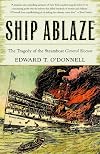
Ship Ablaze: The Tragedy of the Steamboat General Slocum
by Edward T. O'Donnell
On This Page
Description
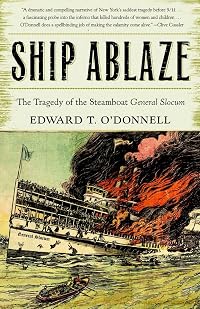
There were few experienced swimmers among over 1,300 Lower East Side residents who boarded the General Slocum on June 15, 1904. It shouldn't have mattered since the steamship was only chartered for a languid excursion from Manhattan to Long Island Sound. But a fire erupted minutes into the trip, forcing hundreds of terrified passengers into the water. By the time the captain found a safe shore for landing, 1,021 had perished. It was New York's deadliest tragedy prior to September 11, 2001. show more The only book available on this compelling chapter in the city's history, Ship Ablaze draws on firsthand accounts to examine why the death toll was so high, how the city responded, and why this event failed to achieve the infamy of the Titanic's 1912 demise or the 1911 Triangle Shirtwaist Factory fire. Masterfully capturing both the horror of the event and heroism of men, women, and children who faced crumbling life jackets and inaccessible lifeboats as the inferno quickly spread, historian Edward T. O'Donnell spotlights an important incident with which most Americans are unfamiliar. Ship Ablaze brings to life a bygone community while honoring the victims of that forgotten day. show lessTags
Recommendations















Member Reviews
From the disaster reading list. Up until 9/11, the General Slocum fire of June 15, 1904 was the single greatest loss of life in New York City history. It has an eerie historical resonance; it’s the subject of a couple of stream-of-consciousness paragraphs in James Joyce’s Ulysses, and was a lead-in for the 1934 film Manhattan Melodrama, notable for being the picture John Dillinger saw just before encountering the G-men outside Chicago’s Biograph Theater. I confess I tend to get the General Slocum mixed up with the Eastland; they were vaguely similar vessels and both were carrying excursion parties – a German Lutheran church picnic in the case of the General Slocum and a Western Electric Company outing for the Eastland.
It’s show more familiar stuff, alas. The General Slocum’s owners found safety measures too expensive, Captain William Van Schaick was in perfect agreement with that point of view, and the United States Steamboat Inspection Service was a bunch of political appointees who were adverse to making waves. As a result the General Slocum had never had a fire drill, the fire hoses were rotten, the cork in the life jackets had long since disintegrated to dust, and the lifeboats were wired to the deck. When a fire broke out in the “lamp room”, crew members made an cursory effort to fight it, found that the fire hose burst in five places when the engine room turned the pump on, and fled (the only crew member lost was the purser, who made the mistake of donning one of the life jackets and promptly sunk to the bottom of Long Island Sound when he went over the side carrying the ship’s money). Captain Van Schaick put on full speed in an attempt to beach the ship on North Brother Island, despite the fact there were much closer locations; Van Schaick latter explained that he was in the tricky Hell Gate passage and was concerned that if he tried to beach there the General Slocum would run aground on the rocks too far from the shore. As it turned out, that’s just what happened anyway; the high speed dash for North Brother Island just fanned the flames and the General Slocum ended up aground more than 50 feet from shore, with many passengers drowning as they were forced off the boat by the flames. Most of the victims were women and children; the men were at work that day. Few knew how to swim, the rotten life jackets quickly waterlogged and dragged the wearers under (in several cases, the only members of a family group lost were those wearing life jackets), and even if a few happened to know how to swim everyone was wearing their best clothes for the picnic and couldn’t manage much in an Edwardian hobble skirt and corset.
The final death toll was around 1021; nobody was quite sure how many were on board. It pretty much wiped out the Lutheran parish involved. The subsequent investigation was something of a whitewash. The owner, after lying at length about conditions (he had his secretary alter records of life jacket purchases but was caught), eventually got off on the plea that since the ship had been inspected and passed by a US government agency he was not liable. The inspector that passed the General Slocum went through three mistrials before his case was eventually dropped (I really don’t understand how this happened; his claim that he saw the ship’s lifeboats “swinging on the davits” turned out to be a little weak when divers brought them up still wired to the deck chocks. I assume the fix was in. He disappeared after the last mistrial and was never found again) His three superiors at the USSIS were forced to retire. Captain Van Schaick was the fall guy; he was sentenced to 10 years in Sing Sing but was paroled after serving two. Survivors gathered for memorial services annual until they were too old; the last died in 2004, age 100.
It’s interesting to compare Ship Ablaze with San Francisco is Burning, also recently reviewed. Ship Ablaze author Edward O’Donnell is a historian, but put considerable effort into understanding fire dynamics, consulting the New York City fire department, an independent fire consultant, and a marine surveyor. As a result his accounts of fire and ship behavior are well explained. The author of San Francisco is Burning, firefighter Dennis Smith, didn’t spend nearly enough time studying earthquakes, resulting in a laughable account of ground shaking behavior. O’Donnell’s book is an exciting page turner with good historical background; Smith’s is derivative and disappointing.
As far a disaster behavior goes, the General Slocum provides some insight. The crew mostly panicked and deserted. Although Van Schaick stayed at his post (he was burned pretty badly) his error in judgment in putting on full speed and heading for North Brother Island contributed to the disaster (ironically, the engine room crew stayed at their posts – if they had abandoned ship like the rest of the crew the General Slocum would have been left dead in the water – allowing a New York City fire boat and numerous other vessels coming to her aid to catch up. As it was they chased her all the way to the beach). Some passengers behaved coolly; others panicked – alas, it didn’t make much difference.
There’s a nice elevation view of the General Slocum, and a map of the East River showing her final trip (unfortunately, it doesn’t show exactly where she was when the fire started; maybe O’Donnell wasn’t quite sure). The references are not organized in a standard bibliography but discussed in a text appendix, which is a little harder to use but still adequate. Interesting and recommended. show less
It’s show more familiar stuff, alas. The General Slocum’s owners found safety measures too expensive, Captain William Van Schaick was in perfect agreement with that point of view, and the United States Steamboat Inspection Service was a bunch of political appointees who were adverse to making waves. As a result the General Slocum had never had a fire drill, the fire hoses were rotten, the cork in the life jackets had long since disintegrated to dust, and the lifeboats were wired to the deck. When a fire broke out in the “lamp room”, crew members made an cursory effort to fight it, found that the fire hose burst in five places when the engine room turned the pump on, and fled (the only crew member lost was the purser, who made the mistake of donning one of the life jackets and promptly sunk to the bottom of Long Island Sound when he went over the side carrying the ship’s money). Captain Van Schaick put on full speed in an attempt to beach the ship on North Brother Island, despite the fact there were much closer locations; Van Schaick latter explained that he was in the tricky Hell Gate passage and was concerned that if he tried to beach there the General Slocum would run aground on the rocks too far from the shore. As it turned out, that’s just what happened anyway; the high speed dash for North Brother Island just fanned the flames and the General Slocum ended up aground more than 50 feet from shore, with many passengers drowning as they were forced off the boat by the flames. Most of the victims were women and children; the men were at work that day. Few knew how to swim, the rotten life jackets quickly waterlogged and dragged the wearers under (in several cases, the only members of a family group lost were those wearing life jackets), and even if a few happened to know how to swim everyone was wearing their best clothes for the picnic and couldn’t manage much in an Edwardian hobble skirt and corset.
The final death toll was around 1021; nobody was quite sure how many were on board. It pretty much wiped out the Lutheran parish involved. The subsequent investigation was something of a whitewash. The owner, after lying at length about conditions (he had his secretary alter records of life jacket purchases but was caught), eventually got off on the plea that since the ship had been inspected and passed by a US government agency he was not liable. The inspector that passed the General Slocum went through three mistrials before his case was eventually dropped (I really don’t understand how this happened; his claim that he saw the ship’s lifeboats “swinging on the davits” turned out to be a little weak when divers brought them up still wired to the deck chocks. I assume the fix was in. He disappeared after the last mistrial and was never found again) His three superiors at the USSIS were forced to retire. Captain Van Schaick was the fall guy; he was sentenced to 10 years in Sing Sing but was paroled after serving two. Survivors gathered for memorial services annual until they were too old; the last died in 2004, age 100.
It’s interesting to compare Ship Ablaze with San Francisco is Burning, also recently reviewed. Ship Ablaze author Edward O’Donnell is a historian, but put considerable effort into understanding fire dynamics, consulting the New York City fire department, an independent fire consultant, and a marine surveyor. As a result his accounts of fire and ship behavior are well explained. The author of San Francisco is Burning, firefighter Dennis Smith, didn’t spend nearly enough time studying earthquakes, resulting in a laughable account of ground shaking behavior. O’Donnell’s book is an exciting page turner with good historical background; Smith’s is derivative and disappointing.
As far a disaster behavior goes, the General Slocum provides some insight. The crew mostly panicked and deserted. Although Van Schaick stayed at his post (he was burned pretty badly) his error in judgment in putting on full speed and heading for North Brother Island contributed to the disaster (ironically, the engine room crew stayed at their posts – if they had abandoned ship like the rest of the crew the General Slocum would have been left dead in the water – allowing a New York City fire boat and numerous other vessels coming to her aid to catch up. As it was they chased her all the way to the beach). Some passengers behaved coolly; others panicked – alas, it didn’t make much difference.
There’s a nice elevation view of the General Slocum, and a map of the East River showing her final trip (unfortunately, it doesn’t show exactly where she was when the fire started; maybe O’Donnell wasn’t quite sure). The references are not organized in a standard bibliography but discussed in a text appendix, which is a little harder to use but still adequate. Interesting and recommended. show less
It's not O'Nan's The Circus Fire (the gold standard by which all other books of sudden death are measured in my mind) but it does its job. O'Donnell is a good historian, clearly fond of the city, and able to deftly contextualize many elements - particularly the German immigrant community from which most of the victims hailed and the media reaction to the tragedy's aftermath - in order to both convey the tremendous impact of the event and explain why it is so nearly forgotten today. And he has a deft touch with the human elements, getting as sentimental and as gruesome as is appropriate and no more so; his descriptions of desperate mothers and children strapping on life vests, unaware that the cork inside had long ago rotted and would show more pull them under, is particularly chilling....
More show less
More show less
It's so hard to really review a non-fiction book. However, this is a wonderful retelling of the tragic voyage of the General Slocum. The author does so well at presenting it almost in a novel format. It really read more like a novel than the series of facts that it actually was. What he did was bring the humanity to history that so few non-fiction writers do. Very good book. Wonderful for anyone interested in early 1900 New York City as well as general maritime history.
Ratings
Members
- Recently Added By
Lists

Accidents, Disasters, and Tragedies
175 works; 7 members
Author Information

78 Works 461 Members
Edward T. O'Donnell is an associate professor of American history at the College of the Holy Cross in Worcester, Massachusetts.
Some Editions
Common Knowledge
- Original title
- Ship Ablaze: The Tragedy of the Steamboat General Slocum
- Original publication date
- 2003
- Important places
- New York, New York, USA; East River, New York, New York, USA
- Important events
- General Slocum fire (1904)
- Canonical DDC/MDS
- 910.916346
- Canonical LCC
- F128.5
Classifications
- Genres
- History, Nonfiction, General Nonfiction, Travel
- DDC/MDS
- 910.916346 — History & geography Geography & travel modified standard subdivisions of Geography and travel Explorers & Travelers Geography of and travel in areas, regions, places in general Air And Water Atlantic Ocean
- LCC
- F128.5 — Local History of the United States, Canada and Latin America United States local history New York
- BISAC
Statistics
- Members
- 216
- Popularity
- 151,754
- Reviews
- 3
- Rating
- (3.99)
- Languages
- English, German
- Media
- Paper, Audiobook, Ebook
- ISBNs
- 6
- ASINs
- 1