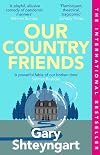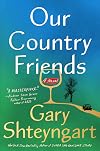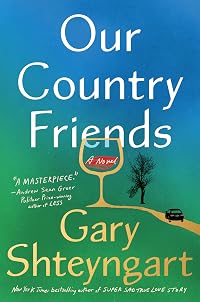
Our Country Friends
by Gary Shteyngart
On This Page
Description
"It's March 2020 and a calamity is unfolding. A group of friends and friends-of-friends gathers in a country house to wait out the pandemic. Over the next few months new bonds of friendship and love will take hold, while old betrayals will emerge among this unlikely cast of characters, each richly drawn and achingly human: a Russian-born novelist; his Russian-born psychiatrist wife; their precocious child obsessed with K-pop; a struggling Indian American writer; a wildly successful Korean show more American app developer; a global dandy with three passports; a young flame-thrower of an essayist, originally from the Carolinas; and a movie star, The Actor, whose arrival upsets the equilibrium of this chosen family"-- show lessTags
Recommendations










Member Reviews
This started out slow for me, and to be honest it stayed slow (Shteyngart is generally pretty frenetic) but this was slow in a Tolstoyian/Chekovian way which I like just fine. I ended up adoring this pandemic Uncle Vanya with loving and explicit nods to The Big Chill and in my opinion clear connections to Les Liaisons Dangereuses and the Pedro season of The Real World: San Francisco.
The book centers on a Covid house party of sorts organized by successful, but financially struggling, writer Sasha Senderovsky. (I always assume Shteyngart is writing some aspect of himself in his main characters, but no character in his fiction has seemed so clearly a Shteyngart avatar as Sasha.) Sasha's wife Masha, a psychiatrist, is terrified by and show more obsessed with Covid. The couple has recently left the city and moved to a rural area near a college town in upstate New York where they have built outbuildings so they can have their city friends surrounding them and avoid rubbing elbows with actual rural people whom they assume are all undereducated, gun-toting, Trump-loving white supremacists. For Covid lockdown they choose to surround themselves with Sasha's three best friends, as well as a writer who studied with Sasha and is currently enjoying some fame for writing a book about being raised poor white trash (see eg Hillbilly Elegy but this author is just a low-key racist, not a right wing propagandist like JD Vance.) Also invited is a famous actor working on a miniseries treatment with Sasha (who I am pretty sure is David Duchovny with a soupcon of James Franco.) Like all of us they assumed lockdown would last for a short time and then realized it was not ending any time soon. There is lots of drama, lots of sex (some gross some not, but all a bit more elemental than I generally enjoy reading about), lots of food and alcohol, lots of weird shifting relationships filled with betrayal and lust and love and reconciliation, lots of analysis of masculinity among ostensibly feminist men, and lots of levels of privilege.
This is a very literary book, in the sense that much of it is essentially a literary salon (until, as they say in The Real World "people stop being polite and start getting real.") This is a very New York book. This is a very Jewish book. This is a very American book. That checks a boatload of boxes for me, but if you have antipathy toward, or simply a lack of interest in, literary Jewish New Yorkers, this is not going to work for you. Also, he really drags the borough in which I reside, so if you love Queens expect to be irked. Extra points for ending in my favorite Filipino restaurant -- he doesn't name it, but I am about 95% sure it is my beloved Jeepny! (Now sadly closed and I sorely miss their banana ribs.) Thanks Gary! A Jeepny memorial is a worthy choice. show less
The book centers on a Covid house party of sorts organized by successful, but financially struggling, writer Sasha Senderovsky. (I always assume Shteyngart is writing some aspect of himself in his main characters, but no character in his fiction has seemed so clearly a Shteyngart avatar as Sasha.) Sasha's wife Masha, a psychiatrist, is terrified by and show more obsessed with Covid. The couple has recently left the city and moved to a rural area near a college town in upstate New York where they have built outbuildings so they can have their city friends surrounding them and avoid rubbing elbows with actual rural people whom they assume are all undereducated, gun-toting, Trump-loving white supremacists. For Covid lockdown they choose to surround themselves with Sasha's three best friends, as well as a writer who studied with Sasha and is currently enjoying some fame for writing a book about being raised poor white trash (see eg Hillbilly Elegy but this author is just a low-key racist, not a right wing propagandist like JD Vance.) Also invited is a famous actor working on a miniseries treatment with Sasha (who I am pretty sure is David Duchovny with a soupcon of James Franco.) Like all of us they assumed lockdown would last for a short time and then realized it was not ending any time soon. There is lots of drama, lots of sex (some gross some not, but all a bit more elemental than I generally enjoy reading about), lots of food and alcohol, lots of weird shifting relationships filled with betrayal and lust and love and reconciliation, lots of analysis of masculinity among ostensibly feminist men, and lots of levels of privilege.
This is a very literary book, in the sense that much of it is essentially a literary salon (until, as they say in The Real World "people stop being polite and start getting real.") This is a very New York book. This is a very Jewish book. This is a very American book. That checks a boatload of boxes for me, but if you have antipathy toward, or simply a lack of interest in, literary Jewish New Yorkers, this is not going to work for you. Also, he really drags the borough in which I reside, so if you love Queens expect to be irked. Extra points for ending in my favorite Filipino restaurant -- he doesn't name it, but I am about 95% sure it is my beloved Jeepny! (Now sadly closed and I sorely miss their banana ribs.) Thanks Gary! A Jeepny memorial is a worthy choice. show less
This clever, often amusing, and touching story is written in the style of a Russian novel with a very decided flavor of “The Big Chill” but set in 2020 during the pandemic.
Alexander Senderovsky (known as Sasha), 48, has invited his best friends to his “House on the Hill” - a main house and five bungalows on a hundred or so acres in upstate New York - to stay during the pandemic. (He also refers to it as “the Sasha Senderovsky Bungalow Colony.”). He, his wife Masha, and their hyper, possibly “on the borderlands of autism” adopted Asian daughter Natasha (“Nat”) who is “eight going on eighty,” welcome a guest for each bungalow: Ed Kim, from a wealthy Korean family and who traveled incessantly because “velocity was show more his friend”; Vinod Mehta, who had lived with Sasha for a decade beginning in college; Karen Cho, a software designer who was a friend of Sasha’s from high school; Dee Cameron, a former student of Sasha’s in his writing workshop; and “the Actor” - someone slated to star in a miniseries based on one of Sasha's books, and of whom everyone was in awe. Unlike the others, the Actor doesn’t stay the whole time, and that was a good thing. As Nat observed:
“After the Actor had left, everyone behaved differently, more kindly, less self-consciously, as if this was just any other summer but with blue surgical masks and spent bottles of hand sanitizer littering the side of the road.”
This group of mostly second generation immigrants make up, as Sasha calls them in a reference to the fake inclusiveness of the former USSR, “the House of People’s Friendship.”
The author shows the bonds among the people in this group developing and morphing through the lens of a number of issues that affect them, including the prospect of illness and death, success and failure, immigration, racism, the lure of dreams, the families you inherit, the families you make, and the balms of love and sex. They all become closer to one another. As Sasha says to one of them, “How are we not going to be friends? What would be the point of anything?”
Discussion: Shteyngart has clearly shaped his poignant saga to reflect the style of 19th Century Russian writers. As author Francine Prose wrote, those authors made the individual seem universal, with works marked by “the force, the directness, the honesty and accuracy with which they depicted the most essential aspects of human experience.” She added that great Russian writers “persuade us that there is such a thing as human nature, that something about the human heart and soul transcends the surface distinctions of nationality, social class and time.” Shteyngart too has summoned timeless themes to create unforgettable characters, even though they are at simultaneously every man, and every woman.
The writing is quite good, full of trenchant insights uttered by the characters about each other, as in this passage revealing Masha's initial thoughts about Ed:
“Ed reminded her of her husband’s parents. Talking with them was like dealing with a smiling adversary who kept a handful of poisoned toothpicks in his pocket. Every time you let your guard down, there would be a sharp prick at your haunches.”
And there is this humorous observation, showing how Sasha is always thinking like a writer, so that he evaluates what is happening around him as if it were for a script. When he shows Dee to her bungalow and she excuses herself to go to the not-quite-soundproof bathroom:
“Student peeing, he thought to himself, not lasciviously, but filing it away for some possible future reference.”
Evaluation: This book is highly recommended for the writing, the insights into human nature and family, or even if one is just looking for exceptional pandemic fiction. show less
Alexander Senderovsky (known as Sasha), 48, has invited his best friends to his “House on the Hill” - a main house and five bungalows on a hundred or so acres in upstate New York - to stay during the pandemic. (He also refers to it as “the Sasha Senderovsky Bungalow Colony.”). He, his wife Masha, and their hyper, possibly “on the borderlands of autism” adopted Asian daughter Natasha (“Nat”) who is “eight going on eighty,” welcome a guest for each bungalow: Ed Kim, from a wealthy Korean family and who traveled incessantly because “velocity was show more his friend”; Vinod Mehta, who had lived with Sasha for a decade beginning in college; Karen Cho, a software designer who was a friend of Sasha’s from high school; Dee Cameron, a former student of Sasha’s in his writing workshop; and “the Actor” - someone slated to star in a miniseries based on one of Sasha's books, and of whom everyone was in awe. Unlike the others, the Actor doesn’t stay the whole time, and that was a good thing. As Nat observed:
“After the Actor had left, everyone behaved differently, more kindly, less self-consciously, as if this was just any other summer but with blue surgical masks and spent bottles of hand sanitizer littering the side of the road.”
This group of mostly second generation immigrants make up, as Sasha calls them in a reference to the fake inclusiveness of the former USSR, “the House of People’s Friendship.”
The author shows the bonds among the people in this group developing and morphing through the lens of a number of issues that affect them, including the prospect of illness and death, success and failure, immigration, racism, the lure of dreams, the families you inherit, the families you make, and the balms of love and sex. They all become closer to one another. As Sasha says to one of them, “How are we not going to be friends? What would be the point of anything?”
Discussion: Shteyngart has clearly shaped his poignant saga to reflect the style of 19th Century Russian writers. As author Francine Prose wrote, those authors made the individual seem universal, with works marked by “the force, the directness, the honesty and accuracy with which they depicted the most essential aspects of human experience.” She added that great Russian writers “persuade us that there is such a thing as human nature, that something about the human heart and soul transcends the surface distinctions of nationality, social class and time.” Shteyngart too has summoned timeless themes to create unforgettable characters, even though they are at simultaneously every man, and every woman.
The writing is quite good, full of trenchant insights uttered by the characters about each other, as in this passage revealing Masha's initial thoughts about Ed:
“Ed reminded her of her husband’s parents. Talking with them was like dealing with a smiling adversary who kept a handful of poisoned toothpicks in his pocket. Every time you let your guard down, there would be a sharp prick at your haunches.”
And there is this humorous observation, showing how Sasha is always thinking like a writer, so that he evaluates what is happening around him as if it were for a script. When he shows Dee to her bungalow and she excuses herself to go to the not-quite-soundproof bathroom:
“Student peeing, he thought to himself, not lasciviously, but filing it away for some possible future reference.”
Evaluation: This book is highly recommended for the writing, the insights into human nature and family, or even if one is just looking for exceptional pandemic fiction. show less
Our Country Friends was a pleasure to read; I spent 10 days reliving life in the pandemic in a New York State county retreat designed to be reminiscent of a Russian Dacha. Sasha Senderovsky is a once famous author and retired college professor who decides to flee the city and invite a group of friends to his compound of bungalows. The guests include his best friends since high school, Vinod and Karen. Another wealthy friend from college, a former attractive female student and a famous actor who is collaborating with Sasha on a screenplay- are all invited to spend some secluded time with Sasha, his wife Masha and their daughter Natalie. After a night testing out Karen's TruEmotions app that has made her rich, the actor and Natalie begin show more a relationship. During the course of the months ahead many complications will ensue with the group. The book is both funny and poignant as we get to weave in and out of the minds of this diverse collection of characters . "Here Shteyngart uses a 19th-century-style omniscience, moving from mind to mind within a scene (and, like Tolstoy, even occasionally inhabiting the minds of animals) while drawing back and commenting to the reader from a perspective that none of the characters are privy to. "(NYT).
Shteyngart wrote this while he himself was in lockdown and experienced his own back to nature insights that were common occurrences in a world forced to take walks and reflect on life. I've read only one other novel of his but would look into others.
Lines
“I think he still loves you,” she said to Karen carelessly. “Loves me?” Karen said. “I don’t think Vinod is that predictable.” But she thought it would be fine if he did. And sad if he did not. The last consistent flame in her life extinguished.
Vinod waved to Ed. The two men were curious friends, the way two dogs set off leash can sometimes run parallel to each other for infinite distances without sharing a glance.
Because she was tall and her face angular, her eyes a repository for a deep alien blue, she knew the boots and something simple like a peasant blouse would bring out a host of Pavlovian reactions in a wide cross section of educated East Coast men. All she had to do was open her mouth and confuse the situation.
Senderovsky was rushing toward him in what looked like Hasidic dress, his lips wine purple, the remaining tufts of his untrimmed hair leaning oddly to the side like a stegosaurus at rest.
But he had to think like a character in a Chekhov play, forever taunted by desires but trapped in a life much too small to accommodate the entirety of a human being. That was why Chekhov was eternally beloved. There were no dashing personages in his works galloping toward an end point like the Actor’s renown or Karen’s algorithm, only vanishing horizons, only overgrown meadows from which one could look above and try to discern misted landscapes.
Like a fool, he had carried those words in the little purse he had sewn beneath his heart as a child, a repository of all the American words his parents would never utter.
That last gesture caught the Actor unaware, and he felt himself slackening with the onslaught of unexplained but often useful sadness that he used as a placeholder for love.
Traveling birds—warblers?—would invade a tree, ravish it with their chirping, and then abandon it just as quickly and for no discernible reason, like bored American tourists at an ancient historical site.
It was clear to all that he was experiencing technical difficulties: His hair had been cut professionally, but it flamed above him like a torch at a failed Olympics, and his eyes had the dimmed luster of dead coral clothed in a mist of algae. show less
Shteyngart wrote this while he himself was in lockdown and experienced his own back to nature insights that were common occurrences in a world forced to take walks and reflect on life. I've read only one other novel of his but would look into others.
Lines
“I think he still loves you,” she said to Karen carelessly. “Loves me?” Karen said. “I don’t think Vinod is that predictable.” But she thought it would be fine if he did. And sad if he did not. The last consistent flame in her life extinguished.
Vinod waved to Ed. The two men were curious friends, the way two dogs set off leash can sometimes run parallel to each other for infinite distances without sharing a glance.
Because she was tall and her face angular, her eyes a repository for a deep alien blue, she knew the boots and something simple like a peasant blouse would bring out a host of Pavlovian reactions in a wide cross section of educated East Coast men. All she had to do was open her mouth and confuse the situation.
Senderovsky was rushing toward him in what looked like Hasidic dress, his lips wine purple, the remaining tufts of his untrimmed hair leaning oddly to the side like a stegosaurus at rest.
But he had to think like a character in a Chekhov play, forever taunted by desires but trapped in a life much too small to accommodate the entirety of a human being. That was why Chekhov was eternally beloved. There were no dashing personages in his works galloping toward an end point like the Actor’s renown or Karen’s algorithm, only vanishing horizons, only overgrown meadows from which one could look above and try to discern misted landscapes.
Like a fool, he had carried those words in the little purse he had sewn beneath his heart as a child, a repository of all the American words his parents would never utter.
That last gesture caught the Actor unaware, and he felt himself slackening with the onslaught of unexplained but often useful sadness that he used as a placeholder for love.
Traveling birds—warblers?—would invade a tree, ravish it with their chirping, and then abandon it just as quickly and for no discernible reason, like bored American tourists at an ancient historical site.
It was clear to all that he was experiencing technical difficulties: His hair had been cut professionally, but it flamed above him like a torch at a failed Olympics, and his eyes had the dimmed luster of dead coral clothed in a mist of algae. show less
4.5 A true tragicomedy of manners in the tradition of Wilde or Shaw, but thoroughly modern and up-to-date. Sasha Senderovsky is an accomplished author, in an academic sense and has used his money to re-create a country retreat like his family attended back in Russia in his childhood. It is in upstate NY, an escape from his city life, and he and his wife Masha, a psychiatrist, and 8 year old daughter Natasha (Nat) are making good use of it since it is spring of 2020. Sasha has invited some good friends to escape the pandemic in NYC and stay ‘safe’ at his self-styled artists’ colony. This includes high school friends, Karen Cho, dating app inventor; Vinod Mehta, never-realized-his-potential super smart restaurant cook who is show more recovering from lung cancer surgery; Ed Kim, a later-life friend who is has family money and cannot currently travel the world; Dee Cameron, a former student of Sasha’s, published writer and a brash personality; the Actor, who is never named, but is ‘famous,’ spoiled, pretentious and has been working with Sasha to turn one of his books into a TV series for years, often starting over from scratch at his own whim. Sasha needs him to follow-through because he needs the money. The story is divided into 4 Acts and the dynamics of the guests are hilarious enough – hook-ups and squabbles and personality clashes and posturing, but it is all complicated further by COVID and what is not known at that stage and what a threat it is, particularly to Vinod and his condition. There is just enough omniscience from the narrator to get inside each character’s point of view (and what they think of each other) which also adds to the humor. Sasha worries about money and impressing his friends, Masha worries about Nat and has some impure thoughts about the Actor, the Actor thinks mostly about himself, though Cupid’s arrow struck through Karen’s dating app, Karen and Vinod revisit high school days and a long-standing crush, and Dee plays the field between the 2 single men, Ed and the Actor and Nat is an overstimulated, somewhat spoiled child operating on another level of understanding. If you had some unusual quarantine companions or experiences, you will appreciate this all the more, but you have to be ready to see the satire in our current state to fully appreciate this book. show less
I must admit that for the first few chapters of this novel I did wonder whether I’d be able to bear to spend more than three hundred pages in the company of a group of such apparently neurotic, narcissistic and over-privileged people! For quite some time the only character I felt any investment in was the delightfully funny and intensely serious Nat, whose obsessions with BTS, a Korean boy band, and watching Japanese reality shows on TV, furthered my education in two ways – by introducing me to K-pop as well as opening my eyes to the differences in tone between Japanese and Western reality-TV shows! However, the author’s ability to combine acutely satirical observations about his characters’ behaviour, with gradual revelations show more which offered insights into the roots of it, enabled me to feel enough empathy to begin to feel more engaged with them. I don’t want to introduce spoilers by going into any detail about their personal histories or the changing nature of the interactions between them, suffice it to say that during the course of the six months they spend together in self-imposed isolation there are numerous examples of long-held secrets being exposed, old resentments surfacing, old scores being settled, new alliances being formed and new sexual relationships being started – and finished!
Although we don’t get to know much in detail about the local community, through his numerous references to a black pickup, driven by a mysterious man who appears to be intent on observing what’s going on in the ‘colony’, to pro-Trump slogans on car bumpers, to some locals sporting white supremacist tattoos and, in the aftermath of the murder of George Floyd, a proliferation of ‘Blue Lives Matter’ banners, the author very powerfully portrayed how the omnipresent fear of the virus wasn’t the only thing which felt threatening to this group of ‘escapees’ from the city.
Explorations of racism, the experiences faced not only immigrants but by anyone who, for whatever reason, feels displaced or different, as well as reflections on marriage, family, parenting, friendship, love, loss, betrayal and the often-insidious nature of social media, are just some of the themes which made this such a thought-provoking and, at times, disturbing story. However, although it was sometimes uncomfortable to be reminded just how scary and unpredictable those early months of the pandemic were, those moments were leavened by the author’s dark humour and his use of satire to poke (mostly!) gentle fun at the self-obsessed, frequently foolish and irrational aspects of the behaviour of some of his characters.
Threaded through the story are numerous allusions to Russian literature, particularly Chekov’s ‘Uncle Vanya’ and for anyone familiar with that play, noticing the parallels between its plot and this contemporary drama is unavoidable! In many ways the scene is set from the outset because the novel opens with a ‘Dramatis Personae’ to introduce the eight main characters and ‘Various American Villagers’. Then, rather than Chapter 1, the cast list is followed by ‘Act One’ (just like the play, the novel is divided into four ‘Acts’), immediately suggesting that the story will draw the reader into a theatrically unfolding drama. As Chekov’s play is a firm favourite of mine, I really enjoyed the author’s metaphorical use of it throughout his storytelling and when, towards the end, his characters put on a performance of it and I found that entirely syntonic, I realised just how successfully he had evoked the various parallels!
Another literary allusion I enjoyed was that he named one of his characters Dee Cameron, immediately bringing to mind Boccaccio’s The Decameron, written in the fourteenth century and featuring a group of ten young aristocrats who flee to the countryside from Florence in an attempt to escape the Black Death … although their stay was just ten days rather than the six months endured by the characters in Shteyngart’s story!
Considering the wide range of themes it embraces, the world of social, cultural, racial and political division it depicts, as well as the author’s particular writing-style, I think this novel would be an interesting choice for book clubs … I’m sure it would generate some very interesting, possibly even heated, discussions! show less
Although we don’t get to know much in detail about the local community, through his numerous references to a black pickup, driven by a mysterious man who appears to be intent on observing what’s going on in the ‘colony’, to pro-Trump slogans on car bumpers, to some locals sporting white supremacist tattoos and, in the aftermath of the murder of George Floyd, a proliferation of ‘Blue Lives Matter’ banners, the author very powerfully portrayed how the omnipresent fear of the virus wasn’t the only thing which felt threatening to this group of ‘escapees’ from the city.
Explorations of racism, the experiences faced not only immigrants but by anyone who, for whatever reason, feels displaced or different, as well as reflections on marriage, family, parenting, friendship, love, loss, betrayal and the often-insidious nature of social media, are just some of the themes which made this such a thought-provoking and, at times, disturbing story. However, although it was sometimes uncomfortable to be reminded just how scary and unpredictable those early months of the pandemic were, those moments were leavened by the author’s dark humour and his use of satire to poke (mostly!) gentle fun at the self-obsessed, frequently foolish and irrational aspects of the behaviour of some of his characters.
Threaded through the story are numerous allusions to Russian literature, particularly Chekov’s ‘Uncle Vanya’ and for anyone familiar with that play, noticing the parallels between its plot and this contemporary drama is unavoidable! In many ways the scene is set from the outset because the novel opens with a ‘Dramatis Personae’ to introduce the eight main characters and ‘Various American Villagers’. Then, rather than Chapter 1, the cast list is followed by ‘Act One’ (just like the play, the novel is divided into four ‘Acts’), immediately suggesting that the story will draw the reader into a theatrically unfolding drama. As Chekov’s play is a firm favourite of mine, I really enjoyed the author’s metaphorical use of it throughout his storytelling and when, towards the end, his characters put on a performance of it and I found that entirely syntonic, I realised just how successfully he had evoked the various parallels!
Another literary allusion I enjoyed was that he named one of his characters Dee Cameron, immediately bringing to mind Boccaccio’s The Decameron, written in the fourteenth century and featuring a group of ten young aristocrats who flee to the countryside from Florence in an attempt to escape the Black Death … although their stay was just ten days rather than the six months endured by the characters in Shteyngart’s story!
Considering the wide range of themes it embraces, the world of social, cultural, racial and political division it depicts, as well as the author’s particular writing-style, I think this novel would be an interesting choice for book clubs … I’m sure it would generate some very interesting, possibly even heated, discussions! show less
I didn't dislike this one as much as a lot of people seemed to, but it's not one of my favorites, either. With his created family and idyllic country getaway in the midst of the pandemic and nationwide unrest, Shteyngart seems to be trying to do something similar to what Lockwood does in No One Is Talking About This, juxtaposing the banal with the realest parts of real life. I'm not sure his effort is as effective as it could be, though. I empathize with his aging GenX cast of characters while at the same time finding them fairly vacuous and self-absorbed. I mean, I guess that's the point, but it doesn't really inspire me to care about what happens to most of them.
I really enjoyed this novel even if it did take me much too long to register “Dee Cameron” -> Decameron. Paying homage to Boccaccio and Chekhov, here we have a group of friends gathering together at a secluded country estate outside NYC as Covid descends upon the city. The characters are mostly immigrants and children of immigrants, uncomfortably situated in a country symbolized by the abandoned and decaying International Children’s Camp nearby and its seeming replacement by menacing black pickup trucks and white supremacist slogans on the flags, bumpers, and tattooed bodies of the locals.
While the outside menace, both viral and human, hovers in the background and occasionally intervenes directly, it’s really the comic and show more pathetic interactions of this group of people that dominate the novel up until the final pages. They lust and ache for each other in ways physical, fraternal, spousal, and parental. They are petty and they are generously warm hearted. Shteyngart very funnily sends himself up as the character of Sasha Senderovsky, aka “the landowner”, once a successful novelist but now a struggling screenwriter known as “Return to Sender” by his would-be benefactor because of all the unsatisfactory scripts he sends in.
In the end it’s not a great Shteyngartian satire or the Great Pandemic Novel as much as it is a surprisingly humane (and comic, yes) novel about people, which is pretty much my favorite kind of novel. show less
While the outside menace, both viral and human, hovers in the background and occasionally intervenes directly, it’s really the comic and show more pathetic interactions of this group of people that dominate the novel up until the final pages. They lust and ache for each other in ways physical, fraternal, spousal, and parental. They are petty and they are generously warm hearted. Shteyngart very funnily sends himself up as the character of Sasha Senderovsky, aka “the landowner”, once a successful novelist but now a struggling screenwriter known as “Return to Sender” by his would-be benefactor because of all the unsatisfactory scripts he sends in.
In the end it’s not a great Shteyngartian satire or the Great Pandemic Novel as much as it is a surprisingly humane (and comic, yes) novel about people, which is pretty much my favorite kind of novel. show less
Members
- Recently Added By
Lists

2022 Tournament of Books
18 works; 15 members

Books Read in 2022
5,226 works; 115 members

COVID in literature
96 works; 9 members

Books Read in 2025
4,128 works; 98 members
Author Information

10+ Works 9,782 Members
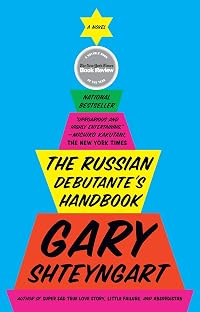
Gary Shteyngart was born in Leningrad, which is now St. Petersburg, Russia, in 1972. He moved to the United States seven years later with his family. He received a bachelor's degree in politics from Oberlin College in Ohio and an MFA in creative writing from City University of New York. His debut novel, The Russian Debutante's Handbook, won the show more Stephen Crane Award for First Fiction and the National Jewish Book Award for Fiction. His other works include Absurdistan, Super Sad True Love Story, which won the Bollinger Everyman Wodehouse Prize, and Little Failure: A Memoir. He has taught writing at Hunter College, Columbia University, and Princeton University. (Bowker Author Biography) show less
Some Editions
Awards and Honors
Common Knowledge
- Canonical title
- Our Country Friends
- Original publication date
- 2021
- Dedication
- To E.W.
- First words
- The House on the Hill was in a tizzy.
- Last words
- (Click to show. Warning: May contain spoilers.)At long last, it was time to go home.
- Blurbers
- Greer, Andrew Sean; Lee, Min Jin; Rushdie, Salman; Kim, Angie; Foer, Jonathan Safran
Classifications
Statistics
- Members
- 665
- Popularity
- 43,187
- Reviews
- 30
- Rating
- (3.33)
- Languages
- Dutch, English, French, German
- Media
- Paper, Audiobook, Ebook
- ISBNs
- 20
- ASINs
- 6