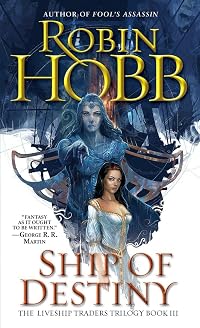
Ship of Destiny
by Robin Hobb
The Liveship Traders (3), Realm of the Elderlings (06 (Liveship Traders 03))
On This Page
Description
As Bingtown slides toward disaster, clan matriarch Ronica Vestrit, branded a traitor, searches for a way to bring the city's inhabitants together against the Chalcedean threat. Meanwhile, Althea Vestrit, unaware of what has befallen Bingtown and her family, continues her perilous quest to track down and recover her liveship Vivacia from the ruthless pirate Kennit. Bold though it is, her scheme may be in vain. For her beloved Vivacia will face the most terrible confrontation of all as the show more secret of the liveships is revealed. It is a truth so shattering, it may destroy Vivacia and all who love her, including the boy-priest Wintrow Vestrit, whose life already hangs in the balance. show lessTags
Recommendations


Member Reviews
Review of the Third Book in The Liveship Traders Trilogy
In the world of The Realm of the Elderlings
Rating: ⭐️4.50
The heart of this book is secrets, layer upon layer of them. The tone shifted again from book two. It wasn’t fast-paced, but rather felt like the story had returned to its natural flow. No crashing waves, just a steady current revealing secret after secret, each one shocking yet perfectly logical. Many of these were things I thought had already been resolved, but Hobb brings them back in ways that make you wonder how you didn’t connect the dots earlier.
The book depicts disturbing, uncomfortable crimes. I understand that these things happen, even within the logic of this world. But it made no sense, neither narratively show more nor historically, that an entire people would collectively accept such acts as normal. Even with my limited historical knowledge, I can’t recall any real world society that unanimously agreed to treat its women in such a way. That created a major rift in the series for me. It goes against basic human instinct, and when the book presents it as universally accepted with no internal dissent, it feels like it’s challenging both logic and reason. I wish the narrative had shown some internal resistance or at least made it clear that not everyone thought alike, but it didn’t.
I loved how events unfolded simultaneously across different plotlines, each one strong and weighty. My attention was constantly divided. As soon as one thread picked up, I’d get excited but also immediately wonder what was happening in the others. This narrative style made the characters feel more alive and important. Each was given the time and space they needed, and none felt less significant than the others.
One of the biggest problems with the first book was the overuse of coincidences and unnatural plot progression. But here, everything felt intentional. Every event was foreshadowed or built up to. The story tied together past, present, and future, making each detail feel earned. I wasn’t surprised by anything, in a good way. I saw brilliance and foresight in every twist. Every character, every creature, even inanimate objects had a purpose. Nothing happened out of nowhere, everything had a reason.
Malta’s transformation is one of the most stunning I’ve ever read. She went from a character I hated and honestly hoped would die, to someone I couldn’t imagine the story without. Her growth was extraordinary, and every change in her was justified. Every doubt, every joy, every fear made sense. Nothing felt forced or sudden. Hobb didn’t just redeem her, she elevated her into one of the most unforgettable characters in the trilogy.
Serilla was a masterclass in manipulation. Her dialogue, her subtle maneuvering, it all showed how well crafted her character was. She represented the kind of person who thrives in the shadows. Her schemes and the way she shifted events to benefit herself were clever and believable. She’s a grey character, and you never quite know if she’s with you or against you. Her world was chaotic, but her pain and struggle were real. Every time someone pushed her, you could see the cracks, her internal battle between composure and collapse. I especially appreciated how Hobb made her desire for power and restoration feel so different from Kennit’s, even though they shared similar emotional roots. She conveyed the same feeling of longing, but through a completely different lens. That’s skillful writing.
As for Kennit, I thought we had already uncovered the most important parts of his past in the previous book. But it turned out we had barely scratched the surface. The revelations here didn’t contradict what we knew, they deepened it. With every glimpse into his history, I understood him more. He’s a vile and reprehensible man, no question, but his backstory is even worse. Every action of his is shaped by what he’s been through. That doesn’t excuse him, but it does explain him. I could imagine someone like him existing in our world, given the same circumstances. His character was consistently written from his first appearance to his last moment. I never felt like he broke character.
Wintrow, in the earlier books, was always asking himself questions about morality, choices, and consequences. But each book chipped away at that part of him, showing the environment’s influence. He was thoughtful and firm in his values, but when you live in a place that punishes that, you start to lose yourself. By the third book, only glimpses of that reflective Wintrow remained. His character shift was gradual and believable. I saw everything that shaped him and understood why he changed. When you reach a point where you understand every action, thought, and emotion a character has, that’s how you know they’re well written. I couldn’t find a single flaw in him.
As for Althea and Brashen, I’ve complained about them before and my opinion hasn’t changed. I’m tired of spending time on them. They’re repetitive, dull, and feel disconnected from the story. Everything I’ve said in previous reviews still applies.
There’s a character I’ve never talked about in previous reviews, Ronica. But in this book, she finally shone. I always expected more from her. In book one, she came off as foolish, and in book two, as confusing. But in Ship of Destiny, she was finally done justice. Every time she spoke, it felt like fire, sharp, confident, full of pride in herself, her husband, and her family. I wish book two had shown that age doesn’t mean weakness, it means wisdom and experience. She’s not fragile or irrelevant.
Etta has been around since the beginning, but I never gave her much credit. She may not have been iconic, but she was well written and developed steadily like everyone else. I appreciated how we saw her without full knowledge of the bigger picture. Whether her decisions were informed or not, they always came from her personal limitations and strengths. Even when I disagreed with her, I understood her, and that’s what matters.
I missed a character like the Fool in this trilogy. His presence in the Farseer books added color, laughter, and emotional relief. I wish we had someone like him here, because everyone else was either depressed or extremely serious.
While reading, someone asked me on Twitter why I didn’t like a certain book I’d read before. I told him it was because there were too many characters and only one was well written. That got me thinking about this trilogy and how incredible Robin Hobb truly is. Despite the rough start, she found her rhythm in books two and three. We got perspectives from around 15 characters and only two were weak. That means 86.67% of the characters were good or excellent. That’s impressive. Yes, the sheer number of POVs was a flaw. It’s hard as a reader to emotionally invest in all of them equally. Fewer characters might’ve had a stronger impact, but even so, Hobb pulled it off beautifully.
The ending was satisfying. Hobb took her time tying everything up, not just the main plotlines, but even what happens after the story ends. It was far better than the Farseer finale. Still, Fitz remains my emotional weak spot, and I want to continue his story. Hobb’s writing demands patience, but I’m definitely coming back to finish the rest of the series after a short break. show less
In the world of The Realm of the Elderlings
Rating: ⭐️4.50
The heart of this book is secrets, layer upon layer of them. The tone shifted again from book two. It wasn’t fast-paced, but rather felt like the story had returned to its natural flow. No crashing waves, just a steady current revealing secret after secret, each one shocking yet perfectly logical. Many of these were things I thought had already been resolved, but Hobb brings them back in ways that make you wonder how you didn’t connect the dots earlier.
The book depicts disturbing, uncomfortable crimes. I understand that these things happen, even within the logic of this world. But it made no sense, neither narratively show more nor historically, that an entire people would collectively accept such acts as normal. Even with my limited historical knowledge, I can’t recall any real world society that unanimously agreed to treat its women in such a way. That created a major rift in the series for me. It goes against basic human instinct, and when the book presents it as universally accepted with no internal dissent, it feels like it’s challenging both logic and reason. I wish the narrative had shown some internal resistance or at least made it clear that not everyone thought alike, but it didn’t.
I loved how events unfolded simultaneously across different plotlines, each one strong and weighty. My attention was constantly divided. As soon as one thread picked up, I’d get excited but also immediately wonder what was happening in the others. This narrative style made the characters feel more alive and important. Each was given the time and space they needed, and none felt less significant than the others.
One of the biggest problems with the first book was the overuse of coincidences and unnatural plot progression. But here, everything felt intentional. Every event was foreshadowed or built up to. The story tied together past, present, and future, making each detail feel earned. I wasn’t surprised by anything, in a good way. I saw brilliance and foresight in every twist. Every character, every creature, even inanimate objects had a purpose. Nothing happened out of nowhere, everything had a reason.
Malta’s transformation is one of the most stunning I’ve ever read. She went from a character I hated and honestly hoped would die, to someone I couldn’t imagine the story without. Her growth was extraordinary, and every change in her was justified. Every doubt, every joy, every fear made sense. Nothing felt forced or sudden. Hobb didn’t just redeem her, she elevated her into one of the most unforgettable characters in the trilogy.
Serilla was a masterclass in manipulation. Her dialogue, her subtle maneuvering, it all showed how well crafted her character was. She represented the kind of person who thrives in the shadows. Her schemes and the way she shifted events to benefit herself were clever and believable. She’s a grey character, and you never quite know if she’s with you or against you. Her world was chaotic, but her pain and struggle were real. Every time someone pushed her, you could see the cracks, her internal battle between composure and collapse. I especially appreciated how Hobb made her desire for power and restoration feel so different from Kennit’s, even though they shared similar emotional roots. She conveyed the same feeling of longing, but through a completely different lens. That’s skillful writing.
As for Kennit, I thought we had already uncovered the most important parts of his past in the previous book. But it turned out we had barely scratched the surface. The revelations here didn’t contradict what we knew, they deepened it. With every glimpse into his history, I understood him more. He’s a vile and reprehensible man, no question, but his backstory is even worse. Every action of his is shaped by what he’s been through. That doesn’t excuse him, but it does explain him. I could imagine someone like him existing in our world, given the same circumstances. His character was consistently written from his first appearance to his last moment. I never felt like he broke character.
Wintrow, in the earlier books, was always asking himself questions about morality, choices, and consequences. But each book chipped away at that part of him, showing the environment’s influence. He was thoughtful and firm in his values, but when you live in a place that punishes that, you start to lose yourself. By the third book, only glimpses of that reflective Wintrow remained. His character shift was gradual and believable. I saw everything that shaped him and understood why he changed. When you reach a point where you understand every action, thought, and emotion a character has, that’s how you know they’re well written. I couldn’t find a single flaw in him.
As for Althea and Brashen, I’ve complained about them before and my opinion hasn’t changed. I’m tired of spending time on them. They’re repetitive, dull, and feel disconnected from the story. Everything I’ve said in previous reviews still applies.
There’s a character I’ve never talked about in previous reviews, Ronica. But in this book, she finally shone. I always expected more from her. In book one, she came off as foolish, and in book two, as confusing. But in Ship of Destiny, she was finally done justice. Every time she spoke, it felt like fire, sharp, confident, full of pride in herself, her husband, and her family. I wish book two had shown that age doesn’t mean weakness, it means wisdom and experience. She’s not fragile or irrelevant.
Etta has been around since the beginning, but I never gave her much credit. She may not have been iconic, but she was well written and developed steadily like everyone else. I appreciated how we saw her without full knowledge of the bigger picture. Whether her decisions were informed or not, they always came from her personal limitations and strengths. Even when I disagreed with her, I understood her, and that’s what matters.
I missed a character like the Fool in this trilogy. His presence in the Farseer books added color, laughter, and emotional relief. I wish we had someone like him here, because everyone else was either depressed or extremely serious.
While reading, someone asked me on Twitter why I didn’t like a certain book I’d read before. I told him it was because there were too many characters and only one was well written. That got me thinking about this trilogy and how incredible Robin Hobb truly is. Despite the rough start, she found her rhythm in books two and three. We got perspectives from around 15 characters and only two were weak. That means 86.67% of the characters were good or excellent. That’s impressive. Yes, the sheer number of POVs was a flaw. It’s hard as a reader to emotionally invest in all of them equally. Fewer characters might’ve had a stronger impact, but even so, Hobb pulled it off beautifully.
The ending was satisfying. Hobb took her time tying everything up, not just the main plotlines, but even what happens after the story ends. It was far better than the Farseer finale. Still, Fitz remains my emotional weak spot, and I want to continue his story. Hobb’s writing demands patience, but I’m definitely coming back to finish the rest of the series after a short break. show less
This is hands down the best trilogy I've read in the past few years. I used to scoff at any fantasy that's not HP or LOTR. Mistborn trilogy is the one that made me realize that it can be about more than dragons and ex-machina magic powers, but it took Liveship Traders to make me actually enjoy the geekier aspects of fantasy. It's my favorite depiction of dragons in anything I've read so far. Seeing the world solely through the eyes of the characters has such a natural approach to world-building that it will be hard to go back to other books that simply detail the world through boring descriptions in attempts of crossing it off the writer's checklist.
I'll be sure to recommend it to others just as annoyingly as it was recommended to me.
I'll be sure to recommend it to others just as annoyingly as it was recommended to me.
So I think this book in particular is an excellent response to the current fad of "grimdark" novels. Especially considering the Guardian piece on it that sparked the twitter joke of inventing Grimpink as a female version of this. (tl:dr Grimdark is a boy's club that girls aren't invited to play in. Female authors and publishers disagree w/ this to hilarious effect.)
What sets this aside from other dark fantasies is that the violence and darkness are shown to full effect. There is no cartoon violence. Violence sits at the core of this novel and rots away at the characters. There are no magic cathartic cures, but there are ways of dealing with it and slowly healing.
This isn't a fun novel to read. It's a lot less fun than the boy's-club show more versions where hitting a bad guy with a sword makes everything better. It does ring true though. I think I understand things relating to cycles of abuse and violence better for reading Hobb's take on them. It wasn't fun, but these aren't fun topics.
Another thing that sets Ship of Destiny and the Liveship Traders series apart is the way that Hobb ruthlessly humanizes her villains. The two characters who do more to cause others pain are not allowed to become cartoonish abstractions of evil. They are made to be flesh and blood human beings. Kyle Haven and Kennit the Pirate are shown to be human beings w/ feelings and positive sides. This really is a triumph, but an uncomfortable one. It is not pleasant to empathize and see one's self in a rapist or in an emotionally abusive and misogynist father. Hobb makes her book human. This is a huge achievement, but again, it isn't fun.
So I think I admire this book and series more than I enjoy it. I think it is definitely required reading for fans of epic fantasy. It belongs in that genre even if it rejects the standard fight-against-embodiment-of-absolute-evil. It belongs because it is a response to the de-humanizing of evil. It does a better job of this than Grimdark novels like Joe Abercrombie's work because instead of simply refusing to make good-evil distinctions, instead it turns the mirror on us and shows us the villain in us. That's an amazing achievement, but not fun at all. show less
What sets this aside from other dark fantasies is that the violence and darkness are shown to full effect. There is no cartoon violence. Violence sits at the core of this novel and rots away at the characters. There are no magic cathartic cures, but there are ways of dealing with it and slowly healing.
This isn't a fun novel to read. It's a lot less fun than the boy's-club show more versions where hitting a bad guy with a sword makes everything better. It does ring true though. I think I understand things relating to cycles of abuse and violence better for reading Hobb's take on them. It wasn't fun, but these aren't fun topics.
Another thing that sets Ship of Destiny and the Liveship Traders series apart is the way that Hobb ruthlessly humanizes her villains. The two characters who do more to cause others pain are not allowed to become cartoonish abstractions of evil. They are made to be flesh and blood human beings. Kyle Haven and Kennit the Pirate are shown to be human beings w/ feelings and positive sides. This really is a triumph, but an uncomfortable one. It is not pleasant to empathize and see one's self in a rapist or in an emotionally abusive and misogynist father. Hobb makes her book human. This is a huge achievement, but again, it isn't fun.
So I think I admire this book and series more than I enjoy it. I think it is definitely required reading for fans of epic fantasy. It belongs in that genre even if it rejects the standard fight-against-embodiment-of-absolute-evil. It belongs because it is a response to the de-humanizing of evil. It does a better job of this than Grimdark novels like Joe Abercrombie's work because instead of simply refusing to make good-evil distinctions, instead it turns the mirror on us and shows us the villain in us. That's an amazing achievement, but not fun at all. show less
I considered calling in sick to work just so I could read this book without any interruptions. That's how good it is.
It is a perfect ending to one of the best trilogies I have ever read.
I didn't even know how attached I was to these characters until the second half of the book when everything went crazy.
The last chapter made me cry and got me hyped for the Tawny Man trilogy.
Edit: I need to write better reviews for these books on my next reread because I do have some issues with them, especially after rereading them. I have issues like paedophiles being presented in a good light for example (there is a character that is 20 and is after - and ends up with - a 13 year old girl). Before people start saying that "it was different in that show more time" about a fantasy novel, the fact that she is just a child and he is an adult is recognized in the text and other characters have issue with it. It's just sad that discussion went nowhere and was brushed off. I still love the books, but these things are very uncomfortable to read and I wish it had been addressed better. show less
It is a perfect ending to one of the best trilogies I have ever read.
I didn't even know how attached I was to these characters until the second half of the book when everything went crazy.
The last chapter made me cry and got me hyped for the Tawny Man trilogy.
Edit: I need to write better reviews for these books on my next reread because I do have some issues with them, especially after rereading them. I have issues like paedophiles being presented in a good light for example (there is a character that is 20 and is after - and ends up with - a 13 year old girl). Before people start saying that "it was different in that show more time" about a fantasy novel, the fact that she is just a child and he is an adult is recognized in the text and other characters have issue with it. It's just sad that discussion went nowhere and was brushed off. I still love the books, but these things are very uncomfortable to read and I wish it had been addressed better. show less
It was pretty damn epic. These three books were very long and had the entire family become heroes in their own right. The wrap-up was long and satisfying, and while the the main action wasn't necessarily a single or even ten different events, the resolution had an inevitable and happy feel to it that wasn't diminished by one main character's death. You'll know who I mean, and you probably won't even mind his passing. After all, he passes on a heritage that perhaps won't be tainted by his past. Probably.
The story has a vast feel to it, despite it taking place in only three cities and the sea. The true enjoyment comes from the sheer amount of details we're given, and given well. Hobb has given us not only live ships but live cities and show more live people that I can still feel moving about and acting in their interests inside my mind.
The book is alive.
Anyone who wants a long adventure should definitely pick these up. It will sit and converse with you for a very long time. show less
The story has a vast feel to it, despite it taking place in only three cities and the sea. The true enjoyment comes from the sheer amount of details we're given, and given well. Hobb has given us not only live ships but live cities and show more live people that I can still feel moving about and acting in their interests inside my mind.
The book is alive.
Anyone who wants a long adventure should definitely pick these up. It will sit and converse with you for a very long time. show less
Not only a solid conclusion to the Liveship Traders trilogy, but one which manages to impact on and change the significance of the conclusion of the Farseer trilogy. Nicely played, Robin Hobb. Kennit is perhaps one of the most intriguing characters she's written. I will note, however, that I'm still wincing at the implications of her treatment of rape, which could be charitably described as clumsy.
To read more reviews in this series and others, check out my blog keikii eats books!
96 points, 5 STARS!
Quote:
Review:
I absolutely loved the journey Ship of Destiny and Liveship Traders took me on. I felt like I ran the range of emotions. I was scared, I was hopeful, I was happy, I was sad. I just loved the feelings this book instilled in me. I loved the book throughout.
I couldn't read Ship of Destiny without comparing it to Assassin's Quest, and I can't review it without comparing it either. Assassin's Quest was a slow start, a very, very slow start. Ship of Destiny picks show more up right after The Mad Ship and it is never, ever slow. Yet, Ship of Destiny also doesn't have the emotional highs I had in Assassin's Quest either. I was a fucking wreck reading Assassin's Quest, while with this I was just wide-eyed and fearful. No crushing despair, though, so thank you Robin Hobb!
The love I have for Robin Hobb and her characters grows with every book of hers I read. The characters I loved, I loved even more. Some of the characters I hated were redeemed, and I'm not certain I can forgive Hobb for doing that to me. Some of the characters I tolerated were vilified, and some I hated, I pitied. Yet always, always, the characters were real. I never once felt like I was reading, I felt like I was experiencing what they were because while I was reading, I was them.
This ending to this trilogy was a one of revelations. I was agog at what I learned. I honestly cannot get over how much I found out in this one book about the entire Realm of the Elderlings. If I found out this much in just this one book, what else is there to learn? What more does my Robin Hobb have in store for me?
This isn't a book of twist and turns, but it is one for slowly unrevealing revelations. Twists and turns are things that shape the book in sharp angles. That isn't what happens here. No, there have been hints and slowly unraveling revelations from the very start of the series. They all come together in one grand finale that is Ship of Destiny. Yet there is more to find out, just out of reach. And I look forward to learning every single one of those things.
I'll admit that the ending to the series had me a bit disappointed. As I said, I can't help compared to Assassin's Quest, and that book had me a wreck. Ship of Destiny just had me craving more. I was disappointed for purely selfish reasons, because it didn't end the way I wanted it to. Some of the endings for the characters were good, but others were just less than I was hoping for. I love my new best friends, and I want the absolute bestest for them. show less
96 points, 5 STARS!
Quote:
"Always, always I lose faith too easily. By now, I should know better. Death does not conquer. It threatens, but it cannot subdue the future. What must be, will be."
Review:
I absolutely loved the journey Ship of Destiny and Liveship Traders took me on. I felt like I ran the range of emotions. I was scared, I was hopeful, I was happy, I was sad. I just loved the feelings this book instilled in me. I loved the book throughout.
I couldn't read Ship of Destiny without comparing it to Assassin's Quest, and I can't review it without comparing it either. Assassin's Quest was a slow start, a very, very slow start. Ship of Destiny picks show more up right after The Mad Ship and it is never, ever slow. Yet, Ship of Destiny also doesn't have the emotional highs I had in Assassin's Quest either. I was a fucking wreck reading Assassin's Quest, while with this I was just wide-eyed and fearful. No crushing despair, though, so thank you Robin Hobb!
The love I have for Robin Hobb and her characters grows with every book of hers I read. The characters I loved, I loved even more. Some of the characters I hated were redeemed, and I'm not certain I can forgive Hobb for doing that to me. Some of the characters I tolerated were vilified, and some I hated, I pitied. Yet always, always, the characters were real. I never once felt like I was reading, I felt like I was experiencing what they were because while I was reading, I was them.
This ending to this trilogy was a one of revelations. I was agog at what I learned. I honestly cannot get over how much I found out in this one book about the entire Realm of the Elderlings. If I found out this much in just this one book, what else is there to learn? What more does my Robin Hobb have in store for me?
This isn't a book of twist and turns, but it is one for slowly unrevealing revelations. Twists and turns are things that shape the book in sharp angles. That isn't what happens here. No, there have been hints and slowly unraveling revelations from the very start of the series. They all come together in one grand finale that is Ship of Destiny. Yet there is more to find out, just out of reach. And I look forward to learning every single one of those things.
I'll admit that the ending to the series had me a bit disappointed. As I said, I can't help compared to Assassin's Quest, and that book had me a wreck. Ship of Destiny just had me craving more. I was disappointed for purely selfish reasons, because it didn't end the way I wanted it to. Some of the endings for the characters were good, but others were just less than I was hoping for. I love my new best friends, and I want the absolute bestest for them. show less
Members
- Recently Added By
Lists

Sentient ships
20 works; 3 members

Female Protagonist
1,056 works; 57 members

Books about pirates
29 works; 10 members
Books tagged favorites
390 works; 30 members

Epic Fantasy of the 90s
111 works; 4 members

Books Read in 2017
4,249 works; 129 members

Books Read in 2018
4,360 works; 110 members

Books Read in 2019
4,052 works; 108 members

Read in 1999–2000
24 works; 1 member

Books Read in 2026
1,910 works; 66 members
Talk Discussions
Past Discussions
Group read: Ship of Destiny by Robin Hobb - The Liveship Trilogy in 75 Books Challenge for 2018 (December 2018)
Author Information

142+ Works 107,024 Members
Robin Hobb was born in California but grew up in Alaska. It was there that she learned to love the forest and the wilderness. She has lived most of her life in the Pacific Northwest and currently resides in Tacoma, Washington. She is the author of five critically acclaimed fantasy series: The Rain Wilds Chronicles (Dragon Keeper, Dragon Haven, show more City of Dragons, Blood of Dragons), The Soldier Son Trilogy, The Tawny Man Trilogy, The Liveship Traders Trilogy, and The Farseer Trilogy. Under the name Megan Lindholm she is the author of The Wizard of the Pigeons, Windsingers, and Cloven Hooves. The Inheritance, a collection of stories, was published under both names. Her short fiction has won the Asimov's Readers' Award and she has been a finalist for both the Nebula and Hugo awards. (Publisher Provided) Margaret Astrid Lindholm Ogden was born in Berkeley, California on March 5, 1952. She writes under the pseudonyms Megan Lindholm and Robin Hobb. She writes fantasy and science fiction under the name Robin Hobb including the Farseer Trilogy, the Liveship Traders Trilogy, the Tawny Man Trilogy, the Soldier Son Trilogy, the Rain Wilds Chronicles, and the Fitz and the Fool Trilogy. Her title, Assassin's Fate, made The New York Times Best Seller List in 2017. (Bowker Author Biography) show less
Some Editions
Awards and Honors
Distinctions
Notable Lists
Series


Work Relationships
Is contained in
Common Knowledge
- Canonical title
- Ship of Destiny
- Original title
- Ship of Destiny
- Original publication date
- 2000-03
- People/Characters
- Wintrow Vestrit; Ronica Vestrit; Althea Vestrit; Vivacia; Malta Haven; Kekki (show all 20); Satrap Cosgo; Reyn Khuprus; Keffria Haven; Selden Haven; Jani Khuprus; Brashen Trell; Roed Caern; Companion Serilla; Kennit; Etta; Tintaglia; Paragon; Amber; Jek
- Important places
- Bingtown; Trehaug; Jamaillia; Chalcedea
- Dedication
- This one is for Jane Johnson and Anne Groell.
For caring enough to insist that I get it right. - First words
- She wondered what it would have been like to be perfect.
- Last words
- (Click to show. Warning: May contain spoilers.)The Lords of the Three Realms had returned.
- Blurbers
- Martin, George R.R.
- Original language
- English
Classifications
Statistics
- Members
- 5,373
- Popularity
- 2,509
- Reviews
- 75
- Rating
- (4.15)
- Languages
- 10 — Dutch, English, Finnish, French, German, Hungarian, Italian, Russian, Spanish, Swedish
- Media
- Paper, Audiobook, Ebook
- ISBNs
- 41
- ASINs
- 18