
On This Page
Description
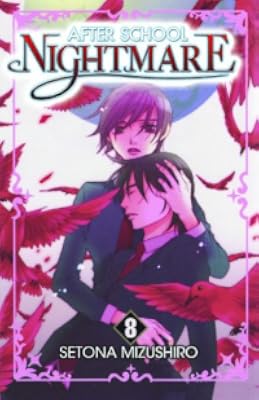
Like most teenagers, Mashiro Ichijo has a secret. But Mashiro's secret is that he's neither fully male nor female! So far, Mashiro's been able to live his life as a boy, but all this changes when he's informed of a new class he must take in order to graduate from his elite prep school. To pass, he must find the "Key"--and the only way to find it is to enter into a nightmare world where his body and soul are put at the mercy of the worst kind of enemies: his classmates!Tags
Recommendations

















































Member Reviews
After School Nightmare is a ten-volume manga series by Setona Mizushiro. I first came across the series while working my way through one of my local library's manga collection which, at the time, was largely shelved alphabetically by title. So, it didn't take me too long to encounter After School Nightmare. I borrowed and read the first few volumes and on the strength of those alone decided to track down and purchase the entire series which had sadly gone out of print. The manga's dark, horror-tinged psychological drama and its themes exploring gender and sexuality immediately appealed to me; the series had the potential to be both disconcerting and compelling. After School Nightmare, Volume 1 was originally published in Japan in 2004. show more The English-language edition of the volume was released in 2006 by the now defunct Go! Comi. After School Nightmare has generally been critically well-received in English, even earning an Eisner Award nomination for Best U.S. Edition of International Material among other honors.
Mashiro Ichijo is an androgynously attractive and well-liked you man, but he's hiding a secret from his classmates--his body is neither entirely male nor entirely female. This has brought Mashiro some challenges in his life and as a result of his physical condition he struggles with his personal identity and gender. Just how much he struggles is made abundantly clear when Mashiro is requested to join a special after-school class which must be completed in order for him to graduate. In it the students must literally live out their nightmares where they are forced to face their darkest fears and bear witness to one another's deepest secrets. What's more is that they aren't there to offer comfort or support. Instead, circumstances encourage them to strike out against their fellow classmates. And even though what happens in the nightmares isn't to carry over into the real world, sharing such an intimate experience can't help but change the young people and how they see one another.
The circumstances surrounding the after-school classes are peculiar. Only the students invited to attend seem to be aware of it. The stairs leading down to the infirmary where the class is held in a basement that shouldn't exist disappears and reappears depending on the day. The teacher in charge isn't known by the school's other faculty. Students who "graduate" quietly go missing and are forgotten. All of these things and more add to the foreboding atmosphere of After School Nightmare and the feeling that something just isn't quite right about what is going on. The shared nightmares themselves are also ominously disconcerting. The imagery is frightening--a girl whose face and heart are gaping holes, disembodied hands and arms, a cruel knight in black armor--but in the end the students' psychological torment and distress may be even more troubling and gut-wrenching. The nightmares simply reveal the darkness and confusion that they already carry within themselves.
In the dreams, the students take on their true forms, representative of the issues, abuse, and trauma that they are dealing with. Many of them appear so distorted in the nightmares that its difficult to know their identities in the waking world. That's not the case for Mashiro who looks exactly the same except that, to his horror, he sometimes is wearing the girls' skirted school uniform in the dreams. This makes him easily identifiable and a target in the real world. He catches the attention of Kureha Fujishima, a young woman who is afraid of men but feels comfortable around Mashiro after learning his secret. And then there's Sou Mizuhashi who has a reputation for being a playboy and womanizer but who also seems to have taken an intense interest in Mashiro. Though somewhat conflicted over these developments in his relationships with his classmates, Mashiro largely welcomes the attention from Kureha and is understandably uncomfortable with Sou's aggressive advances towards him. As the first volume of After School Nightmare shows, reality can be just as terrifying if not more so than any nightmare.
Experiments in Manga show less
Mashiro Ichijo is an androgynously attractive and well-liked you man, but he's hiding a secret from his classmates--his body is neither entirely male nor entirely female. This has brought Mashiro some challenges in his life and as a result of his physical condition he struggles with his personal identity and gender. Just how much he struggles is made abundantly clear when Mashiro is requested to join a special after-school class which must be completed in order for him to graduate. In it the students must literally live out their nightmares where they are forced to face their darkest fears and bear witness to one another's deepest secrets. What's more is that they aren't there to offer comfort or support. Instead, circumstances encourage them to strike out against their fellow classmates. And even though what happens in the nightmares isn't to carry over into the real world, sharing such an intimate experience can't help but change the young people and how they see one another.
The circumstances surrounding the after-school classes are peculiar. Only the students invited to attend seem to be aware of it. The stairs leading down to the infirmary where the class is held in a basement that shouldn't exist disappears and reappears depending on the day. The teacher in charge isn't known by the school's other faculty. Students who "graduate" quietly go missing and are forgotten. All of these things and more add to the foreboding atmosphere of After School Nightmare and the feeling that something just isn't quite right about what is going on. The shared nightmares themselves are also ominously disconcerting. The imagery is frightening--a girl whose face and heart are gaping holes, disembodied hands and arms, a cruel knight in black armor--but in the end the students' psychological torment and distress may be even more troubling and gut-wrenching. The nightmares simply reveal the darkness and confusion that they already carry within themselves.
In the dreams, the students take on their true forms, representative of the issues, abuse, and trauma that they are dealing with. Many of them appear so distorted in the nightmares that its difficult to know their identities in the waking world. That's not the case for Mashiro who looks exactly the same except that, to his horror, he sometimes is wearing the girls' skirted school uniform in the dreams. This makes him easily identifiable and a target in the real world. He catches the attention of Kureha Fujishima, a young woman who is afraid of men but feels comfortable around Mashiro after learning his secret. And then there's Sou Mizuhashi who has a reputation for being a playboy and womanizer but who also seems to have taken an intense interest in Mashiro. Though somewhat conflicted over these developments in his relationships with his classmates, Mashiro largely welcomes the attention from Kureha and is understandably uncomfortable with Sou's aggressive advances towards him. As the first volume of After School Nightmare shows, reality can be just as terrifying if not more so than any nightmare.
Experiments in Manga show less
Ichijo Mashiro has the upper body of a male and the lower of a female. He's lived as a boy up till his freshman year in high school, determined to be strong and clear-headed as he believes men to be, till the day of his first menstruation gives him conflicted feelings. Now, he is told that the students in his school must pass a test in order to graduate, in which they join the dreams of one another and compete to find a key. The key will be revealed to them when they have each completed their own personal task, with Ichijo's concerning his conflicted feelings on his gender. In this world of dreams in which people's appearance are distorted (sometimes recognizably) by the scars of their souls and self-control does not exist, Ichijo is show more made to face the mental scars of his fellow students. The sharing leads Ichijo to romantic entanglements with two of his fellow students, both options forcing Ichijo to confront his issues concerning his gender.
I picked this manga up not knowing I'd already read a series by this author, X-Day. I'm glad I didn't realize, or I might not have picked it up, especially since both series are in some ways of similar content. Both involve mentally scarred high school students coming together, their scars being revealed, and I assume eventually growing closer and out of their pain by what they share. Both are sort of about teen angst and identity, filled with a mildy gloomy, oppressive feel and only occasional moments of humor.
But X-Day was about students who hated their school and wanted to blow it up, and meeting regularly to plan it. The issues the students had were pretty standard, and it wasn't bad but didn't grab me. After School Nightmare's students so far (besides Ichijo) also seem to have the usual traumas commonly chosen for scarred people--abusive father, molestation, parents pushing too hard to do well in school--but Ichijo's gender dilema is more interesting to me, and was dealt with in a more exploratory way, rather than just giving the feeling the author is shaking her finger at Ichijo for not accepting who he/she is and making it blindingly obvious what the "answer" to accepting himself really is.
If you're curious about the relationships, they are so far also used more for exploration of Ichijo's gender issues rather than striving for a romantic feel. Ichijo is undoubtedly becoming involved with a girl at least partially just because it makes him feel more manly. The girl and guy are both attracted to him because they are perhaps (biologically?) heterosexual yet because of past issues hate the opposite sex. What part of any of their feelings are honest attachment to one another as people regardless of gender or just a result of their issues? Will involvement with one or the other make Ichijo worse rather than better at accepting himself?
Of course, being a BL fan, I sort of have a stake in who Ichijo ends up with just in a 'what I find most hot physically' sense. Also my preference for relationships where the couple is resistant to admitting/realizing they like one another and my non-preference for bubbly-peppy-girl-type characters. The girl isn't annoying, though, and currently the guy behaves more like a villain (forcing himself on Ichijo, insisting rudely that he is a girl while at other times making disparaging comments about females), even if we can probably assume we'll learn more and he'll become more sympathetic later. The game could go either way, and interactions with both reveal interesting things about Ichijo, so currently I'm enjoying everything.
Overall, I find the "romance" dealing with more than the 'does he like me/does he not like me' question refreshing and interesting, and the issues of the other students a little more generic but made more interesting to watch compared to X-Day when coupled with this premise involving nightmares and all the truly creepy imagery and moments that come along with it. This series is 10 volumes. If current trends continue, I might get a bit tired of the main's slight wimpiness and unrelenting anxiety about his gender, as well as the melodrama that's likely in store in order to keep such a love triangle going that long. The manga is well done, though, and if it keeps it up, I'll probably stay interested regardless. show less
I picked this manga up not knowing I'd already read a series by this author, X-Day. I'm glad I didn't realize, or I might not have picked it up, especially since both series are in some ways of similar content. Both involve mentally scarred high school students coming together, their scars being revealed, and I assume eventually growing closer and out of their pain by what they share. Both are sort of about teen angst and identity, filled with a mildy gloomy, oppressive feel and only occasional moments of humor.
But X-Day was about students who hated their school and wanted to blow it up, and meeting regularly to plan it. The issues the students had were pretty standard, and it wasn't bad but didn't grab me. After School Nightmare's students so far (besides Ichijo) also seem to have the usual traumas commonly chosen for scarred people--abusive father, molestation, parents pushing too hard to do well in school--but Ichijo's gender dilema is more interesting to me, and was dealt with in a more exploratory way, rather than just giving the feeling the author is shaking her finger at Ichijo for not accepting who he/she is and making it blindingly obvious what the "answer" to accepting himself really is.
If you're curious about the relationships, they are so far also used more for exploration of Ichijo's gender issues rather than striving for a romantic feel. Ichijo is undoubtedly becoming involved with a girl at least partially just because it makes him feel more manly. The girl and guy are both attracted to him because they are perhaps (biologically?) heterosexual yet because of past issues hate the opposite sex. What part of any of their feelings are honest attachment to one another as people regardless of gender or just a result of their issues? Will involvement with one or the other make Ichijo worse rather than better at accepting himself?
Of course, being a BL fan, I sort of have a stake in who Ichijo ends up with just in a 'what I find most hot physically' sense. Also my preference for relationships where the couple is resistant to admitting/realizing they like one another and my non-preference for bubbly-peppy-girl-type characters. The girl isn't annoying, though, and currently the guy behaves more like a villain (forcing himself on Ichijo, insisting rudely that he is a girl while at other times making disparaging comments about females), even if we can probably assume we'll learn more and he'll become more sympathetic later. The game could go either way, and interactions with both reveal interesting things about Ichijo, so currently I'm enjoying everything.
Overall, I find the "romance" dealing with more than the 'does he like me/does he not like me' question refreshing and interesting, and the issues of the other students a little more generic but made more interesting to watch compared to X-Day when coupled with this premise involving nightmares and all the truly creepy imagery and moments that come along with it. This series is 10 volumes. If current trends continue, I might get a bit tired of the main's slight wimpiness and unrelenting anxiety about his gender, as well as the melodrama that's likely in store in order to keep such a love triangle going that long. The manga is well done, though, and if it keeps it up, I'll probably stay interested regardless. show less
Ichijo has always known he was different. Although he has considered himself a boy, he is actually a person of both genders. When his female side suddenly decides to make itself more apparent he thinks that things can't get worse. He was wrong. Suddenly he finds himself in a special after school class where nightmares become reality and he and his classmates discover their true, horrifying selves.
Aesthetically, After School Nightmare had something I haven't seen before in a manga before (in my limited experience). The first few pages are done in color which is visually very pleasing. The story itself is certainly very imaginative. The characters presented are well represented and three dimensional. Ichijo is a sympathetic lead as is show more Kureha, the girl he discovers in the nightmare world who becomes his girlfriend in the real world. Sou, another boy in his school who may or may not be involved in the nightmare as a destructive knight with an unhealthy seeming interest in Ichijo, is rather scary and I'll be curious to see how he develops during the series. I found the nightmare sequences to be a little disturbing and I certainly think the age rating of 16+ for this manga is pretty accurate. This is another series I will have an interest in continuing on with. show less
Aesthetically, After School Nightmare had something I haven't seen before in a manga before (in my limited experience). The first few pages are done in color which is visually very pleasing. The story itself is certainly very imaginative. The characters presented are well represented and three dimensional. Ichijo is a sympathetic lead as is show more Kureha, the girl he discovers in the nightmare world who becomes his girlfriend in the real world. Sou, another boy in his school who may or may not be involved in the nightmare as a destructive knight with an unhealthy seeming interest in Ichijo, is rather scary and I'll be curious to see how he develops during the series. I found the nightmare sequences to be a little disturbing and I certainly think the age rating of 16+ for this manga is pretty accurate. This is another series I will have an interest in continuing on with. show less
This is a weird manga. The main character is a boy on his top half and a girl on his bottom half. I kinda wish he was just regular old intersex of some variety, and not this fantastical sort. Even if he was a chimaera with a nice even split like that, the female hormones giving him a period would also make his breasts grow.But, anyhow, moving past that, I said the manga was weird. The kids in this school have a special class they go to once a week, where they dream. And in the dream, they're competing with each other to get a key. If they get the key, they graduate. Which means leaving the school immediately and nobody will even remember them very well. In the dream, they take a dream form, which is their true self.And the main show more character's all out to prove he's really a guy and not at all a girl. And he starts dating this girl who's afraid of men, while another guy hits on him and treats him like a girl.So, weird. But I kept reading. show less
As Ichijou Mashiro’s hard kept secret is revealed to his classmates, Mashiro’s dream world is turned upside down. The after-hours class Mashiro signs up for is not at all what he expects it to be. Passing the class is his only chance of graduation and the horrors he finds there are only the beginnings to the mysteries yet to be revealed.
This dark series is filled with controversial and emotional issues that take the reader on a journey through what the characters are feeling and what they experience. There is always some sort of twists throughout causing the reader to re-think about the issues involved.
Interesting concept to say the least! The story itself invokes a creepy mysterious concept taking place throughout the school. I was show more impressed with the complexities of the students and situations involved throughout the series. Reading this series the author does an amazing job of making the reader feel the characters pain and suffering.
Note: This review was completed after reading volumes 1-10. show less
This dark series is filled with controversial and emotional issues that take the reader on a journey through what the characters are feeling and what they experience. There is always some sort of twists throughout causing the reader to re-think about the issues involved.
Interesting concept to say the least! The story itself invokes a creepy mysterious concept taking place throughout the school. I was show more impressed with the complexities of the students and situations involved throughout the series. Reading this series the author does an amazing job of making the reader feel the characters pain and suffering.
Note: This review was completed after reading volumes 1-10. show less
At first the premise of this made me think it was something gimmicky; as if it was creating a character just to have a 'twist' to this story. But the more I read, the more the actual mystery of the 'classroom' got me curious. I'll have to say though, this is probably the most 'gender bending manga I've ever read, including Ranma 1/2.
What a strange, strange book. And the whole transgender thing was not handled well. I really enjoyed it for the most part, but was a bit confused about all the issues there were. I don't really know what to think anymore.
Members
- Recently Added By
Talk Discussions
Past Discussions
After School Nightmare in Japanese Culture (June 2011)
Author Information

92 Works 2,583 Members
Awards and Honors
Notable Lists
Series

Common Knowledge
- Canonical title
- After School Nightmare, Volume 1
Classifications
- Genres
- Graphic Novels & Comics, Teen, Horror
- DDC/MDS
- 741.5952 — Arts & recreation Drawing & decorative arts Drawing Comic books, graphic novels, fotonovelas, cartoons, caricatures, comic strips History, geographic treatment, biography Asian Japanese
- LCC
- PN6790 .J34 .H68513 — Language and Literature Literature (General) Literature (General) Collections of general literature Comic books, strips, etc.
- BISAC
Statistics
- Members
- 300
- Popularity
- 107,416
- Reviews
- 11
- Rating
- (3.96)
- Languages
- English, French, German, Japanese
- Media
- Paper
- ISBNs
- 7