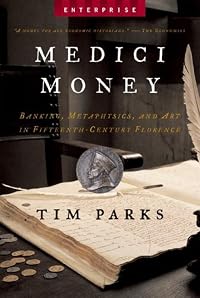
Medici Money: Banking, Metaphysics, and Art in Fifteenth-Century Florence
by Tim Parks
The Enterprise Series (6)
On This Page
Description
Their name is a byword for immense wealth and power, but before their renown as art patrons and noblemen, the Medicis built their fortune on banking. Banking in the fifteenth century, even at the height of the Renaissance, meant running afoul of the Catholic Church's prohibition against usury. It required more than merely financial skills to make a profit, and the legendary Medicis--most famously Cosimo and Lorenzo ("the Magnificent")--were masterly at the political, diplomatic, military, show more and even metaphysical tools that were needed to maintain their family's position. Parks uncovers the intrigues, dodges, and moral qualities that gave the Medicis their edge. Evoking the richness of the Florentine Renaissance and the Medicis' glittering circle, replete with artists, popes, and kings, Medici Money is a look into the origins of modern banking and its troubled relationship with art and religion. --From publisher description. show lessTags
Recommendations











Member Reviews
Not interested in Italian Renaissance History? No problem! Aside from the fact that Parks is a good enough writer to make any subject interesting, this book is about far more than the Medici clan (though it's also a good place to start in relation to them). It's equally about the nature of money, and banking - with plenty of contemporary resonance.
For example:
"Usury alters things. With interest rates, money is no longer a simple and stable metal commodity that just happens to have been chosen as a means of exchange. Projected through time, it multiplies, and this without any toil on the part of the usurer. Everything becomes more fluid. A man can borrow money, buy a loom, sell his wool at a high price, change his station in life. show more Another man can borrow money, buy the first man's wool, ship it abroad, and sell it at an even higher price. He moves up the social scale. Or if he is unlucky, or foolish, he is ruined. Meanwhile, the usurer, the banker, grows richer and richer. We can't even know how rich because money can be moved and hidden, and gains on financial transactions are hard to trace." [pg13]
Parks talks about the book in interview with TMO here show less
For example:
"Usury alters things. With interest rates, money is no longer a simple and stable metal commodity that just happens to have been chosen as a means of exchange. Projected through time, it multiplies, and this without any toil on the part of the usurer. Everything becomes more fluid. A man can borrow money, buy a loom, sell his wool at a high price, change his station in life. show more Another man can borrow money, buy the first man's wool, ship it abroad, and sell it at an even higher price. He moves up the social scale. Or if he is unlucky, or foolish, he is ruined. Meanwhile, the usurer, the banker, grows richer and richer. We can't even know how rich because money can be moved and hidden, and gains on financial transactions are hard to trace." [pg13]
Parks talks about the book in interview with TMO here show less
Surprised by being so unsatisfied with Medici Money. I was expecting a great read but I found it confusing when it should have been easy to bring out the deeper contradictions within the legendary Medici. I didn’t appreciate what felt like a Wall Street Journal type of writing that didn’t offer a single theme (Achilles coupled with Savonarola). Not recommended, and I would think twice about trying to read anything else by the author. Parks seems talented enough to do great work, but this one isn’t.
This was a great fun book. It's an easy introduction to 15th Century Florence. I've read bits and pieces here and there about that time and place, but this book put the pieces together nicely. Of course it is not a long book and not a dense book either, so it is far from comprehensive. Really it is more of a starting point, a trigger to go read more.
Egads I don't think I ever realized that the Pope that Luther fought against was the son of Lorenzo the Magnificent. How about that!
I did find the writing style of the book a bit annoying. There are sentence fragments all over the place. It's not carelessly done - it's too consistent for that. It's just sort of deliberately informal, chatty. It wasn't a total obstacle - it was clear enough show more what the author was saying.
There were many fun references to our current social/political environment. That's a major theme of the book, the way that 15th Century Florence was the birthplace of our modern society. Of course any such hypothesis has to be simplistic to the point almost of absurdity. But the cartoon starkness of it makes it clearer. Maybe the reader will be motivated to study further, to fill in the subtleties. How was Luther different than Savonarola?
The tight relationship between money - banking - and politics: that's the core of it. How money has erased old family power. (There's one of those sentence fragments!)
Ah, there was a sentence in the book somewhere... in a productive economy, banks can make money by investing in productive enterprises. When all the productivity has moved elsewhere, the only money to be made is by encouraging the powerful to overspend on grand gestures, military and otherwise. Definitely many pointed references to present circumstances, though not always clearly labeled as such! show less
Egads I don't think I ever realized that the Pope that Luther fought against was the son of Lorenzo the Magnificent. How about that!
I did find the writing style of the book a bit annoying. There are sentence fragments all over the place. It's not carelessly done - it's too consistent for that. It's just sort of deliberately informal, chatty. It wasn't a total obstacle - it was clear enough show more what the author was saying.
There were many fun references to our current social/political environment. That's a major theme of the book, the way that 15th Century Florence was the birthplace of our modern society. Of course any such hypothesis has to be simplistic to the point almost of absurdity. But the cartoon starkness of it makes it clearer. Maybe the reader will be motivated to study further, to fill in the subtleties. How was Luther different than Savonarola?
The tight relationship between money - banking - and politics: that's the core of it. How money has erased old family power. (There's one of those sentence fragments!)
Ah, there was a sentence in the book somewhere... in a productive economy, banks can make money by investing in productive enterprises. When all the productivity has moved elsewhere, the only money to be made is by encouraging the powerful to overspend on grand gestures, military and otherwise. Definitely many pointed references to present circumstances, though not always clearly labeled as such! show less
The very thing that made the Medici rich (usury)made them vulnerable. The antidote, emblematic of the pragmatist patriarch Cosimo Medici, was to link their wealth to the public, cultural good. The other centrepiece in this story is the Renaissance with its accompanying inquiry into the nature of man, science and beauty (along with the predictably prickly relationship with the Church). Tim Parks is a wonderful raconteur and this book is another winner in his repetoire.
Tim Parks Medici Money is a somewhat peculiar look at the famed Medici family of renaissance Italy and the banking organization they were most recognized for. The book suffers from rather poor editing, with timeline jumps, poor sentencing and at times overbearing waffle - his explanation of monetary connections between the Medici provincial banks left me confused. His writing style doesn’t seem too far removed from that of a script to a light hearted documentary. I would say this is a good introduction to the 15th century Europe and the fame Medici family but sadly nothing more.
A pretentious title to a moderately well written but sometimes poorly edited book. Because unnatural. Yup, that's what got printed on page 193. Plus the author seems to have equated religion or the Catholic Church of the time with metaphyiscs. Or he just wanted to sound fancy. I think the book would have been better without the pretentiousness.
My biggest complaint is that if this is supposed to be a non-fiction work, then a true bibliography and a notes section should have been included. Instead there is a "Bibliographic Notes" section where he gives his opinion of other works on the Medici.
My biggest complaint is that if this is supposed to be a non-fiction work, then a true bibliography and a notes section should have been included. Instead there is a "Bibliographic Notes" section where he gives his opinion of other works on the Medici.
Excellent
Members
- Recently Added By
Published Reviews
But the author of a book whose subtitle - 'Banking, Metaphysics and Art in 15th-century Florence' - promises to conjure a dazzling prism needs his own stratagems to manoeuvre the reader's attention and, in this, Parks is only partly successful, surveying the wide panorama of the 15th century when often the particular would suffice. Although this is a relatively short book, it is hard not to show more feel that buried within it there is a brilliant essay on the metaphysics of money crying to be let out. show less
added by lilithcat
Author Information

55+ Works 5,645 Members
Tim Parks is the author of more than twenty novels and works of nonfiction, including Italian Neighbors, An Italian Education, Adultery, Hell and Back, and Teach Us to Sit Still. He is also a contributor to the New York Review of Books and The New Yorker, and translator of the works of Alberto Moravia, Roberto Calasso, Italo Calvino, and Antonio show more Tabucchi, among others. He lives in Italy. show less
Awards and Honors
Distinctions
Series

Common Knowledge
- Canonical title
- Medici Money: Banking, Metaphysics, and Art in Fifteenth-Century Florence
- Original title
- Medici money : banking, metaphysics, and art in fifteenth-century Florence
- Original publication date
- 2005
- People/Characters
- Cosimo de' Medici, the Elder; Lorenzo de' Medici; Giovanni di Bicci de' Medici
- Important places
- Florence, Tuscany, Italy; Rome, Papal States, Italy
- First words
- "With usura,"
wrote Ezra Pound
...hath no man a house of good stone
each block cut smooth and well fitting
that design might cover their face
By usura Pound meant usury, or the lending of ... (show all)money at an interest. Not just an exorbitantly high rate of interest, as in the modern usage of the word usury,but any interest at all. - Last words
- (Click to show. Warning: May contain spoilers.)These new Medici of the sixteenth and seventeenth centuries ordered monuments of tax-funded magnificence to establish an aura of legitimacy. All the fruitful ambiguity that had characterized the old Costmo's commissions, all the urgent tension between money and metaphysics, was gone. With the grant dukes of Tuscany, we are in the world of larger-than-life equestrian statues, fluttering official portraits, imagined military glory, and extravagant, though always breathtaking mannerism. In such circumstances, there was no need to revive the bank. In fact, the sooner people forgot that the family had ever sat behind their tables in via Porta Rossa, copying down the details of dubious exchange deals, the better.
- Original language*
- Englisch
- Canonical DDC/MDS
- 330
- Canonical LCC
- HG3090.F562 P37
*Some information comes from Common Knowledge in other languages. Click "Edit" for more information.
Classifications
Statistics
- Members
- 524
- Popularity
- 57,354
- Reviews
- 9
- Rating
- (3.33)
- Languages
- 5 — Dutch, English, German, Italian, Portuguese
- Media
- Paper, Ebook
- ISBNs
- 14
- ASINs
- 4