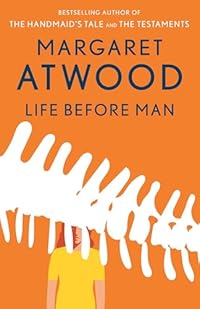
Life Before Man
by Margaret Atwood
On This Page
Description
Life Before Man vividly portrays three people in thrall to the tragicomedy some call love. Imprisoned by walls of their own construction, they are forced to make drastic choices - after the rules have changed and the boundaries have become faded. There is Elizabeth, with her controlled sensuality, who seeks solutions in the wrong men; Nate, wry and gentle husband of Elizabeth, racked by an inability to decide; and Lesje, quiet and inexperienced, who prefers dinosaurs to most men. Hanging show more over all of them is the ghost of Elizabeth's dead lover...and the threat of three lives careering inevitably toward potential catastrophe. show lessTags
Recommendations















Member Reviews
Margaret Atwood pulls apart the threads of family and relationship like no other. This novel is told from three perspectives: Elizabeth's, Nate's, and Lesje's. Elizabeth and Nate are married, though Elizabeth's lover Chris has just committed suicide. Elizabeth and Lesje work together at a museum. Nate becomes entranced by Lesje and tries to enter her life. The lives of the three become entangled in interesting ways, as they try to work out what they each want.
This is the first of Atwood's 1970s work I've read, and I enjoyed it. Obviously, infidelity and adults behaving badly is not pleasant subject material, but Atwood makes her novel compulsively readable with a narrative structure that has you reading each perspective with show more alternating sympathy and repulsion. show less
This is the first of Atwood's 1970s work I've read, and I enjoyed it. Obviously, infidelity and adults behaving badly is not pleasant subject material, but Atwood makes her novel compulsively readable with a narrative structure that has you reading each perspective with show more alternating sympathy and repulsion. show less
I was delighted that one of the Margaret Atwood novels I had tbr fitted snugly into one of the last years of my A Century of Books and I could join in with Margaret Atwood reading month, hosted by Buried in Print and Consumed by Ink.
Life Before Man is a fairly early Atwood novel, one I had missed in the late eighties when I first began reading her novels. In this novel, Atwood’s characters are not always very likeable – but I really don’t think that matters. The novel’s three main characters are deftly explored, people trapped in damaging relationships, in thrall to their various love affairs. I found Life Before Man immensely readable and thoroughly enjoyed it.
The stories of these three people are told in alternate chapters show more with events told from each character’s perspective.
Elizabeth is a woman struggling with grief – her lover Chris has recently taken his own life, and she can barely function for the silent rage inside her. Unhappily married to Nate, the two have lived separate lives from within the same house for a while. Her two little girls are oblivious to their mother’s turmoil, though even they sense something is wrong. They plan joyfully for Halloween, lighting jack-o-lanterns while it is still light. Elizabeth lies on her bed listening from a faraway place inside her.
“It used to touch her, that excitement, that fierce joy, the planning that would go on for weeks behind the closed door of their room. It used to twist something in her, some key. This year they are remote from her. The soundless glass panel of the hospital nursery where she would stand in her housecoat for each of them in turn, watching the pink mouths open and close, the faces contort.
She can see them, they can see her. They know something is wrong. Their politeness, their evasion, is chilling because it’s so perfectly done.”
Elizabeth’s husband Nate is a gentle, weak soul, but his relationship with his wife is in the past. Once Nate was a lawyer, but he gave that up to make bespoke wooden rocking horses in his basement. Nate knew all about Chris, everyone at the Museum where Elizabeth and Chris worked knew about them, there were no secrets, no sneaking about, just a strange chilly kind of politeness. All the time Elizabeth was seeing Chris, Nate had been seeing Martha. Nate and Elizabeth had an agreed timetable as to who was out when, and Elizabeth would meet up with Martha for a drink from time to time, to gauge how things stood. With Chris dead, Nate feels there is something of an imbalance – and with his relationship with Martha pretty much having run its course he ends his affair. Now though, he has his eye on a replacement.
Lesje is the innocent,and the young woman who Nate is interested in, though she seems far fonder of dinosaurs than men. Lesje, a young woman of Jewish/Ukrainian parentage works in the museum’s palaeontology department, her mind is never far from her favourite subject. However, soon enough the two are entering into an affair, despite the fact that Lesje is already living with William.
“Copulating with William was not unpleasant she thinks, but neither was it memorable. It was like sleeping with a large and fairly active slab of Philadelphia cream cheese. Emulsified.”
Lesje soon realises that in taking on Nate – she is also taking on his daughters, and Elizabeth is always in the background – or on the phone, not to mention around at work. Nate is finding things financially very tight – and his wooden horses are no longer selling very well. Everything becomes rather fraught.
One of my favourite aspects of the novel – aside from the wonderful writing – is the story of Elizabeth growing up, told in flashback. Elizabeth and her sister were taken into their Auntie Muriel’s house as young girls – the reasons become sadly apparent as the novel progresses. Auntie Muriel’s house was a joyless place of rules and embroidery.
“It’s the third of January. Elizabeth is sitting on the slippery rose-colored chesterfield in her Auntie Muriel’s parlor, which is truly a parlor and not a living room. It’s a parlor because of the spider and the fly. It isn’t a living room, because Auntie Muriel cannot be said to live.
Auntie Muriel is both the spider and the fly, the sucker-out of life juice and the empty husk. Once she was just the spider and Uncle Teddy was the fly, but ever since Uncle Teddy’s death Auntie Muriel has taken over both roles.”
Elizabeth’s life with Auntie Muriel and the fate suffered by her sister has blighted her life – and Elizabeth has never really recovered from it or forgiven her Aunt. This aspect of Elizabeth’s story is much easier to sympathise with, and in Auntie Muriel – who we mainly she through the filter of Elizabeth’s memory – Atwood has created a marvellously horrible character.
Hanging over the heads of all these people is the ghost of Elizabeth’s dead lover. Atwood’s characters are wonderfully realistic and she has a great ear for dialogue. As much as the story of these people has tragic undertones, Life Before Man is also frequently funny. show less
Life Before Man is a fairly early Atwood novel, one I had missed in the late eighties when I first began reading her novels. In this novel, Atwood’s characters are not always very likeable – but I really don’t think that matters. The novel’s three main characters are deftly explored, people trapped in damaging relationships, in thrall to their various love affairs. I found Life Before Man immensely readable and thoroughly enjoyed it.
The stories of these three people are told in alternate chapters show more with events told from each character’s perspective.
Elizabeth is a woman struggling with grief – her lover Chris has recently taken his own life, and she can barely function for the silent rage inside her. Unhappily married to Nate, the two have lived separate lives from within the same house for a while. Her two little girls are oblivious to their mother’s turmoil, though even they sense something is wrong. They plan joyfully for Halloween, lighting jack-o-lanterns while it is still light. Elizabeth lies on her bed listening from a faraway place inside her.
“It used to touch her, that excitement, that fierce joy, the planning that would go on for weeks behind the closed door of their room. It used to twist something in her, some key. This year they are remote from her. The soundless glass panel of the hospital nursery where she would stand in her housecoat for each of them in turn, watching the pink mouths open and close, the faces contort.
She can see them, they can see her. They know something is wrong. Their politeness, their evasion, is chilling because it’s so perfectly done.”
Elizabeth’s husband Nate is a gentle, weak soul, but his relationship with his wife is in the past. Once Nate was a lawyer, but he gave that up to make bespoke wooden rocking horses in his basement. Nate knew all about Chris, everyone at the Museum where Elizabeth and Chris worked knew about them, there were no secrets, no sneaking about, just a strange chilly kind of politeness. All the time Elizabeth was seeing Chris, Nate had been seeing Martha. Nate and Elizabeth had an agreed timetable as to who was out when, and Elizabeth would meet up with Martha for a drink from time to time, to gauge how things stood. With Chris dead, Nate feels there is something of an imbalance – and with his relationship with Martha pretty much having run its course he ends his affair. Now though, he has his eye on a replacement.
Lesje is the innocent,and the young woman who Nate is interested in, though she seems far fonder of dinosaurs than men. Lesje, a young woman of Jewish/Ukrainian parentage works in the museum’s palaeontology department, her mind is never far from her favourite subject. However, soon enough the two are entering into an affair, despite the fact that Lesje is already living with William.
“Copulating with William was not unpleasant she thinks, but neither was it memorable. It was like sleeping with a large and fairly active slab of Philadelphia cream cheese. Emulsified.”
Lesje soon realises that in taking on Nate – she is also taking on his daughters, and Elizabeth is always in the background – or on the phone, not to mention around at work. Nate is finding things financially very tight – and his wooden horses are no longer selling very well. Everything becomes rather fraught.
One of my favourite aspects of the novel – aside from the wonderful writing – is the story of Elizabeth growing up, told in flashback. Elizabeth and her sister were taken into their Auntie Muriel’s house as young girls – the reasons become sadly apparent as the novel progresses. Auntie Muriel’s house was a joyless place of rules and embroidery.
“It’s the third of January. Elizabeth is sitting on the slippery rose-colored chesterfield in her Auntie Muriel’s parlor, which is truly a parlor and not a living room. It’s a parlor because of the spider and the fly. It isn’t a living room, because Auntie Muriel cannot be said to live.
Auntie Muriel is both the spider and the fly, the sucker-out of life juice and the empty husk. Once she was just the spider and Uncle Teddy was the fly, but ever since Uncle Teddy’s death Auntie Muriel has taken over both roles.”
Elizabeth’s life with Auntie Muriel and the fate suffered by her sister has blighted her life – and Elizabeth has never really recovered from it or forgiven her Aunt. This aspect of Elizabeth’s story is much easier to sympathise with, and in Auntie Muriel – who we mainly she through the filter of Elizabeth’s memory – Atwood has created a marvellously horrible character.
Hanging over the heads of all these people is the ghost of Elizabeth’s dead lover. Atwood’s characters are wonderfully realistic and she has a great ear for dialogue. As much as the story of these people has tragic undertones, Life Before Man is also frequently funny. show less
Life Before Man is one of the few (the only?) Atwood novels in which there's a mostly palatable male character. Most of Atwood's men are pretty revolting, if sometimes compellingly so. I like to imagine that Atwood wrote this for her husband, so that there was something in her body of work that imagined better relationships.
Like all Atwoods, there are mothers, daughters, a little bit of sex. But this novel is really about grief, and exquisitely done. It's plodding at times, which is not an accident. "Nothing is ever finished" says Elizabeth. The real genius is that no character really feels justified in his/her grief, which is a realistic facet of the experience. Elizabeth mourns the lover she already cast away. Nate mourns the marriage show more that unraveled a long time ago. Lesje mourns the crummy boyfriend she never loved, and then the relationship she wanted and got. Elizabeth mourns the aunt she hated.
As a bonus, one of the main characters is a paleontologist, which I love. show less
Like all Atwoods, there are mothers, daughters, a little bit of sex. But this novel is really about grief, and exquisitely done. It's plodding at times, which is not an accident. "Nothing is ever finished" says Elizabeth. The real genius is that no character really feels justified in his/her grief, which is a realistic facet of the experience. Elizabeth mourns the lover she already cast away. Nate mourns the marriage show more that unraveled a long time ago. Lesje mourns the crummy boyfriend she never loved, and then the relationship she wanted and got. Elizabeth mourns the aunt she hated.
As a bonus, one of the main characters is a paleontologist, which I love. show less
As someone ending a marriage that was likely not always loveless, though I cannot remember it as such, this is a book that spoke deeply to me. The stories of Elizabeth, Nate and Lesje make me want to cry, to laugh, to scream, to comfort. They make me realize that each of us have sides of ourselves that we would rather not be shown to the world, but in our worst times, those are the sides that are usually the most obvious.
Atwood never ceases to amaze me, but often I am more drawn into her stories than I am the characters. Here was the exact opposite. Instead of a dystopia where women are made into baby carriages, instead of a tale of the end of our world and the start of a new generation, instead of a lookback into the mind of a serial show more killer, we are faced with the mundane. A loveless marriage. How that is impacted by the addition of other relationships. How it ends. How each member in that play deals with the emotions circling above them.
And this is enough to push me page after page, quickly, and with eagerness, to see when I can catch a glimpse of myself the next time. show less
Atwood never ceases to amaze me, but often I am more drawn into her stories than I am the characters. Here was the exact opposite. Instead of a dystopia where women are made into baby carriages, instead of a tale of the end of our world and the start of a new generation, instead of a lookback into the mind of a serial show more killer, we are faced with the mundane. A loveless marriage. How that is impacted by the addition of other relationships. How it ends. How each member in that play deals with the emotions circling above them.
And this is enough to push me page after page, quickly, and with eagerness, to see when I can catch a glimpse of myself the next time. show less
contemp fic ***1/2
[Life Before Man] [[Margaret Atwood]]
Can't say that I consider this one of Atwood's best, but I believe Atwood is clever enough to pull one over on me, so I hardly dare insist. The story focusses around a couple, Elizabeth (works at the museum of natural history) and Nate (former lawyer/toymaker) Torontoans, for whom ten years of marriage has proved about the limit. There are side characters, including the absent lover of Elizabeth who has recently committed suicide before the novel opens. With her own voice there is also Nate's new love interest Lesje, ten years younger, who also works at the museum of natural history in dinosaurs. Elizabeth is a schemer and manipulator with a ruthless streak, Nate comes across show more alternately as a decent guy and self-absorbed and a crafter if justifications for less than ethical behaviour. Lesje, by nature a science geek and not very good at reading human signals or giving them, comes across as an aging naif, almost dangerously so. But in classic Atwoodian fashion, just as you are fed up with one character or another they shift, do something that has you shrug and forgive them. They are human like you and me. I didn't especially enjoy LBM but I respect Atwood too much to put down one of her books without a very good reason. Here's Lesje describing William (who was her partner before Nate) "In that prehistoric era during which she lived with William, she was able to depend on him. He liked being on time for work. he also liked getting up. He'd take a brisk shower, scrubbing himself with some kind of medieval flagellation instrument, and emerge pink as a rubber duck to ferret in the kitchen for Shreddies and milk . . . " So vivid. ***1/2 show less
[Life Before Man] [[Margaret Atwood]]
Can't say that I consider this one of Atwood's best, but I believe Atwood is clever enough to pull one over on me, so I hardly dare insist. The story focusses around a couple, Elizabeth (works at the museum of natural history) and Nate (former lawyer/toymaker) Torontoans, for whom ten years of marriage has proved about the limit. There are side characters, including the absent lover of Elizabeth who has recently committed suicide before the novel opens. With her own voice there is also Nate's new love interest Lesje, ten years younger, who also works at the museum of natural history in dinosaurs. Elizabeth is a schemer and manipulator with a ruthless streak, Nate comes across show more alternately as a decent guy and self-absorbed and a crafter if justifications for less than ethical behaviour. Lesje, by nature a science geek and not very good at reading human signals or giving them, comes across as an aging naif, almost dangerously so. But in classic Atwoodian fashion, just as you are fed up with one character or another they shift, do something that has you shrug and forgive them. They are human like you and me. I didn't especially enjoy LBM but I respect Atwood too much to put down one of her books without a very good reason. Here's Lesje describing William (who was her partner before Nate) "In that prehistoric era during which she lived with William, she was able to depend on him. He liked being on time for work. he also liked getting up. He'd take a brisk shower, scrubbing himself with some kind of medieval flagellation instrument, and emerge pink as a rubber duck to ferret in the kitchen for Shreddies and milk . . . " So vivid. ***1/2 show less
Another borrowed book, which I read because Atwood's novels are always interesting. This is one of her quieter books, an exploration of a triangular relationship between Elizabeth and Nate, a married couple with two children whose marriage is failing but held together fairly amicably for the sake of the children, and Lesje, a rather naive young paleontologist and specialist in dinosaur bones.
The chapters alternate between these three perspectives in a mostly chronological sequence over a period of a couple of years. Elizabeth works in a more senior role in the same museum as Lesje, and Nate is just about scraping a living making wooden toys after abandoning a career in law.
At the start Elizabeth is recovering from the suicide of her show more lover and work colleague Chris, and Nate is in the process of ending another relationship with Martha, while Lesje is living with her partner William.
What plot there is follows Nate's relationship with Lesje to the point where he has moved in with her and gone back to working in the law firm, but none of them are really happy or fulfilled. So it is quite a low-key and subtle novel, but there is plenty of room for acute observation and a degree of wry humour, and it never felt like a chore to read. show less
The chapters alternate between these three perspectives in a mostly chronological sequence over a period of a couple of years. Elizabeth works in a more senior role in the same museum as Lesje, and Nate is just about scraping a living making wooden toys after abandoning a career in law.
At the start Elizabeth is recovering from the suicide of her show more lover and work colleague Chris, and Nate is in the process of ending another relationship with Martha, while Lesje is living with her partner William.
What plot there is follows Nate's relationship with Lesje to the point where he has moved in with her and gone back to working in the law firm, but none of them are really happy or fulfilled. So it is quite a low-key and subtle novel, but there is plenty of room for acute observation and a degree of wry humour, and it never felt like a chore to read. show less
This book was slow for me to get into, but when I sat down to really dig in, it was Atwood as usual. Painting characters who have real thoughts and actions--whose behavior confuses them (like my own behavior sometimes confuses me). This books I would say is about the patterns we find ourselves in. Relationship patterns with significant others, children, relatives--and how it all just breaks down.
I would be hard pressed to say who the protagonist of this novel is. There are three main characters, and they are all so real I can't say that I was rooting for any of them. They were selfish and petty, but caring and loving and scared too. Just like characters outside of books.
I would be hard pressed to say who the protagonist of this novel is. There are three main characters, and they are all so real I can't say that I was rooting for any of them. They were selfish and petty, but caring and loving and scared too. Just like characters outside of books.
Members
- Recently Added By
Lists

The Best of Canadian Literature
235 works; 32 members

Literature About Women and Girls
394 works; 39 members

Urban Fiction
74 works; 7 members

Books Set in Canada
57 works; 10 members

Books About Older People
50 works; 11 members

University literature
145 works; 5 members

Books You Read For University
184 works; 3 members

living room bookshelf
150 works; 1 member
School Made Us Read It
380 works; 196 members

Fiction With Familiar Settings
279 works; 92 members
Author Information

283+ Works 198,583 Members
Margaret Atwood was born on November 18, 1939 in Ottawa, Canada. She received a B.A. from Victoria College, University of Toronto in 1961 and an M.A. from Radcliff College in 1962. Her first book of verse, Double Persephone, was published in 1961 and was awarded the E. J. Pratt Medal. She has published numerous books of poetry, novels, story show more collections, critical work, juvenile work, and radio and teleplays. Her works include The Journals of Susanna Moodie, Power Politics, Cat's Eye, The Robber Bride, Morning in the Buried House, the MaddAdam trilogy, and The Heart Goes Last. She has won numerous awards including the Prince of Asturias Award for Literature, the Booker Prize in 2000 for The Blind Assassin, the Giller Prize and the Premio Mondello for Alias Grace, and the Governor General's Award in 1966 for The Circle Game and in 1986 for The Handmaid's Tale, which also won the very first Arthur C. Clarke Award in 1987. She won the PEN Pinter prize in 2016 for her political activism. She was awarded the 2016 PEN Pinter Prize for the outstanding literary merit of her body of work. (Bowker Author Biography) show less
Some Editions
Awards and Honors
Awards
Distinctions
Series
Belongs to Publisher Series
Work Relationships
Common Knowledge
- Canonical title
- Life Before Man
- Original title
- Life Before Man
- Original publication date
- 1979
- People/Characters
- Elizabeth; Nate; Lesje
- Important places
- Toronto, Ontario, Canada
- Epigraph
- Instead of a part of the organism itself, the fossil may be some kind of record of its presence, such as a fossilized track or burrow....These fossils give us our only chance to see the extinct animals in action and to study ... (show all)their behavior, though definite identification is only possible where the animal has dropped dead in its tracks and become fossilized on the spot.
- Bjorn Kurten, The Age of Dinosaurs
Look, I'm smiling at you, I'm smiling in you, I'm smiling through you. How can I be dead if I breathe in every quiver of your hand?
- Abram Terz (Andrei Sinyavsky), The Icicle - Dedication
- For G.
- First words
- I don't know how I should live.
- Last words
- (Click to show. Warning: May contain spoilers.)China does not exist. Nevertheless she longs to be there.
- Blurbers
- French, Marilyn; Gee, Maggie
- Original language
- English
Classifications
Statistics
- Members
- 2,107
- Popularity
- 9,713
- Reviews
- 30
- Rating
- (3.34)
- Languages
- 14 — Czech, Danish, Dutch, English, Finnish, French, German, Italian, Norwegian, Russian, Spanish, Swedish, Turkish, Portuguese (Portugal)
- Media
- Paper, Audiobook, Ebook
- ISBNs
- 50
- ASINs
- 13