
The Moon-Spinners
by Mary Stewart
On This Page
Description
Nicola, in Crete for a holiday, discovers a young Englishman in hiding and although warned away, can't help herself from becoming entangled in his affairs.Tags
Recommendations

















Member Reviews
A young woman arrives at a remote village in Crete a day ahead of schedule; she is not yet expected at the tiny just-opened hotel, and her travel companion won't arrive until tomorrow. This is a perfect set-up for a bit of suspenseful adventure, and that's what we get. Nikky hikes off the road into shepherd and windmill country, and what does she encounter but a gunshot Englishman and his knife-wielding Cretan guide hiding out in a hut. Does she run like crazy back to the village for help and safety? Nooooo....what kind of a story would that be? She insists on sticking around to help these suspicious characters, who could be up to damn near anything, none of it savory, and spends the night in the hut caring for the feverish injured hunk show more fellow while his companion strikes out for their boat to fetch supplies. The story continues in this incredibly unlikely fashion for around 200 pages, and it's just great Romantic fun, if you can hush up that bit of your brain that keeps saying "NO WAY" to all of it. Disney did grave damage to this story in its delightfully sanitized movie version, eliminating some characters, changing some of the good guys to bad guys, and turning the competent independent Nikky into Hayley Mills. What both book and movie have going for them is the breathtaking beauty of the Aegean...Mary Stewart regales us constantly with sea, sun, birds and flowers. I think that distracted me enough to allow me to buy into the whole escapade. That, and knowing that with Stewart things always work out in the end.
February 2017 show less
February 2017 show less
Mary Stewart always brings out the wanna-be traveler in me. I cannot think how anyone could read her gorgeous descriptions of the White Mountains of Crete and not be wishing to board the next plane out for Greece. Of course, one would hope not to encounter any of the diabolical characters she plants in the way of her heroine, but then it wouldn’t be a Mary Stewart novel if they weren’t there, would it?
I knew I was going to be in love with this novel when I read the opening paragraph.
I saw it straight away as the conventional herald of adventure, the white stag of the fairytale, which, bounding from the enchanted thicket, entices the prince away from his followers, and loses him in the forest where danger threatens with the dusk.
My show more mind threw back immediately to Arthur pursuing the white stag to find Excalibur in her masterpiece Merlin trilogy, and I settled down to love every word yet to come.
Who can resist a man in trouble? No Nicola Ferris, evidently, for despite the imminent danger, she links her fate with a wounded stranger she finds in the remote mountains of a Cretan village. Perhaps I have always loved Stewart so much because she paints the kind of witty, fearless, adventurous women that all young girls secretly long to be. I certainly did. Nancy Drew for a slightly older crowd? Whatever it is, I seem to sink into her world and never wish to exit until I have reached the last page, and I find them just as much fun at my advanced age as I did when I was in my teens and devouring them for the first time.
Lest you think Mary Stewart a simple, unsophisticated romance writer, allow me to assure you that she writes with wit, and with a knowledge base that shows at every turn. She brings her settings to life, she stirs in some mythology and classical references, and she gives you a bit of classic poetry to start off every chapter head.
They’re not fates, or anything terrible; they don’t affect the lives of men; all they have to do is see that the world gets its hours of darkness, and they do this by spinning the moon down out of the sky. Night after night, you can see the moon getting less and less, the ball of light waning, while it grows on the spidles of the maidens. Then, at length, the moon is gone, and the world has darkness, and rest, and the creatures of the hillsides are safe from the hunter and the tides are still...Then in the darkest night, the maidens take their spindles down to the sea, to wash their wool. And the wool slips from the spindles into the water, and unravels in long ripples of light from the shore to the horizon, rising above the sea, just a thin curved thread, reappearing in the sky.
I’m not sure I will ever look at the full or waning moon in the same light again. If that image doesn’t grab you, you have no romance in your soul, and this isn’t the author for you. If, like me, you would like to exercise your ability to suspend your disbelief and stroll in a land you might never see in reality and come away feeling you have been there and walked its streets...well, dive in...Mary Stewart and Crete are waiting. show less
I knew I was going to be in love with this novel when I read the opening paragraph.
I saw it straight away as the conventional herald of adventure, the white stag of the fairytale, which, bounding from the enchanted thicket, entices the prince away from his followers, and loses him in the forest where danger threatens with the dusk.
My show more mind threw back immediately to Arthur pursuing the white stag to find Excalibur in her masterpiece Merlin trilogy, and I settled down to love every word yet to come.
Who can resist a man in trouble? No Nicola Ferris, evidently, for despite the imminent danger, she links her fate with a wounded stranger she finds in the remote mountains of a Cretan village. Perhaps I have always loved Stewart so much because she paints the kind of witty, fearless, adventurous women that all young girls secretly long to be. I certainly did. Nancy Drew for a slightly older crowd? Whatever it is, I seem to sink into her world and never wish to exit until I have reached the last page, and I find them just as much fun at my advanced age as I did when I was in my teens and devouring them for the first time.
Lest you think Mary Stewart a simple, unsophisticated romance writer, allow me to assure you that she writes with wit, and with a knowledge base that shows at every turn. She brings her settings to life, she stirs in some mythology and classical references, and she gives you a bit of classic poetry to start off every chapter head.
They’re not fates, or anything terrible; they don’t affect the lives of men; all they have to do is see that the world gets its hours of darkness, and they do this by spinning the moon down out of the sky. Night after night, you can see the moon getting less and less, the ball of light waning, while it grows on the spidles of the maidens. Then, at length, the moon is gone, and the world has darkness, and rest, and the creatures of the hillsides are safe from the hunter and the tides are still...Then in the darkest night, the maidens take their spindles down to the sea, to wash their wool. And the wool slips from the spindles into the water, and unravels in long ripples of light from the shore to the horizon, rising above the sea, just a thin curved thread, reappearing in the sky.
I’m not sure I will ever look at the full or waning moon in the same light again. If that image doesn’t grab you, you have no romance in your soul, and this isn’t the author for you. If, like me, you would like to exercise your ability to suspend your disbelief and stroll in a land you might never see in reality and come away feeling you have been there and walked its streets...well, dive in...Mary Stewart and Crete are waiting. show less
pretty sure i picked this up bc i was told it was in the same vein as Moonraker's Bride which i actually really liked and yeah. It is. it is certainly a product of its time - i wonder what it is about mysteries of the 60s w Americans or English people in 'foreign countries' - but also some level of fun. liked the writing, that's for sure - lovely descriptions and i just generally enjoy the chaos of that time period mystery writing style. i guess it sure was a book. the ""romance"" was fun
This beautifully written, utterly charming romantic thriller kept my heart pounding in terrified suspense, even though my original copy of the book is falling apart because I’ve read the story so many times. When I was twelve or thirteen, Mary Stewart was a favorite author of everyone I knew who loved to read--my mother, her friends, me, and eventually my younger sisters--and of all Stewart’s books it was The Moon-Spinners that siren-called me back to its pages again and again.
Nicola Ferris is on holiday in Crete, surrounded by age-old ruins, sunny skies, and colorful wildflowers. While hiking among fragrant lemon groves on the craggy hills of the White Mountains, she impulsively follows the path of flying egret and runs into an show more Englishman who’s been shot, yet won’t tell her what happened and just wants her to go away and forget she ever saw him, though he obviously needs help. But as Nicola continues her vacation, enjoying the beautiful scenery and relaxing with her cousin, she can’t help noticing details that draw her back to the mystery and into danger.
I’m not normally a reader who enjoys a lot of description in books, but in The Moon-Spinners it’s so gorgeous and transporting I relish every word and image. While the story is set firmly and very compellingly in the all-too-real world, Stewart’s writing is laced with ancient myths and literary allusions.
The novel was written in the early 1960’s and Nicola shares some of the attitudes of that era, a time when men were leaders, male superiority was casually accepted by just about everyone, and the ideal for women was to be safely put up on a pedestal, but Nicola strains against those strictures too because she’s observant, quick-witted, and independent. It had been decades since my last reading, and delving back into The Moon-Spinners was like going on an archaeological dig through layers of my own worldview, helping me remember, even re-feel, some of my earliest understandings of life and love and the kind of person I wanted to be, since I was brought up surrounded by those early 60’s assumptions too, before everything started changing just a few years later in the decade. show less
Nicola Ferris is on holiday in Crete, surrounded by age-old ruins, sunny skies, and colorful wildflowers. While hiking among fragrant lemon groves on the craggy hills of the White Mountains, she impulsively follows the path of flying egret and runs into an show more Englishman who’s been shot, yet won’t tell her what happened and just wants her to go away and forget she ever saw him, though he obviously needs help. But as Nicola continues her vacation, enjoying the beautiful scenery and relaxing with her cousin, she can’t help noticing details that draw her back to the mystery and into danger.
I’m not normally a reader who enjoys a lot of description in books, but in The Moon-Spinners it’s so gorgeous and transporting I relish every word and image. While the story is set firmly and very compellingly in the all-too-real world, Stewart’s writing is laced with ancient myths and literary allusions.
The novel was written in the early 1960’s and Nicola shares some of the attitudes of that era, a time when men were leaders, male superiority was casually accepted by just about everyone, and the ideal for women was to be safely put up on a pedestal, but Nicola strains against those strictures too because she’s observant, quick-witted, and independent. It had been decades since my last reading, and delving back into The Moon-Spinners was like going on an archaeological dig through layers of my own worldview, helping me remember, even re-feel, some of my earliest understandings of life and love and the kind of person I wanted to be, since I was brought up surrounded by those early 60’s assumptions too, before everything started changing just a few years later in the decade. show less
Another thoroughly enjoyable Mary Stewart, as I work my way through a few of her novels. While I was convinced there was more to Mark than tourist in the wrong place, what I really enjoyed was the women, and mostly heroine Nicola, being smart and brave and tough. I've read far too many of ditzy females doing stupid things, Nicola was one to be reckoned with. The actual suspense plot got more than a bit muddled at times but the ending mostly pulled it all together in a satisfying way. A fun read.
Nicola Ferris, an employee of the British embassy in Greece, decides to take a holiday in Crete, in the tiny coastal village of Agios Georgios. On her way there, she takes a long walk through the countryside and stumbles upon a wounded Englishman and his Greek guide. Shocked and dismayed by the Englishman’s condition, Nicola does everything she can to help the two men, and eventually she learns that he is harboring dangerous secrets. He tells Nicola to leave and forget about his affairs, but of course she ends up becoming more deeply involved. As Nicola slowly uncovers a sinister plot masterminded by a gang of thugs, her knowledge places her in grave danger.
I always enjoy Mary Stewart’s novels of romantic suspense, and this one is show more certainly true to type. There’s a beautiful girl, a mysterious man, a gorgeous and exotic setting, and a dangerous criminal plot at work. I was a bit disappointed in the romance, simply because it wasn’t as prominent as I’d hoped. While the ending between Nicola and her man was satisfying, I wish I’d seen more of their journey to get there. I was also sorry to find that there’s really no mystery in this book. The plot is suspenseful enough, but there’s never any real doubt as to who the bad guys are. In a lot of Stewart’s novels, there’s a shocking twist halfway through that places the events of the book in a whole new light; but no such twist occurs here. I enjoyed this book, simply because it’s a Mary Stewart novel, but it’s not one of my favorites by her. show less
I always enjoy Mary Stewart’s novels of romantic suspense, and this one is show more certainly true to type. There’s a beautiful girl, a mysterious man, a gorgeous and exotic setting, and a dangerous criminal plot at work. I was a bit disappointed in the romance, simply because it wasn’t as prominent as I’d hoped. While the ending between Nicola and her man was satisfying, I wish I’d seen more of their journey to get there. I was also sorry to find that there’s really no mystery in this book. The plot is suspenseful enough, but there’s never any real doubt as to who the bad guys are. In a lot of Stewart’s novels, there’s a shocking twist halfway through that places the events of the book in a whole new light; but no such twist occurs here. I enjoyed this book, simply because it’s a Mary Stewart novel, but it’s not one of my favorites by her. show less
A few days holiday on the coast of Greece turns from idyllic adventure to nerve-stretching suspense for Nicola Ferris. A moment's whim has the young British Embassy worker straying from the beaten path straight into international intrigue, murder and kidnapping.
Chock full of suspense and the gentle romance Stewart is known for, it's worth tracking down, although it's perhaps not Stewart's strongest.
Chock full of suspense and the gentle romance Stewart is known for, it's worth tracking down, although it's perhaps not Stewart's strongest.
Members
- Recently Added By
Lists

Best Beach Reads
99 works; 61 members

1960s
281 works; 16 members

Works That Inspired Disney Movies
119 works; 13 members

Books Read in 2018
4,360 works; 110 members

Books Read in 2021
5,361 works; 114 members

Books Read in 2023
5,547 works; 144 members

1970s
657 works; 23 members

Greece - a reading list
82 works; 4 members

EGBERTINA'S List of childhood books worthy of merit or unspeakable delight
155 works; 6 members
Author Information

51+ Works 40,210 Members
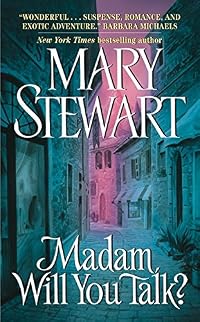
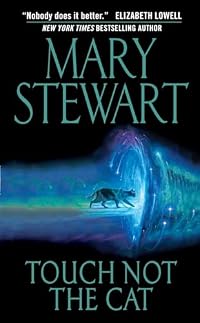
Mary Stewart was born on September 17, 1916 in Sunderland, County Durham, England. She received a First Class Honours B.A. in English from Durham University in 1938 and a teaching certificate in 1939. She taught in elementary school until 1941 when she was offered a post at Durham University. She taught there until 1945 and received a M.A. in show more English during that time. Her first book, Madam, Will You Talk?, was published in 1955. Her other works included My Brother Michael, Touch Not the Cat, This Rough Magic, Nine Coaches Waiting, Thornyhold, Rose Cottage, and the Merlin Trilogy. She also wrote children's books including Ludo and the Star Horse and A Walk in Wolf Wood. She died on May 9, 2014 at the age of 97. (Bowker Author Biography) show less
Some Editions
Awards and Honors
Distinctions
Series
Belongs to Publisher Series
Work Relationships
Is contained in
The moonspinners ; Nine coaches waiting ; The ivy tree ; Madam, will you talk? [omnibus] by Mary Stewart
Common Knowledge
- Canonical title
- The Moon-Spinners
- Original publication date
- 1962
- People/Characters
- Nicola "Nicky" Ferris; Frances Scorby; Mark Langley; Colin Langley; Lambis
- Important places
- Crete, Greece; Greece
- Related movies
- The Moon-Spinners (1964 | IMDb)
- Epigraph
- Lightly this little herald flew aloft...,
Onward it flies...
Until it reach'd a splashing fountain's side
That, near a cavern's mouth, for ever pour'd
Unto the temperat air...
Keats: Endymion - Dedication
- For Kitty and Gerald Rainbow
- First words
- It was the egret, flying out of the lemon grove, that started it.
- Quotations
- The author is indebted to Mr. A. E. Gunther for permission to quote from his father's edition of THE GREEK HERBAL OF DIOSCORIDES.
- Last words
- (Click to show. Warning: May contain spoilers.)"...Nell, Nicola, so this is your Mark?"
"Why, yes," I said. - Original language
- English
- Disambiguation notice
- Do not combine with the movie.
Classifications
Statistics
- Members
- 1,644
- Popularity
- 13,550
- Reviews
- 33
- Rating
- (3.93)
- Languages
- 6 — Dutch, English, French, German, Spanish, Swedish
- Media
- Paper, Audiobook, Ebook
- ISBNs
- 34
- ASINs
- 30