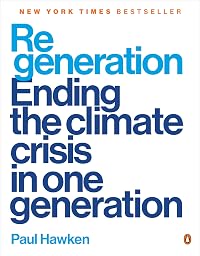
Regeneration: Ending the Climate Crisis in One Generation
by Paul Hawken
On This Page
Description
"Regeneration is a response to the urgency of the climate crisis, a what-to-do manual for all levels of society, from individuals to national governments and everything and everyone in between. This four-color illustrated work describes a system of interlocking initiatives that aim to stem the climate crisis in one generation"--Tags
Recommendations











































Member Reviews
This book is part sequel and part update to the author's previous work Drawdown: The Most Comprehensive Plan Ever Proposed to Reverse Global Warming. Although it's more recent and hence a bit more up to date on recent facts, figures, and the current state of technologies, politics, and society (e.g. the Covid-19 pandemic), it isn't nearly as good. It retains the main drawback of Drawdown, rather than a cohesive and consistent narrative, it's a loosely organised mishmash collection of contributions by different authors, which vary wildly in both tone and quality.
But the biggest problem is that all of the numbers and specifics and details have stripped out [a few a relegated to an appendix]. Where Drawdown provided a pretty clear plan show more for combatting global warming, this book takes a more humanistic and animistic approach, more appropriate to a spiritual or religious text than a scientific, political, or technological one. Only about a third of the content actually deals with climate change, the rest is a rehash of traditional environmentalist (updated for the 21st century with a renewed emphasis on indigenous knowledge) and marginally related social justice causes such as universal healthcare.
The focus away from hard facts and numbers has also lead to a lot of contradictory ideas, spurious logic, and leaps of faith. For instance, the forest fires in the American West are blamed on poor forest management policies, and contrasted to those of the indigenous population. Only several pages later is it revealed that the modern approach is 200x as productive, and supports a population thousands of times larger than would be supported if we reverted to the traditional ways. Similarly, we are urged to switch to electric vehicles to eliminate the carbon emissions not only from internal combustion engines, but also from the associated infrastructure such as the steel used to construct gas stations. As if the doubling of the electrical grid and installation of thousands of charging stations would be an entirely carbon-free endeavor. While I agree that the net benefit likely outweighs the negatives, to present it without any supporting calculations is irresponsible. Especially given that the very next chapter addresses the challenges of enhancing the electrical grid to meet the increased demand.
In a way I can't fault the author for trying. Serious solutions with plans of action and specific targets have been largely ignored. So maybe resorting to waxing poetic about majestic chestnut trees and orphaned meerkats is the way to spur action. But given the current political and social climate, it seems too preachy, and preaching to the choir at that. Don't get me wrong, I wholeheartedly agree with 90% of the book's content and ideas, I just don't think it will help convince anyone who isn't already on board. show less
But the biggest problem is that all of the numbers and specifics and details have stripped out [a few a relegated to an appendix]. Where Drawdown provided a pretty clear plan show more for combatting global warming, this book takes a more humanistic and animistic approach, more appropriate to a spiritual or religious text than a scientific, political, or technological one. Only about a third of the content actually deals with climate change, the rest is a rehash of traditional environmentalist (updated for the 21st century with a renewed emphasis on indigenous knowledge) and marginally related social justice causes such as universal healthcare.
The focus away from hard facts and numbers has also lead to a lot of contradictory ideas, spurious logic, and leaps of faith. For instance, the forest fires in the American West are blamed on poor forest management policies, and contrasted to those of the indigenous population. Only several pages later is it revealed that the modern approach is 200x as productive, and supports a population thousands of times larger than would be supported if we reverted to the traditional ways. Similarly, we are urged to switch to electric vehicles to eliminate the carbon emissions not only from internal combustion engines, but also from the associated infrastructure such as the steel used to construct gas stations. As if the doubling of the electrical grid and installation of thousands of charging stations would be an entirely carbon-free endeavor. While I agree that the net benefit likely outweighs the negatives, to present it without any supporting calculations is irresponsible. Especially given that the very next chapter addresses the challenges of enhancing the electrical grid to meet the increased demand.
In a way I can't fault the author for trying. Serious solutions with plans of action and specific targets have been largely ignored. So maybe resorting to waxing poetic about majestic chestnut trees and orphaned meerkats is the way to spur action. But given the current political and social climate, it seems too preachy, and preaching to the choir at that. Don't get me wrong, I wholeheartedly agree with 90% of the book's content and ideas, I just don't think it will help convince anyone who isn't already on board. show less
This is far and away one of the best works of climate activism I've ever read. The book is expansive, demonstrating the diverse and many avenues we have to combat climate change from all sides. Mainstream media harps so often on the same means of becoming carbon neutral, like electric cars and wind turbines. Hawken's collection obviously includes and contextualizes these popular solutions, but emphasizes every time that one cannot wipe their hands after buying a Tesla and recycling. Precluding the worst of climate change requires redefining our way of life. The book feels like optimistic realism: you can see the solutions are not idyllic and radical. Hawken consistently makes an appeal to the importance of stability for regular people, show more and adduces the ways these solutions flow with our everyday lives.
My only reservation with this book is simply the lack of footnotes. For a book so full of data and statistics, examples of companies the world over researching and working against climate change, there are no footnotes to back any of them up. When you look them up, of course, the data are real and verifiable, but it would be nice to have that index of sources and resources. show less
My only reservation with this book is simply the lack of footnotes. For a book so full of data and statistics, examples of companies the world over researching and working against climate change, there are no footnotes to back any of them up. When you look them up, of course, the data are real and verifiable, but it would be nice to have that index of sources and resources. show less
Ratings
Members
- Recently Added By
Lists

Climate Change
50 works; 1 member

Books Read in 2023
5,638 works; 147 members
Author Information

18+ Works 4,377 Members
Common Knowledge
- Original publication date
- 2021
- First words
- Regeneration means putting life at the center of every action and decision.
- Last words
- (Click to show. Warning: May contain spoilers.)It's the same principle we use with our children—we invest love and attention in them so they can go forward and do good work in their lives.
- Original language*
- Engels
*Some information comes from Common Knowledge in other languages. Click "Edit" for more information.
Classifications
- Genres
- Science & Nature, Nonfiction
- DDC/MDS
- 363.738 — Society, government, & culture Social problems and social services Public Safety - Police, Crime Investigation Environmental Issues - Pollution, Recycling, Global Warming Pollution Pollutants by source
- LCC
- QC981.8 .G56 .H38 — Science Physics Physics Meteorology. Climatology Climatology and weather
- BISAC
Statistics
- Members
- 130
- Popularity
- 251,932
- Reviews
- 2
- Rating
- (3.95)
- Languages
- Dutch, English
- Media
- Paper, Ebook
- ISBNs
- 6
- ASINs
- 1