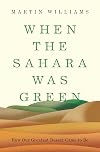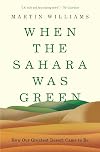
When the Sahara Was Green: How Our Greatest Desert Came to Be
by Martin Williams
On This Page
Description
"The Sahara is the largest hot desert in the world, equal in size to China or the United States. Yet, this arid expanse was once a verdant, pleasant, fertile land, fed by rivers and lakes. The Sahara sustained abundant plant and animal life, such as Nile perch, turtles, crocodiles, and hippos, and attracted prehistoric hunters and herders. What transformed this land of lakes into a sea of sands? When the Sahara Was Green describes the remarkable history of Earth's greatest desert-including show more why its climate changed, the impact this had on human populations, and how scientists uncovered the evidence for these extraordinary events. From the Sahara's origins as savanna woodland and grassland to its current arid incarnation, Martin Williams takes us on a vivid journey through time. He describes how the desert's ancient rocks were first fashioned, how dinosaurs roamed freely across the land, and how it was later covered in tall trees. Along the way, Williams addresses many questions: Why was the Sahara previously much wetter, and will it be so again? Did humans contribute to its desertification? What was the impact of extreme climatic episodes-such as prolonged droughts-upon the Sahara's geology, ecology, and inhabitants? Williams also shows how plants, animals, and humans have adapted to the Sahara and what lessons we might learn for living in harmony with the harshest, driest conditions in an ever-changing global environment. A valuable look at how an iconic region has changed over millions of years, When the Sahara Was Green reveals the desert's surprising past to reflect on its present, as well as its possible future"-- show lessTags
Recommendations






























Member Reviews
The title of this book was so intriguing that I felt compelled to read it. The book was fascinating despite it's "dry" subject matter (pun could not be resisted). Martin Williams has done extensive research across the Sahara for decades and uses his experiences to provide a detailed history of the Sahara in a form suitable for the general reader. The book contains an abundance of photographs, maps and diagrams to illustrate each topic. Unfortunately, these are not so easily examined on a KIndle so a hardcover version of the book might be better for readers.
Topics dealt with in the book include:
- Archaeological and geological evidence of the Sahara's history including animal, plant and human prehistoric remains from a time when the show more Sahara was green.
- Explanations of the different and diverse landscapes within the Sahara.
- Answers to the question about where all the sand came from
- A discussion of Sahara dust and it's impact around the world
- An explanation of the impact of ocean currents on the moisture received by the Sahara
- A discussion about how animals, plants, and humans have adapted to the desertification of the Sahara
- A refutation of arguments blaming humans alone for the desertification of the Sahara
The book is highly recommended for anyone interested in environmental history or prehistory. show less
Topics dealt with in the book include:
- Archaeological and geological evidence of the Sahara's history including animal, plant and human prehistoric remains from a time when the show more Sahara was green.
- Explanations of the different and diverse landscapes within the Sahara.
- Answers to the question about where all the sand came from
- A discussion of Sahara dust and it's impact around the world
- An explanation of the impact of ocean currents on the moisture received by the Sahara
- A discussion about how animals, plants, and humans have adapted to the desertification of the Sahara
- A refutation of arguments blaming humans alone for the desertification of the Sahara
The book is highly recommended for anyone interested in environmental history or prehistory. show less
Ratings
Members
- Recently Added By
Author Information

5 Works 64 Members
Awards and Honors
Awards
Common Knowledge
- Important places
- Sahara
Classifications
- Genres
- Science & Nature, Nonfiction, General Nonfiction, History
- DDC/MDS
- 551.4150966 — Natural sciences & mathematics Earth sciences; geology Geology, Hydrology Meteorology Landforms / Bodies of Water Continents
- LCC
- GB618.88 .S23 .W55 — Geography, Anthropology and Recreation Physical geography Physical geography Geomorphology. Landforms. Terrain Other natural landforms: Floodplains, caves,
- BISAC
Statistics
- Members
- 52
- Popularity
- 585,051
- Reviews
- 1
- Rating
- (4.25)
- Languages
- English
- Media
- Paper, Audiobook, Ebook
- ISBNs
- 4