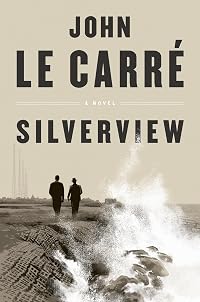
Silverview
by John le Carré
On This Page
Description
"In Silverview, John le Carré turns his focus to the world that occupied his writing for the past sixty years-the secret world itself. Julian Lawndsley has renounced his high-flying job in the city for a simpler life running a bookshop in a small English seaside town. But only a couple of months into his new career, Julian's evening is disrupted by a visitor. Edward, a Polish émigré living in Silverview, the big house on the edge of town, seems to know a lot about Julian's family and is show more rather too interested in the inner workings of his modest new enterprise. When a letter turns up at the door of a spy chief in London warning him of a dangerous leak, the investigations lead him to this quiet town by the sea . . . Silverview is the mesmerizing story of an encounter between innocence and experience and between public duty and private morals. In his inimitable voice John le Carré, the greatest chronicler of our age, seeks to answer the question of what we truly owe to the people we love"-- show lessTags
Recommendations








Member Reviews
Those of us who followed John LeCarré’s remarkable career as a chronicler of global politics in the form of sophisticated espionage stories until his death last year felt a pang of sadness mixed with excitement to learn a final posthumous novel was to be published. Its manuscript had been languishing in a drawer, a story the author couldn’t quite finish tinkering with, unwilling to bring it to the public. According to an afterword by his son, it was drafted after A DELICATE TRUTH (published in 2013). He had promised his father he would finish any manuscript that was incomplete on his death, but to his surprise the draft of SILVERVIEW was essentially complete. Why didn’t LeCarré publish it during his lifetime? His son speculates show more that it cut a little too close to the bone, depicting a service that had entirely lost its way.
It’s quite a short book, though it offers the usual cast of eccentric characters, elliptical plotting that involves plenty of double-crosses and moral morasses, and a jaundiced view of the role espionage plays in contemporary geopolitical power struggles. It even includes wives who, like Smiley’s enigmatic Ann, are both unfaithful and cold-hearted. Perhaps marriage was a metaphor for him of betrayal in the face of an incurable romantic streak. It’s not very fair on the women characters, though.
The story focuses on Julian Lawndsley, a burned-out financier who has retired to the countryside to open a bookshop though he knows very little about books, and Edward Avon, a Polish émigré who sweeps in and befriends him in an extravagant way. We know that Edward is married to a wealthy former spy who is now dying of cancer in her mansion, Silverview. We also know they have a prickly daughter who, in the opening scene, crossly delivers a letter from her mother to an official in London. To a large extent her irritation is with having to live a hidden life among spies.
Edward Avon previously worked through a local bric-a-brac shop to sell off a valuable collection of Chinese porcelain. Now he proposes to launch a “Republic of Books” at Julian’s shop, providing lists of classic works and boundless energy. Though he wonders if he’s being conned, Julian becomes enthusiastic. Then Edward asks Julian to take a letter to a mysterious woman in London, all while intelligence officials maneuver in the background, delving into Edward’s past. Clearly there are things afoot that Julian cannot see.
SILVERVIEW is not top-notch LeCarré; compared to immediate predecessors it’s a minor work, but it fits in the trajectory of his late career dissection of the unheroic role British intelligence services play in post-cold war politics. As one career spook thinks to himself, “the very idea of a consuming passion bewildered him – let alone allowing one’s life to be conducted by it. Absolute commitment of any sort constituted to his trained mind a grave security threat.” Despite the author’s son’s belief this slight novel was too cynical for his father to publish he does, in the end, allow one character a chance to act purely on principle. show less
It’s quite a short book, though it offers the usual cast of eccentric characters, elliptical plotting that involves plenty of double-crosses and moral morasses, and a jaundiced view of the role espionage plays in contemporary geopolitical power struggles. It even includes wives who, like Smiley’s enigmatic Ann, are both unfaithful and cold-hearted. Perhaps marriage was a metaphor for him of betrayal in the face of an incurable romantic streak. It’s not very fair on the women characters, though.
The story focuses on Julian Lawndsley, a burned-out financier who has retired to the countryside to open a bookshop though he knows very little about books, and Edward Avon, a Polish émigré who sweeps in and befriends him in an extravagant way. We know that Edward is married to a wealthy former spy who is now dying of cancer in her mansion, Silverview. We also know they have a prickly daughter who, in the opening scene, crossly delivers a letter from her mother to an official in London. To a large extent her irritation is with having to live a hidden life among spies.
Edward Avon previously worked through a local bric-a-brac shop to sell off a valuable collection of Chinese porcelain. Now he proposes to launch a “Republic of Books” at Julian’s shop, providing lists of classic works and boundless energy. Though he wonders if he’s being conned, Julian becomes enthusiastic. Then Edward asks Julian to take a letter to a mysterious woman in London, all while intelligence officials maneuver in the background, delving into Edward’s past. Clearly there are things afoot that Julian cannot see.
SILVERVIEW is not top-notch LeCarré; compared to immediate predecessors it’s a minor work, but it fits in the trajectory of his late career dissection of the unheroic role British intelligence services play in post-cold war politics. As one career spook thinks to himself, “the very idea of a consuming passion bewildered him – let alone allowing one’s life to be conducted by it. Absolute commitment of any sort constituted to his trained mind a grave security threat.” Despite the author’s son’s belief this slight novel was too cynical for his father to publish he does, in the end, allow one character a chance to act purely on principle. show less
John Le Carré’s last novel, does not disappoint. It gives the same, practical insight into the British intelligence world his readers will be familiar with from his earlier books. He shows the life of an organisation, not only doing the job it was created to do, but also concerned about how things look and who is going to be the fall-guy if anything goes wrong, and worried about its position vis-à-vis inter-agency rivalry and blame culture.
There is also an appropriateness about the subject matter of the story given the stage in John Le Carré’s writing career it was written. His novels have always reflected the geo-political environment of their time, and his characters have been shown practising their craft, mostly in mid-career. show more In “A Legacy of Spies” we saw a retrospective of past exploits from the viewpoint of retired service officers. In “Silverview” we are shown what happens in the life of a former agent once retired. “Silvervew” gives us a glimpse at the reality of the-happy-ever-after for an agent once they are no longer of use to the agency.
As always, Le Carré brings human motivation to the surface, and demonstrates the wilful blindness of organisations that can sometimes let errors of judgement slip through to cause cracks in what appears to be a totally watertight operation. He describes a situation where an organisation’s failure to care for its members’ wellbeing, and to take cognizance of an agent’s mental state, can lead to aberrant behaviour, a trait common to many organisations in every sector.
Never one to shy away from highlighting his views on the political leadership of the countries concerned, he describes the internal questioning of an intelligence agency that is serving a country ruled by a government with no coherent foreign policy, a government that is focused on its own internal political power rather than its relationship with the rest of the world.
This is an excellent read. show less
There is also an appropriateness about the subject matter of the story given the stage in John Le Carré’s writing career it was written. His novels have always reflected the geo-political environment of their time, and his characters have been shown practising their craft, mostly in mid-career. show more In “A Legacy of Spies” we saw a retrospective of past exploits from the viewpoint of retired service officers. In “Silverview” we are shown what happens in the life of a former agent once retired. “Silvervew” gives us a glimpse at the reality of the-happy-ever-after for an agent once they are no longer of use to the agency.
As always, Le Carré brings human motivation to the surface, and demonstrates the wilful blindness of organisations that can sometimes let errors of judgement slip through to cause cracks in what appears to be a totally watertight operation. He describes a situation where an organisation’s failure to care for its members’ wellbeing, and to take cognizance of an agent’s mental state, can lead to aberrant behaviour, a trait common to many organisations in every sector.
Never one to shy away from highlighting his views on the political leadership of the countries concerned, he describes the internal questioning of an intelligence agency that is serving a country ruled by a government with no coherent foreign policy, a government that is focused on its own internal political power rather than its relationship with the rest of the world.
This is an excellent read. show less
vintage John le Carre, his last (complete) spy thriller published after his demise. From page one onwards one wallows in the hands of a crafty narrator, revealing layer upon layer of backstory, leading you by the hand into the dark and murky world of spy craft, faith and betrayal.
Le Carre applies his trademark story-telling skills, starting with a retired day trader from the City, who settles to a life as a bookseller in a quiet seaside village in East Anglia. In walks a respectable Polish gentleman spy who charms his way into young Julian’s life with old-fashioned manners of speech and quiet reassurance. The Republic of Letters is born, a joint classic book collection and selling project, which incidentally also aids our Polish spy, show more Edward Avon, to communicate with his network. Which network? That only becomes clear much, much later.
Julian becomes an innocent pawn in one of those historic leaks in British Intelligence. Once the leak has been discovered, the chase is on, with Stewart Proctor, a typical restrained upper class spymaster burrowing backwards into the life of one his first and most valuable Joes, the very Edward Avon (aka Florian) of the classic collection of Ming vases and recently of literary treasures. The backstory touches upon Florian’s Polish Nazi father, his strong anti-fascist and anti-Imperialist idealism, which is turned on its head once he spends a year in Gdansk, when he perceives communism to be a form of advanced connery and starts spying for the British. After the fall of the wall his spy career seems over, until his past stint as a teacher in Croatia and his knowledge of languages, proves useful during the Bosnian war. Here he finds a new cause, which leads him astray from the British, though he is married to an English lady spy, head of the Middle East desk, and settles for a sedate life in a manor (Silverview) at the edge of the village of our new bookseller. And there we go.
The only pity is the briefness of this last Le Carre – in fact the story is quite thin, with no real tradecraft in action. show less
Le Carre applies his trademark story-telling skills, starting with a retired day trader from the City, who settles to a life as a bookseller in a quiet seaside village in East Anglia. In walks a respectable Polish gentleman spy who charms his way into young Julian’s life with old-fashioned manners of speech and quiet reassurance. The Republic of Letters is born, a joint classic book collection and selling project, which incidentally also aids our Polish spy, show more Edward Avon, to communicate with his network. Which network? That only becomes clear much, much later.
Julian becomes an innocent pawn in one of those historic leaks in British Intelligence. Once the leak has been discovered, the chase is on, with Stewart Proctor, a typical restrained upper class spymaster burrowing backwards into the life of one his first and most valuable Joes, the very Edward Avon (aka Florian) of the classic collection of Ming vases and recently of literary treasures. The backstory touches upon Florian’s Polish Nazi father, his strong anti-fascist and anti-Imperialist idealism, which is turned on its head once he spends a year in Gdansk, when he perceives communism to be a form of advanced connery and starts spying for the British. After the fall of the wall his spy career seems over, until his past stint as a teacher in Croatia and his knowledge of languages, proves useful during the Bosnian war. Here he finds a new cause, which leads him astray from the British, though he is married to an English lady spy, head of the Middle East desk, and settles for a sedate life in a manor (Silverview) at the edge of the village of our new bookseller. And there we go.
The only pity is the briefness of this last Le Carre – in fact the story is quite thin, with no real tradecraft in action. show less
Years ago, I never missed a new John le Carré book, but in more recent times, I haven’t been between the covers of any of his books. When the press started up about his 26th book, Silverview, his last novel completed in the ten years before his death, December of 2020, I noticed it. But it wasn’t until I learned that it was somehow centered around a small British bookshop, that I became quite curious. The existence of this review reveals the final level of my curiosity.
We are told that his character, Julian Lawndsley, had been a very successful trader in London before he became a bookseller in a small English town on the coast. As he said, “I have forsaken the glitter of gold for the scent of old paper.” Shortly after his show more change of location and lifestyle, a man named Edward Avon walks into Lawndsley’s bookshop, and after browsing, casually offered him some advice and a possible investment. He’s a Polish émigré, a retired academic, an old colleague of Julian’s father. In time, he supplies plenty of curious banter, a computer, and some assistance in developing a certain section, to be called the Republic of Literature, which would feature the classics of the great thinkers and authors. Along the way, he asks for a few small favors of Julian, delivering a package to Edward’s mother, and to use the computer he supplied the shop.
Things began to change, and soon Julian learns that his new friend and investor was a former member of M16, Britain’s foreign intelligence service. He also learns that Edward loves two women, one a longtime mistress, and his wife Deborah, who is nearing death from cancer.
After watching my own wife suffer and succumb to cancer, John le Carré impressed me with the following line. “Edward has, as might any man whose wife is dying: the gaze is more inward, the jaw is crisper and the more determined for it, the flowing white hair more disciplined.” When Deborah’s time seems to be running out, le Carré wrote something that again was sadly very familiar to me. “But it could be any day. She knows that, and she doesn’t like pity. She speaks what she thinks and she thinks a lot, so anything can happen, okay?” Soon she is in a morphine-assisted coma and, “Around midnight her doctor certified life extinct.”
How the reader connects with a book can be very personal, and Silverview reached out to me in several ways that were non-crucial to the plot, but drew this particular reader close. Having owned a bookshop that moved and reestablished itself in four new locations, the following line about Julian struck home. “After six weeks of running a stagnant business, he has become quite the connoisseur of people who stare at the shop and don’t come in, and they are beginning to get on his nerves.” While I’m talking about observations that felt so right, the following line brought a smile and sadness to me, a man who was lucky enough to be married to a beautiful woman with a fabulous mane of hair. “Ellen unpins her incomparable auburn hair and lets it cascade over her shoulders, as practiced by beautiful women since the beginning of time.”
“Meanwhile, Edward is being investigated by the service’s head of domestic security, Stewart Proctor.” And with that le Carré adds another major layer to the story, which is what I always loved about his books. It doesn’t take long before Proctor seems to be on a collision course with Edward, and our shopkeeper Julian is caught in the middle of it all.
When things suddenly don’t go as planned, and Edward isn’t where he was expected to be, Proctor sends out his entire team of watchers to scour the area for him. The most important of their instructions is that if they find Edward, “they should restrain him, employing minimal force, but in no circumstances hand him over to the police or anyone else until Proctor has had an opportunity to talk to him.” The old spies are portrayed as decent people who, at the end of their lives, realize their life’s work has accomplished nothing. The book’s last surprise is from Julian’s daughter Lily, who has had a larger role than either the reader or her father knew of.
In a number of reviews people have wondered aloud if because of the brevity of the book, and its sudden ending, if the author had actually finished the manuscript. The New York Times was more generous than I when they said: “And if ‘Silverview’ feels less than fully executed, its sense of moral ambivalence remains exquisitely calibrated. Besides, novelists of le Carré’s stature are not diminished by their lesser efforts.” The Guardian said it like this, “If we’re left dangling by the end, there’s an added tease of sorts in the novel’s billing as le Carré’s “last complete masterwork” – on the strong side, no doubt, but a tag that nonetheless holds out the prospect of rougher treasures still awaiting the light.” I wasn’t feeling satisfied by the way the book wrapped up, and I was also feeling like I was missing something all along. Had my long absence from his writing created an expectation for more than had ever really been there before, or was I not remembering things accurately. Just maybe I need to reach back to a favorite le Carré.
But the story continues in a way in the book’s afterword, which is written by the author’s youngest son, Nick Cornwell. Nick is also a writer, one who writes under the name Nick Harkway. He tells of a promise that he made to his dad about taking this completed manuscript through to publication. “I read it, and my bewilderment deepened. It was fearsomely good.” It was with great relief that he found his father’s book only in need of some minor editing, prompting him to ask, “What, exactly, was I supposed to fix? Should I put eyebrows on this Mona Lisa?”
Nick writes about how his dad was, as always, striving to tell a good story and to tell the truth. Nick continues about his father’s legacy. “But Silverview does something that no other le Carré novel ever has. It shows a service fragmented: filled with its own political factions.” And he adds: “In Silverview, the spies of Britain have, like many of us, lost their certainty about what the country means, and who we are to ourselves.”
I have purposely not given many details of the book’s plot, (go on, buy a book), but overall, it’s a simpler book than many of his previous. As with any spy novel, we are always left with judging how much are we to believe? What do we know for sure? show less
We are told that his character, Julian Lawndsley, had been a very successful trader in London before he became a bookseller in a small English town on the coast. As he said, “I have forsaken the glitter of gold for the scent of old paper.” Shortly after his show more change of location and lifestyle, a man named Edward Avon walks into Lawndsley’s bookshop, and after browsing, casually offered him some advice and a possible investment. He’s a Polish émigré, a retired academic, an old colleague of Julian’s father. In time, he supplies plenty of curious banter, a computer, and some assistance in developing a certain section, to be called the Republic of Literature, which would feature the classics of the great thinkers and authors. Along the way, he asks for a few small favors of Julian, delivering a package to Edward’s mother, and to use the computer he supplied the shop.
Things began to change, and soon Julian learns that his new friend and investor was a former member of M16, Britain’s foreign intelligence service. He also learns that Edward loves two women, one a longtime mistress, and his wife Deborah, who is nearing death from cancer.
After watching my own wife suffer and succumb to cancer, John le Carré impressed me with the following line. “Edward has, as might any man whose wife is dying: the gaze is more inward, the jaw is crisper and the more determined for it, the flowing white hair more disciplined.” When Deborah’s time seems to be running out, le Carré wrote something that again was sadly very familiar to me. “But it could be any day. She knows that, and she doesn’t like pity. She speaks what she thinks and she thinks a lot, so anything can happen, okay?” Soon she is in a morphine-assisted coma and, “Around midnight her doctor certified life extinct.”
How the reader connects with a book can be very personal, and Silverview reached out to me in several ways that were non-crucial to the plot, but drew this particular reader close. Having owned a bookshop that moved and reestablished itself in four new locations, the following line about Julian struck home. “After six weeks of running a stagnant business, he has become quite the connoisseur of people who stare at the shop and don’t come in, and they are beginning to get on his nerves.” While I’m talking about observations that felt so right, the following line brought a smile and sadness to me, a man who was lucky enough to be married to a beautiful woman with a fabulous mane of hair. “Ellen unpins her incomparable auburn hair and lets it cascade over her shoulders, as practiced by beautiful women since the beginning of time.”
“Meanwhile, Edward is being investigated by the service’s head of domestic security, Stewart Proctor.” And with that le Carré adds another major layer to the story, which is what I always loved about his books. It doesn’t take long before Proctor seems to be on a collision course with Edward, and our shopkeeper Julian is caught in the middle of it all.
When things suddenly don’t go as planned, and Edward isn’t where he was expected to be, Proctor sends out his entire team of watchers to scour the area for him. The most important of their instructions is that if they find Edward, “they should restrain him, employing minimal force, but in no circumstances hand him over to the police or anyone else until Proctor has had an opportunity to talk to him.” The old spies are portrayed as decent people who, at the end of their lives, realize their life’s work has accomplished nothing. The book’s last surprise is from Julian’s daughter Lily, who has had a larger role than either the reader or her father knew of.
In a number of reviews people have wondered aloud if because of the brevity of the book, and its sudden ending, if the author had actually finished the manuscript. The New York Times was more generous than I when they said: “And if ‘Silverview’ feels less than fully executed, its sense of moral ambivalence remains exquisitely calibrated. Besides, novelists of le Carré’s stature are not diminished by their lesser efforts.” The Guardian said it like this, “If we’re left dangling by the end, there’s an added tease of sorts in the novel’s billing as le Carré’s “last complete masterwork” – on the strong side, no doubt, but a tag that nonetheless holds out the prospect of rougher treasures still awaiting the light.” I wasn’t feeling satisfied by the way the book wrapped up, and I was also feeling like I was missing something all along. Had my long absence from his writing created an expectation for more than had ever really been there before, or was I not remembering things accurately. Just maybe I need to reach back to a favorite le Carré.
But the story continues in a way in the book’s afterword, which is written by the author’s youngest son, Nick Cornwell. Nick is also a writer, one who writes under the name Nick Harkway. He tells of a promise that he made to his dad about taking this completed manuscript through to publication. “I read it, and my bewilderment deepened. It was fearsomely good.” It was with great relief that he found his father’s book only in need of some minor editing, prompting him to ask, “What, exactly, was I supposed to fix? Should I put eyebrows on this Mona Lisa?”
Nick writes about how his dad was, as always, striving to tell a good story and to tell the truth. Nick continues about his father’s legacy. “But Silverview does something that no other le Carré novel ever has. It shows a service fragmented: filled with its own political factions.” And he adds: “In Silverview, the spies of Britain have, like many of us, lost their certainty about what the country means, and who we are to ourselves.”
I have purposely not given many details of the book’s plot, (go on, buy a book), but overall, it’s a simpler book than many of his previous. As with any spy novel, we are always left with judging how much are we to believe? What do we know for sure? show less
I've been reading John Le Carre for probably forty years now, beginning way back with THE SPY WHO CAME IN FROM THE COLD, then zig-zagging through at least half a dozen more of his many works, so I thoroughly enjoyed SILVERVIEW, albeit with an undertone of sadness, knowing this would be his last. He died last year at 89. This last manuscript was rescued from a desk drawer by Le Carre's son, Nick Cornwell, who I assume proofread and polished it some, but not much, because the book reads like vintage Le Carre, who is the acknowledged master of the literary spy novel. (The one glaring error Nick missed, unless it was just a typo, was the line that read: "Top brass from Langley, NASA, Defence and the White House brigade." Anyone who knows show more anything about the intelligence community knows that shou!d have been NSA, not NASA.)
Indeed, the author's son tells us, in his Afterword, that the novel was very much a finished product, and feels his father was only hesitant to publish it because of its implications that Le Carre's beloved Secret Service had lost its way in recent years. This can be seen in the musings of Proctor, a central character, as he wonders about Edward, a valuable agent who had turned and was on the run.
"Did Edward still love the Service despite its many blemishes? ... Did Edward see the Service as the problem rather than the solution? ... Did Edward fear that, in the absence of any coherent British foreign policy, the Service was getting too big for its boots?"
The characters here are all fascinating, if at times unfathomable. And, as the book is barely two hundred pages, they are perhaps not quite as fully developed as some of his more famous ones - Smiley's people. However, they all seem to work, because I kept on feverishly turning pages, wanting desperately to know what would happen next. Perhaps the author had more he wanted to add to the story, but his time ran out. And what is here is, in the end, sufficient - one hell of a good spy story in fact. There are a few "old hands," as well as a young city trader turned bookseller in a small town. A couple love stories, one old, one new. Some possible infidelity. It's all in here. Le Carre was still very much at the top of his game when he left us. RIP, Sir, and thank you for all of it. My highest recommendation.
- Tim Bazzett, author of the memoir, BOOKLOVER show less
Indeed, the author's son tells us, in his Afterword, that the novel was very much a finished product, and feels his father was only hesitant to publish it because of its implications that Le Carre's beloved Secret Service had lost its way in recent years. This can be seen in the musings of Proctor, a central character, as he wonders about Edward, a valuable agent who had turned and was on the run.
"Did Edward still love the Service despite its many blemishes? ... Did Edward see the Service as the problem rather than the solution? ... Did Edward fear that, in the absence of any coherent British foreign policy, the Service was getting too big for its boots?"
The characters here are all fascinating, if at times unfathomable. And, as the book is barely two hundred pages, they are perhaps not quite as fully developed as some of his more famous ones - Smiley's people. However, they all seem to work, because I kept on feverishly turning pages, wanting desperately to know what would happen next. Perhaps the author had more he wanted to add to the story, but his time ran out. And what is here is, in the end, sufficient - one hell of a good spy story in fact. There are a few "old hands," as well as a young city trader turned bookseller in a small town. A couple love stories, one old, one new. Some possible infidelity. It's all in here. Le Carre was still very much at the top of his game when he left us. RIP, Sir, and thank you for all of it. My highest recommendation.
- Tim Bazzett, author of the memoir, BOOKLOVER show less
I read a couple of the Smiley books many years ago. I had forgotten how enjoyable Le Carré's style is: complex sentences with well-ordered subordinate clauses, always clear, never boring. The characters are interesting and engaging, although sometimes you might want to give Julian a good shake. Le Carré presents the moral ambiguities of the decay of empire into multilateral chaos; what is a spy to do when the world turns upside down? So much simpler when the sun never set on the empire; no wonder Deborah wanted Kipling read at her traditional C of E funeral.
Julian Lawndsley hat seinen stressigen Job in London aufgegeben, um in einem kleinen englischen Küstenort eine Buchhandlung zu eröffnen, auch wenn er bislang nur wenig Erfahrung in diesem Bereich hat. Eines Abends kommt ein ungewöhnlicher Kunde in seinen Laden, der auf dem nahegelegenen Herrschaftssitz Silverview wohnt und sich als Jugendfreund von Julians Vater vorstellt. Mit Ratschlägen will er den Neubuchhändler unterstützen, der nicht sicher ist, was er von Edward Avon halten soll. Sein Vater hatte ihn nie erwähnt, aber er scheint bestens informiert über Julians Familie und da Edwards Frau schwerkrank ist, will er den älteren Herren auch nicht gleich der Lüge bezichtigen. Zur selben Zeit klingeln bei den Geheimdiensten show more alle Alarmglocken, eine undichte Stelle weist auf den kleinen Küstenort und setzt eine Maschinerie von Agenten in Gang.
„Silverview“ ist der letzte Roman des großen britischen Krimiautors, der selbst für die Geheimdienste gearbeitet hat und immer wieder sein Insiderwissen geschickt für seine Romane einsetzte. John le Carré bleibt auch in diesem Krimi dem Stil treu, den man von seinen letzten Geschichten kennt. Es ist nicht mehr der Agent in Action, der zwischen die Fronten gerät und selbst den eigenen Leuten nicht trauen kann, sondern eine komplexe Hintergrundgeschichte, die sich erst langsam enthüllt und vor allem von dem erzählerischen Geschickt des Autors lebt.
Julian ist offenkundig ein unschuldiger Zivilist, der die Bitten des älteren Herren nicht wirklich abschlagen kann und so in die Handlungen verstrickt wird, die er nicht mehr abschätzen oder gar stoppen kann. Dass er sich in Edwards Tochter verliebt, ist geradezu klassisch und geschieht dezent nebenbei. Man hat es mit distinguierten und höchst zivilisierten Menschen zu tun, deren kriminelles Potenzial woanders liegt.
Als geübter le Carré Leser weiß man, dass man den harmlosen Figuren genauso wenig trauen darf wie den offenkundig verdächtigen. Mit feinem Humor präsentiert der Brite dann auch eine Spionagegeschichte in Reinform, die sich vor aller Augen und doch im Verborgenen abspielt und aus dem netten, freundlichen Nachbarn plötzlich einen ganz großen Player im globalen Spiel der Mächte macht. All das geschieht ohne moderne Technik auf herrlich klassische Weise mit Briefen, die heimlich überbracht werden, und konspirativen Verabredungen an öffentlichen Orten.
Mit dem Roman taucht man ein wenig ab in eine längst vergangene Zeit und kann noch einmal einen großen Autor erleben. Und wieder einmal reißt dieser die großen Fragen auf, nämlich danach, wo letztlich die Loyalitäten liegen, wie weit Integrität geht und wo schlicht Menschlichkeit über strategische Überlegungen siegt. Vielleicht nicht der größte Roman le Carrés, aber auf jeden Fall ein würdiger Abschied. show less
„Silverview“ ist der letzte Roman des großen britischen Krimiautors, der selbst für die Geheimdienste gearbeitet hat und immer wieder sein Insiderwissen geschickt für seine Romane einsetzte. John le Carré bleibt auch in diesem Krimi dem Stil treu, den man von seinen letzten Geschichten kennt. Es ist nicht mehr der Agent in Action, der zwischen die Fronten gerät und selbst den eigenen Leuten nicht trauen kann, sondern eine komplexe Hintergrundgeschichte, die sich erst langsam enthüllt und vor allem von dem erzählerischen Geschickt des Autors lebt.
Julian ist offenkundig ein unschuldiger Zivilist, der die Bitten des älteren Herren nicht wirklich abschlagen kann und so in die Handlungen verstrickt wird, die er nicht mehr abschätzen oder gar stoppen kann. Dass er sich in Edwards Tochter verliebt, ist geradezu klassisch und geschieht dezent nebenbei. Man hat es mit distinguierten und höchst zivilisierten Menschen zu tun, deren kriminelles Potenzial woanders liegt.
Als geübter le Carré Leser weiß man, dass man den harmlosen Figuren genauso wenig trauen darf wie den offenkundig verdächtigen. Mit feinem Humor präsentiert der Brite dann auch eine Spionagegeschichte in Reinform, die sich vor aller Augen und doch im Verborgenen abspielt und aus dem netten, freundlichen Nachbarn plötzlich einen ganz großen Player im globalen Spiel der Mächte macht. All das geschieht ohne moderne Technik auf herrlich klassische Weise mit Briefen, die heimlich überbracht werden, und konspirativen Verabredungen an öffentlichen Orten.
Mit dem Roman taucht man ein wenig ab in eine längst vergangene Zeit und kann noch einmal einen großen Autor erleben. Und wieder einmal reißt dieser die großen Fragen auf, nämlich danach, wo letztlich die Loyalitäten liegen, wie weit Integrität geht und wo schlicht Menschlichkeit über strategische Überlegungen siegt. Vielleicht nicht der größte Roman le Carrés, aber auf jeden Fall ein würdiger Abschied. show less
Members
- Recently Added By
Published Reviews
ThingScore 88
While it's perhaps true that the posthumous publications of the recently deceased have a tendency to be more or less reviewer-proof, the good news is that Silverview, the 26th novel from John le Carré, who died last December, aged 89, offers plenty to enjoy and admire. Crisp prose, a precision-tooled plot, the heady sense of an inside track on a shadowy world... all his usual pleasures are show more here, although it can’t be ignored that they're aren’t always quite in sync. ...
Ultimately, Silverview unspools as a cat-and-mouse chase narrative, with the novel's dual perspective putting us in the control room, one step ahead of the characters, able to see the bigger picture, albeit heavily pixellated until the final pages. Such are the layers of irony that it's easy to forget that the sting in the tale was already delivered upfront, in an enigmatic opening shorn of vital context. Suffice to say that, in the typically male world of le Carré's fiction, the defining act this time turns on the vexed filial loyalty between a mother and daughter.
If we're left dangling by the end, there’s an added tease of sorts in the novel’s billing as le Carré's "last complete masterwork" – on the strong side, no doubt, but a tag that nonetheless holds out the prospect of rougher treasures still awaiting the light. show less
Ultimately, Silverview unspools as a cat-and-mouse chase narrative, with the novel's dual perspective putting us in the control room, one step ahead of the characters, able to see the bigger picture, albeit heavily pixellated until the final pages. Such are the layers of irony that it's easy to forget that the sting in the tale was already delivered upfront, in an enigmatic opening shorn of vital context. Suffice to say that, in the typically male world of le Carré's fiction, the defining act this time turns on the vexed filial loyalty between a mother and daughter.
If we're left dangling by the end, there’s an added tease of sorts in the novel’s billing as le Carré's "last complete masterwork" – on the strong side, no doubt, but a tag that nonetheless holds out the prospect of rougher treasures still awaiting the light. show less
added by Cynfelyn
First-rate prose and a fascinating plot distinguish the final novel from MWA Grand Master le Carré (1931–2020). Two months after leaving a banking job in London, 33-year-old Julian Lawndsley gets a visit from an eccentric customer, Edward Avon, just before closing time at the bookshop Julian now runs in East Anglia. When Julian asks the man what he does, he replies, “Let us say I am a show more British mongrel, retired, a former academic of no merit and one of life’s odd-job men.” The next morning, Julian runs into Edward at the local café, where Edward claims he knew Julian’s late father at Oxford. Julian later learns that Edward, a Polish emigré, was recruited into the Service years before. Julian senses something is off, as does the head of Domestic Security for the Service, who’s investigating Edward’s wife, an Arabist and outstanding Service intelligence analyst. While laying out the Avons’ intriguing backstories and their current activities, le Carré highlights the evils spies and governments have perpetrated on the world. Many readers will think the book is unfinished—it ends abruptly—but few will find it unsatisfying. This is a fitting coda to a remarkable career. show less
added by VivienneR
Lists

Best Spy Fiction
153 works; 102 members

Top Five Books of 2021
604 works; 181 members

Books recommended by Barack Obama
295 works; 28 members

Books Read in 2023
5,547 works; 145 members

Books Read in 2022
5,168 works; 114 members

Barak Obama's Summer Reads
14 works; 1 member

Barack Obama's Summer Reading List 2022
14 works; 2 members
Author Information

216+ Works 99,065 Members
David John Moore Cornwell was born in Poole, Dorsetshire, England in 1931. He attended Bern University in Switzerland from 1948-49 and later completed a B.A. at Lincoln College, Oxford. He taught at Eton from 1956-58 and was a member of the British Foreign Service from 1959 to 1964. He writes espionage thrillers under the pseudonym John le Carré. show more The pseudonym was necessary when he began writing, in the early 1960s because, at that time, he held a diplomatic position with the British Foreign Office and was not allowed to publish under his own name. When his third book, The Spy Who Came in from the Cold, became a worldwide bestseller in 1964, he left the foreign service to write full time. His other works include Call for the Dead; A Murder of Quality; Tinker, Tailor, Soldier, Spy; The Honourable Schoolboy; and Smiley's People. He has received numerous awards for his writing, including the Grand Master Award from the Mystery Writers of America in 1986 and the Diamond Dagger from the Crime Writers Association in 1988. In 2011 he accepted the Goethe Medal. And in 2020, he accepted the Olof Palme Prize. Ten of his books have been adapted for television and motion pictures including The Spy Who Came in from the Cold, The Russia House, The Constant Gardener, A Most Wanted Man, and Our Kind of Traitor. Le Carré's memoir, The Pigeon Tunnel: Stories from my Life, became a New York Times bestseller in 2016. In 2019, he published a spy thriller, Agent Running in the Field. John Le Carré died on December 12, 2020 from pneumonia at the age of 89. (Bowker Author Biography) John le Carre was born in 1931. After attending the univesities of Berne and Oxford, he spent five years in the British Foreign Service. He's the author of eighteen novels, translated into twenty-five languages. He lives in England. (Publisher Provided) show less
Some Editions
Awards and Honors
Distinctions
Notable Lists
Common Knowledge
- Canonical title
- Silverview
- Original publication date
- 2021
- People/Characters
- Julian Lawndsley; Edward Avon; Stewart Proctor; Lily Avon; Deborah Avon
- Important places
- Bosnia
- First words
- At ten o'clock of a rainswept morning in London's West End, a young woman in a baggy anorak, a woollen scarf pulled up around her head, strode resolutely into the storm that was roaring down South Audley Street.
- Last words
- (Click to show. Warning: May contain spoilers.)'And that's the last secret I'll keep from you.'
- Original language
- English
Classifications
Statistics
- Members
- 1,425
- Popularity
- 16,559
- Reviews
- 55
- Rating
- (3.68)
- Languages
- 13 — Catalan, Danish, Dutch, English, Finnish, French, German, Greek, Italian, Polish, Portuguese, Spanish, Swedish
- Media
- Paper, Audiobook, Ebook
- ISBNs
- 42
- ASINs
- 14