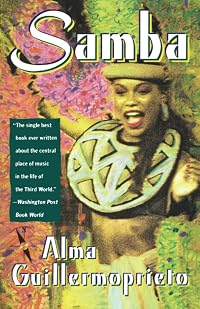
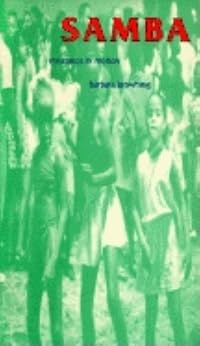
Samba
by Alma Guillermoprieto
On This Page
Description
For one year, Alma Guillermoprieto lived in Manguiera, a village near Rio de Janeiro, to learn the ritual of samba--the sensuous song and dance marked by a rapturous beat--and to take part in Rio's renowned carnivale parade.Tags
Recommendations
























Member Recommendations

Member Reviews
Alma Guillermoprieto is a journalist specialising in Latin America (she's originally Mexican but now US-based). This book is an account of preparations for the Rio Carnival in 1988, by one of the 'samba schools' - loose organisations which compete with each other during the Carnival, each with a parade complete with elaborate floats, costumes, and a 'story samba' song encapsulating the theme, which can be surprisingly serious (in the 1988 carnival many of the schools chose to theme their parade around the 100th anniversary of the abolition of slavery).
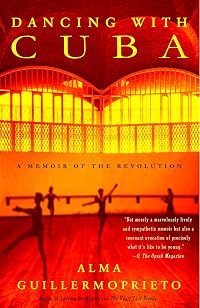
Guillermoprieto was an avant-garde ballet dancer before she became a journalist (last year I really enjoyed her memoir of being a ballet instructor in revolutionary Cuba, Dancing With show more Cuba). She becomes a member of the samba school, learning to dance in the parade, and after some time moves to the favela where the school is based.
Her book would be a wonderful read even if it stuck only to the subject of the preparations for Carnival, because of her descriptive abilities:
Gradually a ripple set in, laid over the basic rhythm by smaller drums. Then the cuica: a subversive, humorous squeak, dirty and enticing, produced by rubbing a stick inserted into the middle of a drumskin. The cuica is like an itch, and the only way to scratch it is to dance. Already, people were wiggling in place to the beat, not yet dancing, building up the rhythm inside their bodies, waiting for some releasing command of the drums.
Or later:
She must have been about fourteen years old, but there was none of the sharp-edged busyness of the mosquito brigade's dancing in her movements, and none of the blatant sexual appeal coached into sambistas from toddlerhood. Delicately, she explored every interstice in the rhythm, dancing first to the light metal instruments, then to the drums, reshaping the music into movement and making all its different parts visible: the song line's rise and fall, the changes in rhythm, the backbeat of the mandolin.
But Carnival is much more than just a community event: it's mass entertainment, part of a major money-spinning industry. It's exclusive - I had assumed that Carnival paraded through the streets for all to enjoy, but in fact it takes place in a vast purpose-built Sambadrome, with the seats filled by the wealthiest Cariocas. And it's also an excellent window onto the relationships between classes and races in Brazil. "In Rio, when state of local officials want to show appreciation for black culture, they visit a samba school": but the only paid members of the samba school are the parade designers (carnavalescos), generally white, and the prestigious roles of singers on the floats are also generally handed out to the white and wealthy. The exhausting job of dancing in the parade, continuously while the floats are moving through the sambadrome, goes to the favelados who are perceived as the ones with the real 'samba spirit'.
I found this book absolutely fascinating and would love to read a 2011 update - I wonder whether Brazil's improving economy has had any impact on the lives of the favelados in the last twenty years. show less
Guillermoprieto was an avant-garde ballet dancer before she became a journalist (last year I really enjoyed her memoir of being a ballet instructor in revolutionary Cuba, Dancing With show more Cuba). She becomes a member of the samba school, learning to dance in the parade, and after some time moves to the favela where the school is based.
Her book would be a wonderful read even if it stuck only to the subject of the preparations for Carnival, because of her descriptive abilities:
Gradually a ripple set in, laid over the basic rhythm by smaller drums. Then the cuica: a subversive, humorous squeak, dirty and enticing, produced by rubbing a stick inserted into the middle of a drumskin. The cuica is like an itch, and the only way to scratch it is to dance. Already, people were wiggling in place to the beat, not yet dancing, building up the rhythm inside their bodies, waiting for some releasing command of the drums.
Or later:
She must have been about fourteen years old, but there was none of the sharp-edged busyness of the mosquito brigade's dancing in her movements, and none of the blatant sexual appeal coached into sambistas from toddlerhood. Delicately, she explored every interstice in the rhythm, dancing first to the light metal instruments, then to the drums, reshaping the music into movement and making all its different parts visible: the song line's rise and fall, the changes in rhythm, the backbeat of the mandolin.
But Carnival is much more than just a community event: it's mass entertainment, part of a major money-spinning industry. It's exclusive - I had assumed that Carnival paraded through the streets for all to enjoy, but in fact it takes place in a vast purpose-built Sambadrome, with the seats filled by the wealthiest Cariocas. And it's also an excellent window onto the relationships between classes and races in Brazil. "In Rio, when state of local officials want to show appreciation for black culture, they visit a samba school": but the only paid members of the samba school are the parade designers (carnavalescos), generally white, and the prestigious roles of singers on the floats are also generally handed out to the white and wealthy. The exhausting job of dancing in the parade, continuously while the floats are moving through the sambadrome, goes to the favelados who are perceived as the ones with the real 'samba spirit'.
I found this book absolutely fascinating and would love to read a 2011 update - I wonder whether Brazil's improving economy has had any impact on the lives of the favelados in the last twenty years. show less
It was interesting to go back and read this. I originally read this in college for an Anthro course on South America. This was very entertaining this time around and I remembered so much more. Learning how samba and Carnival intersected and how the whole process works was entertaining.
Ratings
Members
- Recently Added By
Author Information

19+ Works 690 Members
Alma Guillermoprieto worked for "The Washington Post" before joining "The New Yorker" in the late 1980s. She also writes for "The New York Review of Books". She is the author of two previous books, "Samba" & "The Heart That Bleeds" (both available from Vintage) & was named a MacArthur Fellow in 1995. She lives in Mexico City. (Bowker Author show more Biography) show less
Awards and Honors
Awards
Series
Belongs to Publisher Series
Common Knowledge
- Original publication date
- 1990
- Important places
- Mangueira, Brazil
- Dedication
- Obrigada Mangueira.
- First words
- When I first arrived in Rio de Janeiro several years ago, I rented an apartment in Ipanema, an elegant oceanfront neighborhood, and along with the refrigerator and the bed and a couple of chests of drawers I inherited a maid.
Classifications
- Genres
- Nonfiction, Travel, General Nonfiction
- DDC/MDS
- 394.25098153 — Society, government, & culture Customs, etiquette & folklore General customs Special Occasions Carnival
- LCC
- GT4233 .R5 .G85 — Geography, Anthropology and Recreation Manners and customs (General) Manners and customs (General) Customs relative to public and social life
- BISAC
Statistics
- Members
- 123
- Popularity
- 265,780
- Reviews
- 2
- Rating
- (3.59)
- Languages
- English
- Media
- Paper
- ISBNs
- 4