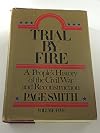
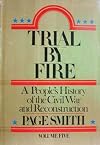
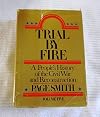
Trial by Fire: A People's History of the Civil War and Reconstruction
by Page Smith
People's History (5)
On This Page
Description
The fifth volume of a multi-volume history of the United States from 1861 to 1874.Tags
Recommendations





















Member Reviews
There are three eras during which the future of the nation was at stake, in the 18th century it was the Revolution and in the 19th century it was Civil War. Trial by Fire: A People’s History of the Civil War and Reconstruction is the fifth volume of Page Smith’s A People’s History series from Fort Sumter to the election of 1876 as the nation is racked by four years of war to successfully save the Union and 11 years of Reconstruction that failed to bring the freedman truly within body politic short-term but creating a promissory note for the future.
This volume is by the nature of its emphasis in a particularly 15-year period of the nation’s history different from Smith’s previous volumes in terms of scope in military, show more political, and cultural elements. Over the nearly 1000 pages of text, Smith not only detailed the events of the war along the twists and turns of Reconstruction to correct the record of the period that the “Lost Cause” myth perpetuated about the period over the course of over half a century. Among the most important parts of the book was Smith’s concluding analysis of both the war and Reconstruction: when writing about the former Smith concluded that the South probably should have won given various factors at the beginning of the war but poor strategic decisions by the South allowed the North’s numbers and industrial capacity overwhelm it while the later was always doomed to fail due to Southern intransigence and the fact Northern opinion of blacks was negative Reconstruction needed to be attempted because the alternative would have been emphatically worse. While the overall product was very well written and very informative, Smith made a lot of head scratching mistakes that stood out because they were contradicted by the actual facts just paragraphs later which appears to be sloppy editing by someone because it was blatant that something happened between first draft manuscript and ready for publication proof that allowed these errors to creep in. The fact that I downgraded the rating an entire star compared to the previous volumes is an indication of how much it got my attention.
Trial by Fire is a culmination of events that Page Smith chronicled in his history of the United States as the two conflicting views of what the country clashed and its aftermath that created a more “national” though still incomplete vision of the country that would lead into it’s next chapter. show less
This volume is by the nature of its emphasis in a particularly 15-year period of the nation’s history different from Smith’s previous volumes in terms of scope in military, show more political, and cultural elements. Over the nearly 1000 pages of text, Smith not only detailed the events of the war along the twists and turns of Reconstruction to correct the record of the period that the “Lost Cause” myth perpetuated about the period over the course of over half a century. Among the most important parts of the book was Smith’s concluding analysis of both the war and Reconstruction: when writing about the former Smith concluded that the South probably should have won given various factors at the beginning of the war but poor strategic decisions by the South allowed the North’s numbers and industrial capacity overwhelm it while the later was always doomed to fail due to Southern intransigence and the fact Northern opinion of blacks was negative Reconstruction needed to be attempted because the alternative would have been emphatically worse. While the overall product was very well written and very informative, Smith made a lot of head scratching mistakes that stood out because they were contradicted by the actual facts just paragraphs later which appears to be sloppy editing by someone because it was blatant that something happened between first draft manuscript and ready for publication proof that allowed these errors to creep in. The fact that I downgraded the rating an entire star compared to the previous volumes is an indication of how much it got my attention.
Trial by Fire is a culmination of events that Page Smith chronicled in his history of the United States as the two conflicting views of what the country clashed and its aftermath that created a more “national” though still incomplete vision of the country that would lead into it’s next chapter. show less
Page Smith gently but irrefragably puts to rest the racist antebellum Reconstruction myth lately taught to me from Texan schoolbooks to the effect that a radical Republican Congress was trying to punish the poor defeated Confederacy after the War for "State's Rights". But for President Grant and the Republicans, Andrew Johnson and the obstinate Southern politicians would have returned the freed slaves to vassalage.
The War was fought over Slavery -- all other issues were manipulations and spin. The South never had a serious commitment to individual rights, and the North never contested that ground. Even Secession was an option that could be discussed without resort to arms.
The rich planters were fighting for their "black harems" -- show more in the words of the wife of one of the South's finest Generals. This was a War over unrestricted sexual access to black women and labor theft from "colored" people by white men.
Harvard-educated Smith, a professional historian, made use of first person accounts, and not just the institutional records. Focus is on the lives of the people, with detailed portraits of the leaders on both sides.
Smith shares his conclusion that the War was inevitable, and why. He explains the strategies, and describes the battles. He is remarkable for the evidence he gathers -- it is primary, and often at odds with prevailing myth. For example, most of the material he presents about the soldier and President Grant shows him in an entirely different light than his reputation. We now understand why men and women of compassion and experience regarded him as such a friend [for example Mark Twain, and even Robert E. Lee's family]. Page quotes Grant in admitting his lack of moral courage for not resigning his commission rather than joining in the War against Mexico -- a conflict he knew to be unjust and which he despised. [153]. show less
The War was fought over Slavery -- all other issues were manipulations and spin. The South never had a serious commitment to individual rights, and the North never contested that ground. Even Secession was an option that could be discussed without resort to arms.
The rich planters were fighting for their "black harems" -- show more in the words of the wife of one of the South's finest Generals. This was a War over unrestricted sexual access to black women and labor theft from "colored" people by white men.
Harvard-educated Smith, a professional historian, made use of first person accounts, and not just the institutional records. Focus is on the lives of the people, with detailed portraits of the leaders on both sides.
Smith shares his conclusion that the War was inevitable, and why. He explains the strategies, and describes the battles. He is remarkable for the evidence he gathers -- it is primary, and often at odds with prevailing myth. For example, most of the material he presents about the soldier and President Grant shows him in an entirely different light than his reputation. We now understand why men and women of compassion and experience regarded him as such a friend [for example Mark Twain, and even Robert E. Lee's family]. Page quotes Grant in admitting his lack of moral courage for not resigning his commission rather than joining in the War against Mexico -- a conflict he knew to be unjust and which he despised. [153]. show less
2649 Trial by Fire: A People's History of the Civil War and Reconstruction Volume Five, by Page Smith (read 25 Sep 1994) This volume tells the story of the Civil War, not getting bogged down in military intricacies (in this an improvement over his volumes on the Revolution, where I thought he paid too much attention to minutiae of battles), and of Reconstruction. He makes plain the Civil War had to be to end slavery, and how close the country came to not doing the war right. (Gettysburg, Vicksburg had been forgotten by August 1964 and timely Union victories thereafter assured Lincoln's re-election in Nov. 1864.) Smith is also right on Reconstruction--it played a role in the eventual realization, 100 years later, of civil rights for blacks.
Ratings
Members
- Recently Added By
Lists

Books Read in 2025
4,128 works; 98 members
Author Information

64+ Works 3,168 Members
Series

Common Knowledge
- Important events
- American Civil War (1861 | 1865)
Classifications
Statistics
- Members
- 256
- Popularity
- 126,916
- Reviews
- 3
- Rating
- (4.00)
- Languages
- English
- Media
- Paper
- ISBNs
- 2
- ASINs
- 4