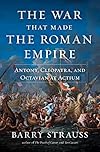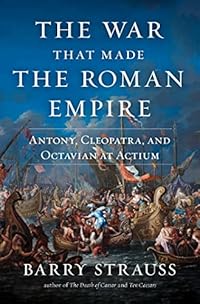
The War that Made the Roman Empire: Antony, Cleopatra, and Octavian at Actium
by Barry S. Strauss 
On This Page
Description
"The story of one of history's most decisive and yet little known battles, the Battle of Actium in 31 BC, which brought together Antony and Cleopatra on one side and Octavian, soon to be emperor Augustus, on the other, and whose outcome determined the future of the Roman Empire"--Tags
Recommendations




Member Reviews
Being aware of some of the negative reviews that other folks have posted about this book, and at this point being skeptical of anyone associated with the Hoover Institute, I was wondering whether I wanted to actually read this work.
That said I actually did wind up enjoying this study of the wars of the Second Triumvirate, and I think that Strauss does a good job of explaining a complicated subject to a general audience; always keeping in mind the problematic nature of our sources.
That said I actually did wind up enjoying this study of the wars of the Second Triumvirate, and I think that Strauss does a good job of explaining a complicated subject to a general audience; always keeping in mind the problematic nature of our sources.
Although I’ve done some reading on the general history of the Roman Empire over the years, I will admit my awareness of the Battle of Actium mainly comes Shakespeare’s plays and the Cleopatra movie.
This well researched volume places that battle in its wider context of the civil wars after the death of Julius Caesar, and the rise of the man who would become Rome’s first true Emperor.
As Strauss points out history is written by the victors, which means that what sources we have about the events discussed are sparse, one-sided, and inherently hostile to Anthony (and to a lesser extent Cleopatra). As such much of what is presented here is well informed supposition.
Yet it manages to present what feels like a balanced account that show more pierces the bias while providing some insights into the actions of the participants as people rather than myths. show less
This well researched volume places that battle in its wider context of the civil wars after the death of Julius Caesar, and the rise of the man who would become Rome’s first true Emperor.
As Strauss points out history is written by the victors, which means that what sources we have about the events discussed are sparse, one-sided, and inherently hostile to Anthony (and to a lesser extent Cleopatra). As such much of what is presented here is well informed supposition.
Yet it manages to present what feels like a balanced account that show more pierces the bias while providing some insights into the actions of the participants as people rather than myths. show less
As with his previous works, the author has an easy reading style that makes his book flow smoothly and quickly. He has the ability to include just the right amount of detail so as not to bog down the reader but still inform.
By any standard, this book will be the preeminent source for the background and context of the Battle of Actium as well as its immediate aftermath. It includes an informative discussion of both Octavian (the future Augustus) and Mark Antony, as well as Cleopatra. Other notable figures are also included such as Agrippa, Octavian's sister Octavia, etc.
A minor complaint is that the author, as is his style, over inflates the importance of female figures. No doubt his intent is to be inclusive in his historical reporting, show more but he loses credibility by overemphasizing the importance of such figures despite their lack of historical accounts. show less
By any standard, this book will be the preeminent source for the background and context of the Battle of Actium as well as its immediate aftermath. It includes an informative discussion of both Octavian (the future Augustus) and Mark Antony, as well as Cleopatra. Other notable figures are also included such as Agrippa, Octavian's sister Octavia, etc.
A minor complaint is that the author, as is his style, over inflates the importance of female figures. No doubt his intent is to be inclusive in his historical reporting, show more but he loses credibility by overemphasizing the importance of such figures despite their lack of historical accounts. show less
He is a bit casual for an academic and not good enough for a professional writer. It reads as a book he wanted to write, but not clear that anyone should read.
Ratings
Members
- Recently Added By
Published Reviews
ThingScore 100
"In The War that Made the Roman Empire, Barry Strauss once again proves his ample street cred in all things ancient and Roman as he reanimates and reappraises a handful of history’s most interesting and electrifying characters."
added by bookfitz
"A fine book about the battle whose outcome created the Roman Empire."
added by bookfitz
"Historian Strauss (The Caesars) delivers a gripping account of the war for control of the Roman Empire that culminated in Octavian’s decisive victory over Mark Antony and Cleopatra at the Battle of Actium in western Greece in 31 BCE."
added by bookfitz
Lists

Western & Northern Europe
60 works; 1 member
Author Information

27+ Works 3,445 Members
Barry Strauss is Professor of History and Classics, Bryce and Edith M. Bowmar Professor in Humanistic Studies at Cornell University. He is the author of seven books on ancient history, including The Death of Caesar, The Spartacus War, and The Trojan War: A New History. His books have been translated into eleven foreign languages.
Barry S. Strauss is a LibraryThing Author, an author who lists their personal library on LibraryThing.
Common Knowledge
- Canonical title
- The War that Made the Roman Empire: Antony, Cleopatra, and Octavian at Actium
- Original title
- The War that Made the Roman Empire: Antony, Cleopatra, and Octavian at Actium
- Original publication date
- 2022-03
- People/Characters
- Gaius Octavius; Marcus Antonius; Cleopatra VII
- Important places
- Rome, Italy; Alexandria, Egypt; Actium, Greece
- Important events
- Battle of Actium
- Dedication
- In memory of my parents
- First words
- High on a hill astride a peninsula lying between the sea and a wide and marshy gulf, in a seldom-visited corner of western Greece, stand the ruins of one of history's most important but least acknowledged war memorials.
- Last words
- (Click to show. Warning: May contain spoilers.)With his taste for irony, Augustus might even have considered this: in spite of the rams of Actium, in spite of the swords that took Alexandria, and in spite of the bite of the asp, in the end, Cleopatra had come to Rome after all.
- Blurbers
- Stavridis, Admiral James; Mayor, Adrienne; Pressfield, Steven; Scott, Michael
- Original language
- English
Classifications
- Genres
- History, Nonfiction, General Nonfiction, Biography & Memoir
- DDC/MDS
- 937.05 — History & geography History of ancient world (to ca. 499) Italian Peninsula to 476 and adjacent territories to 476 Period of civil strife, 146-31 B.C.
- LCC
- DG268 .S77 — History of Europe, Asia, Africa and Oceania City History of Italy Ancient Italy. Rome to 476 History By period Kings and Republic, 753-27 B.C. Republic, 509-27 Fall of the Republic and establishment Second Triumvirate, 43-31
- BISAC
Statistics
- Members
- 208
- Popularity
- 156,624
- Reviews
- 4
- Rating
- (4.03)
- Languages
- English, Portuguese
- Media
- Paper, Audiobook, Ebook
- ISBNs
- 8
- ASINs
- 5