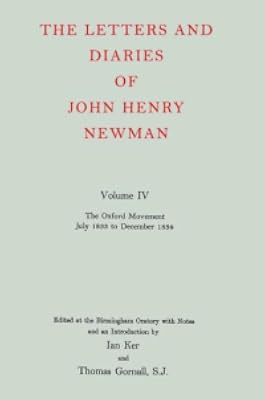
The Letters and Diaries of John Henry Newman, Vol. 4: The Oxford Movement, July 1833 to December 1834
by John Henry Cardinal Newman
The Letters and Diaries of John Henry Newman (4)
On This Page
Description
John Henry Newman (1801-90) was brought up in the Church of England in the Evangelical tradition. An Oxford graduate and Fellow of Oriel College, he was appointed Vicar of St Mary's Oxford in 1828; from 1839 onwards he began to have doubts about the claims of the Anglican Church and in 1845 he was received into the Roman Catholic Church. He was made a Cardinal in 1879. His influence on both the restoration of Roman Catholicism in England and the advance of Catholic ideas in the Church of show more England was profound. This volume covers a crucially important and significant period in Newman's life. The Church of England bishops' continuing condemnation of Tract 90 - plus Pusey's two-year suspension for preaching a university sermon on the Real Presence - are major factors in Newman resigning as Vicar of St Mary's, Oxford. His doubts about the Church of England are deeper and stronger than ever, and he is moving closer to Rome. William Lockhart's sudden defection to Rome in August 1843 precipitates his resignation. He preaches his final Anglican sermon, 'The Parting of Friends', and retires into lay communion at Littlemore. The first edition of University Sermons, including the celebrated sermon on theological development, virtually sells out within a fortnight. show lessTags
Members
- Recently Added By
Author Information

578+ Works 10,604 Members
English clergyman John Henry Newman was born on February 21, 1801. He was educated at Trinity College, University of Oxford. He was the leader of the Oxford movement and cardinal after his conversion to the Roman Catholic Church. In 1822, he received an Oriel College fellowship, which was then the highest distinction of Oxford scholarship, and was show more appointed a tutor at Oriel. Two years later, he became vicar of St. Mary's, the Anglican church of the University of Oxford, and exerted influence on the religious thought through his sermons. When Newman resigned his tutorship in 1832, he made a tour of the Mediterranean region and wrote the hymn "Lead Kindly Light." He was also one of the chief contributors to "Tracts for the Times" (1833-1841), writing 29 papers including "Tract 90", which terminated the series. The final tract was met with opposition because of its claim that the Thirty-nine Articles of the Church of England are aimed primarily at the abuses of Roman Catholicism. Newman retired from Oxford in 1842 to the village of Littlemore. He spent three years in seclusion and resigned his post as vicar of St. Mary's on October 9, 1845. During this time, he wrote a retraction of his criticisms of the Roman Catholic Church and after writing his "Essay on the Development of Christian Doctrine," he became a Roman Catholic. The following year, he went to Rome and was ordained a priest and entered the Congregation of the Oratory. The remainder of Newman's life was spent in the house of the Oratory that he established near Birmingham. He also served as rector of a Roman Catholic university that the bishops of Ireland were trying to establish in Dublin from 1854-1858. While there, he delivered a series of lectures that were later published as "The Idea of a University Defined" (1873), which says the function of a university is the training of the mind instead of the giving of practical information. In 1864, Newman published "Apologia pro Vita Sua (Apology for His Life)" in response to the charge that Roman Catholicism was indifferent to the truth. It is an account of his spiritual development and regarded as both a religious autobiography and English prose. Newman also wrote "An Essay in Aid of a Grammar of Assent" (1870), and the novels "Loss and Gain" (1848), Callista" (1856) and "The Dream of Gerontius" (1865). Newman was elected an honorary fellow of Trinity College, Oxford, in 1877 and was made cardinal by Pope Leo XIII in 1879. He died on August 11, 1890. (Bowker Author Biography) show less
All Editions
Series

Common Knowledge
- Canonical title
- The Letters and Diaries of John Henry Newman, Vol. 4: The Oxford Movement, July 1833 to December 1834
Classifications
- Genres
- Religion & Spirituality, Nonfiction, Biography & Memoir
- DDC/MDS
- 282.0924 — Religion Christian denominations Roman Catholic Church Catholic Biography And History Biography
- LCC
- BX4705 .N5 — Philosophy, Psychology and Religion Christian Denominations Christian Denominations Catholic Church Biography and portraits Individual
- BISAC
Statistics
- Members
- 5
- Popularity
- 3,424,964
- Languages
- English
- Media
- Paper
- ISBNs
- 1