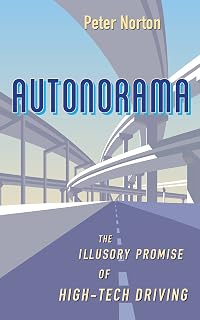
Autonorama: The Illusory Promise of High-Tech Driving
by Peter Norton
On This Page
Description
"The foundation has been laid for fully autonomous," Elon Musk announced in 2016, when he assured the world that Tesla would have a driverless fleet on the road in 2017. "It's twice as safe as a human, maybe better." Promises of technofuturistic driving utopias have been ubiquitous wherever tech companies and carmakers meet. In Autonorama: The Illusory Promise of High-Tech Driving, technology historian Peter Norton argues that driverless cars cannot be the safe, sustainable, and inclusive show more "mobility solutions" that tech companies and automakers are promising us. The salesmanship behind the driverless future is distracting us from investing in better ways to get around that we can implement now. Unlike autonomous vehicles, these alternatives are inexpensive, safe, sustainable, and inclusive. Norton takes the reader on an engaging ride --from the GM Futurama exhibit to "smart" highways and vehicles--to show how we are once again being sold car dependency in the guise of mobility. He argues that we cannot see what tech companies are selling us except in the light of history. With driverless cars, we're promised that new technology will solve the problems that car dependency gave us--zero crashes! zero emissions! zero congestion! But these are the same promises that have kept us on a treadmill of car dependency for 80 years. Autonorama is hopeful, advocating for wise, proven, humane mobility that we can invest in now, without waiting for technology that is forever just out of reach. Before intelligent systems, data, and technology can serve us, Norton suggests, we need wisdom. Rachel Carson warned us that when we seek technological solutions instead of ecological balance, we can make our problems worse. With this wisdom, Norton contends, we can meet our mobility needs with what we have right now show lessTags
Recommendations




















Member Reviews
What one has here is an unabashed polemic, showing how the current supposed automotive great leap forward is only the latest in a line of supposed technological utopias that proclaim a new era of safe and efficient driving, but which turn out to be highly overrated. I personally know that I've been highly skeptical of the current claims that truly "smart" cars are just over the horizon, particularly when it'll just be an excuse to take the steering wheel out of hand of drivers (I personally enjoy driving, thank you); not to mention representing a golden opportunity for the automotive industry of gouge "subscription" fees out of car buyers for electronic features. In any case Norton has done the general public a service by calling show more attention to an old party trick of the car industry.
A little less good is Norton's take on urban congestion and cars, and yeah, there's no denying that we've reached peak automotive congestion in our cities and peak sprawl; both conditions being unsustainable. What I don't see is any admission in this book regarding the political and social attitudes that led to this state of affairs, as affluent White America turned its back on urban living. Also, I did enjoy bike riding as an avocation before my knees basically gave out, and the reality is that, speaking of the Greater Washington Area, the weather is too unpleasant most of the time to justify commuting by bike to work; unless you're young, fit and your boss doesn't mind you looking like a slob all day. Norton really likes bicycles and really likes the Netherlands; it'll be some time before a significant chunk of the United States looks like the Netherlands.
None of the above negates the main theme of this extended essay. show less
A little less good is Norton's take on urban congestion and cars, and yeah, there's no denying that we've reached peak automotive congestion in our cities and peak sprawl; both conditions being unsustainable. What I don't see is any admission in this book regarding the political and social attitudes that led to this state of affairs, as affluent White America turned its back on urban living. Also, I did enjoy bike riding as an avocation before my knees basically gave out, and the reality is that, speaking of the Greater Washington Area, the weather is too unpleasant most of the time to justify commuting by bike to work; unless you're young, fit and your boss doesn't mind you looking like a slob all day. Norton really likes bicycles and really likes the Netherlands; it'll be some time before a significant chunk of the United States looks like the Netherlands.
None of the above negates the main theme of this extended essay. show less
Ratings
Members
- Recently Added By
Lists

The War on Cars podcast
108 works; 1 member
Author Information
97 Works 929 Members
Classifications
- Genres
- Nonfiction, Technology, General Nonfiction, History, Art & Design
- DDC/MDS
- 629.2046 — Applied science & technology Engineering Transportation Vehicles Cars, Trucks, Bulldozers, RVs, Motocyles
- LCC
- TL152.8 .N67 — Technology Motor vehicles. Aeronautics. Astronautics Motor vehicles. Aeronautics. Astronautics Motor vehicles. Cycles
- BISAC
Statistics
- Members
- 23
- Popularity
- 1,150,845
- Reviews
- 1
- Rating
- (3.63)
- Languages
- English
- Media
- Paper, Ebook
- ISBNs
- 2
- ASINs
- 1