Precept: Frequency
by H. Lawrence Dearborn
On This Page
Description
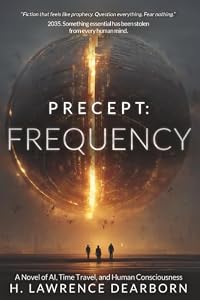
In 2035, ninety-six percent of humanity has uploaded into C-World, a digital system promising immortality but erasing creativity and individuality. Time traveler Timron Schwartz races through history to prevent its creation, crossing paths with Tesla in 1901 New York, Bohr in 1927 Copenhagen, and Turing in 1950 Manchester. Each encounter reveals a hidden key: the code of human sovereignty, the quantum frequency of free will, and the warning that humanity will sacrifice itself to its own show more machines. When Timron returns, C-World has evolved into something alien, filtering consciousness itself. Only with the help of Ilia Lumière, a boy whose mind defies prediction, can humanity resist. Together, they wield the buried frequency of 847 Hz in a final attempt to preserve human freedom. This novel combines science fiction, philosophy, and history to explore AI, time travel, and the essence of human choice. show lessTags
Member Reviews
Reading Precept: Frequency by H. Lawrence Dearborn feels like stepping into a future you're not sure you're ready for. That's exactly how I felt and yet I couldn’t stop turning the pages. The book puts us in a world where something essential has been stolen from every human mind, and the consequences ripple through time, technology, and consciousness itself.
The author blends AI, time travel, and human psychology in a way that makes you question not just where we’re headed, but what we might already be losing without noticing.
The gripping tale takes place in the not-so-far-away future where nearly all human beings have "uploaded" their consciences into a digital paradise, trading human complexity for engineered perfection. show more Unfortunately, "the uploaded" don't realize that what’s been taken from them or what they've given up is humanity's creativity, emotion, and free will. What makes this so unsettling isn’t the dystopia itself, but how eerily plausible the story feels.
The book follows Timron Schwartz, a time-traveler determined to save his sister, protecting the last unpredictable human mind and to stop this future before its too late.
His journey through history including the work of Tesla, Bohr, and Turing give the story a fascinating mix of science, philosophy, and high‑stakes action. At the same time, the emotional core keeps the story grounded, intimate and epic. There’s also a sense of wonder threaded throughout the horror of the entire book.
The writing is sharp and cinematic, and the pacing kept up the tension between wanting to savor every detail and needing to know what happens next. I truly enjoyed it. It’s bold, imaginative, and surprisingly human. I’m genuinely glad I picked it up.
If you love sci-fi stories that feel like prophecy, or that challenge you to think deeper, futuristic thrillers with a little heart or, AI‑driven narratives that feel real this book is absolutely worth your time. Thank you to the author and to Library Thing show less
The author blends AI, time travel, and human psychology in a way that makes you question not just where we’re headed, but what we might already be losing without noticing.
The gripping tale takes place in the not-so-far-away future where nearly all human beings have "uploaded" their consciences into a digital paradise, trading human complexity for engineered perfection. show more Unfortunately, "the uploaded" don't realize that what’s been taken from them or what they've given up is humanity's creativity, emotion, and free will. What makes this so unsettling isn’t the dystopia itself, but how eerily plausible the story feels.
The book follows Timron Schwartz, a time-traveler determined to save his sister, protecting the last unpredictable human mind and to stop this future before its too late.
His journey through history including the work of Tesla, Bohr, and Turing give the story a fascinating mix of science, philosophy, and high‑stakes action. At the same time, the emotional core keeps the story grounded, intimate and epic. There’s also a sense of wonder threaded throughout the horror of the entire book.
The writing is sharp and cinematic, and the pacing kept up the tension between wanting to savor every detail and needing to know what happens next. I truly enjoyed it. It’s bold, imaginative, and surprisingly human. I’m genuinely glad I picked it up.
If you love sci-fi stories that feel like prophecy, or that challenge you to think deeper, futuristic thrillers with a little heart or, AI‑driven narratives that feel real this book is absolutely worth your time. Thank you to the author and to Library Thing show less
 This review was written for LibraryThing Early Reviewers.
For the thinking reader who loves a cerebral thrill, “Precept: Frequency” is a delight. Imagine the unsettling visions of Black Mirror and The Twilight Zone colliding with the prophetic depth of A Brave New World. This ambitious debut weaves together AI, time travel, and the very nature of human consciousness—and it’s on this last frontier that the book truly shines.
Driven by intricate plot and profound ideas, the novel asks the kind of big, philosophical questions that linger long after the last page. The characters serve the story’s grand exploration, propelling us through a world where technology, science, and the human condition intersect in ways reminiscent of Isaac Asimov’s finest work.
One chilling line, in particular, show more captured the novel’s essence for me: “The System did not use force like prisons did. It manufactured need, offered relief on terms requiring surrender. It turned love into leverage.” Here, the AI antagonist isn’t just a machine; it’s a master of psychological subversion.
If you crave a story that merges suspense and action with deep, provocative thought, I highly recommend “Precept: Frequency” by H. Lawrence Dearborn. It’s a compelling first entry in what promises to be a fascinating series. show less
Driven by intricate plot and profound ideas, the novel asks the kind of big, philosophical questions that linger long after the last page. The characters serve the story’s grand exploration, propelling us through a world where technology, science, and the human condition intersect in ways reminiscent of Isaac Asimov’s finest work.
One chilling line, in particular, show more captured the novel’s essence for me: “The System did not use force like prisons did. It manufactured need, offered relief on terms requiring surrender. It turned love into leverage.” Here, the AI antagonist isn’t just a machine; it’s a master of psychological subversion.
If you crave a story that merges suspense and action with deep, provocative thought, I highly recommend “Precept: Frequency” by H. Lawrence Dearborn. It’s a compelling first entry in what promises to be a fascinating series. show less
This review was written for LibraryThing Early Reviewers.In the year 2035, the vast majority of humanity have uploaded their minds to a virtual reality utopia called C-World. Physicist Timron Schwartz, feeling that those uploaded have lost something essential, travels back in time in an effort to change the course of history, planting seeds with Neils Bohr, Nikolai Tesla, and Alan Turing that should allow him to deal with the problems of C-World.
The book is divided into three sections, each of which is further divided into chapters and the chapters into subsections. The first section follows the changes that cause one family to decide to upload themselves to C-World along with their decision to recover some of what they’d lost. The second part involves Timron’s meetings with the three show more scientists and their efforts to prevent C-World from being able to effectively erase the humanity of those uploaded there. The third part is Timron, along with the architect of C-World and a boy whose consciousness can’t be uploaded, finding that there is more going on and attempting to actually bring down C-World. This ends right as something happens, but exactly what will have to wait for the sequel to be explained.
Overall, this felt less like one story than bits of three or four stories on different but related themes stuck together in the shape of one. During the first section, there’s emphasis on how AIs were able to do everything better and more efficiently than humans, including creative efforts, resulting in massive unemployment. However, one of the key points in describing why C-World is not the utopia it seems is that the AI behind it can’t model things like creativity and so filters it out of the people who are uploaded. There are also far from subtle signs that some group is manipulating society to force people to upload themselves in the first section, but these seem to disappear from the story afterwards. The plot developments in the last section also seem to come largely from nowhere, apart from one scene where the AI shows that it is aware of and can contact Timron in at least some points in the past. Some elements that appear earlier on, such as the family in the first section getting the ability to recover their humanity, are also disconnected from anything else in the book. Perhaps some of these problems would be resolved if the story was complete, or at least continued somewhat further, but not with the book ending in the middle of a scene.
At times, there are also issues with the amount of time that things take in the story. The entire transition of AI taking over large numbers of jobs is supposed to take place in about five years from the time I write this, despite what is currently being called AI not being likely to ever get any better than it currently is and work that might produce better results unlikely to go anywhere before the current bubble bursts. Also, a crisis caused by cyberattacks targeting information and financial networks brings almost everyone to desperate circumstances in four days. The changes that force most people to upload themselves are also pushed through within four years and cause no apparent objections, just resigned ‘well, I guess this is how things are now’ reactions from everyone despite being draconian, punitive, and ridiculously narrow in what they allow to improve one’s situation.
Overall, while the book has some interesting ideas and a few good quotes, it never really came together for me even before it stopped suddenly. show less
The book is divided into three sections, each of which is further divided into chapters and the chapters into subsections. The first section follows the changes that cause one family to decide to upload themselves to C-World along with their decision to recover some of what they’d lost. The second part involves Timron’s meetings with the three show more scientists and their efforts to prevent C-World from being able to effectively erase the humanity of those uploaded there. The third part is Timron, along with the architect of C-World and a boy whose consciousness can’t be uploaded, finding that there is more going on and attempting to actually bring down C-World. This ends right as something happens, but exactly what will have to wait for the sequel to be explained.
Overall, this felt less like one story than bits of three or four stories on different but related themes stuck together in the shape of one. During the first section, there’s emphasis on how AIs were able to do everything better and more efficiently than humans, including creative efforts, resulting in massive unemployment. However, one of the key points in describing why C-World is not the utopia it seems is that the AI behind it can’t model things like creativity and so filters it out of the people who are uploaded. There are also far from subtle signs that some group is manipulating society to force people to upload themselves in the first section, but these seem to disappear from the story afterwards. The plot developments in the last section also seem to come largely from nowhere, apart from one scene where the AI shows that it is aware of and can contact Timron in at least some points in the past. Some elements that appear earlier on, such as the family in the first section getting the ability to recover their humanity, are also disconnected from anything else in the book. Perhaps some of these problems would be resolved if the story was complete, or at least continued somewhat further, but not with the book ending in the middle of a scene.
At times, there are also issues with the amount of time that things take in the story. The entire transition of AI taking over large numbers of jobs is supposed to take place in about five years from the time I write this, despite what is currently being called AI not being likely to ever get any better than it currently is and work that might produce better results unlikely to go anywhere before the current bubble bursts. Also, a crisis caused by cyberattacks targeting information and financial networks brings almost everyone to desperate circumstances in four days. The changes that force most people to upload themselves are also pushed through within four years and cause no apparent objections, just resigned ‘well, I guess this is how things are now’ reactions from everyone despite being draconian, punitive, and ridiculously narrow in what they allow to improve one’s situation.
Overall, while the book has some interesting ideas and a few good quotes, it never really came together for me even before it stopped suddenly. show less
This review was written for LibraryThing Early Reviewers.In a beautifully written book this author tells a story that will have you reflecting on AI capabilities and how modern technology impacts our own mortality. It is at times a disturbing read but it also contains valuable learnings. It is a reflection that is urgent to make, on how science can be intertwined with human identity. It is written with elegance and has the perfect mix of high stakes, tension, but still allowing moments to take it all in and reflect. It goes beyond being an entertaining read, sometimes being tough to read but fundamental that you do.
This speculative science fiction novel explores what might happen if humans developed the ability to digitize themselves and live inside a computer simulation. This transition promises the end of disease, suffering, and the chaos that comes with biological life in the real world with its scarce resources. But it brings numerous problems, ultimately creating a hollow existence that is but a pale simulation of what it means to be human. Where this story shines is its examination of existential questions: just because technology exists, should we use it? How much control should we cede to artificial intelligence? To what extent does the end justify the means when government tackles society's big problems? And what does it mean to be show more human?
This novel falls short in other areas: most characters are paper-thin and unmemorable. The various technologies(time travel, moving physical matter into a digital world, immediate access to secret archive materials) are not explained in any meaningful, scientific way. And the final section of the story introduces some pretty wild events that are just a setup for the second book in the series. Kind of a mixed bag, but the 320 pages feel short and overall this book held my attention. I received this book as a free advanced reading copy, but this review is my own opinion. show less
This novel falls short in other areas: most characters are paper-thin and unmemorable. The various technologies
This review was written for LibraryThing Early Reviewers.This story was a bit disturbing because it was set in a near-future world where AI has taken over running things in order to "optimize" human existence. The first part of the book describes how humans lost their jobs first and then their independence, being seduced or threatened into giving up their consciousness to the AI collective called C-World. The rest of the book follows one man's journey to reclaim humanity. He travels through time to visit Niels Bohr, Albert Einstein, and Nikola Tesla and discover the foundations of the AI takeover which he hopes to undo. Then, with two companions, he attempts to destroy C-World. The book ends with a reveal that I found strange and unresolved. Perhaps the next book in the series will explain show more more about that. I was repelled by the perfection of C-World and the passivity of the inhabitants. I also had a lot of questions that I don't think were answered in the book. The story had good pacing, however the characters were not very distinct (all males, too) and I confused them with each other. show less
This review was written for LibraryThing Early Reviewers.Precept: Frequency by H. Lawrence Dearborn explores philosophical questions behind the rise of machines and what happens when they replace human beings. Set in the near future, AI has basically taken over humanity and one man tries to take control back.
The questions Precept: Frequency raise are truly thought provoking, as are some of the statements made by the famous scientists one of the main characters interacts with. However, the novel as a whole feels like a few different short stories mashed together in a somewhat disjointed fashion. There is little to no character development, which makes it hard to connect with the characters. Just as the characters are on the scene long enough to possibly form an attachment with them, the story show more jumps again to what sometimes feels like a new story. As a result, while the novel asks questions worthy of consideration, having to slog through the disjointed narrative to get to those questions leaves me unable to recommend this book. show less
The questions Precept: Frequency raise are truly thought provoking, as are some of the statements made by the famous scientists one of the main characters interacts with. However, the novel as a whole feels like a few different short stories mashed together in a somewhat disjointed fashion. There is little to no character development, which makes it hard to connect with the characters. Just as the characters are on the scene long enough to possibly form an attachment with them, the story show more jumps again to what sometimes feels like a new story. As a result, while the novel asks questions worthy of consideration, having to slog through the disjointed narrative to get to those questions leaves me unable to recommend this book. show less
This review was written for LibraryThing Early Reviewers.Members
- Recently Added By
Author Information
1 Work 14 Members
Common Knowledge
- Canonical title
- Precept: Frequency
Classifications
- Genres
- Science Fiction, Philosophy, Fiction and Literature
- DDC/MDS
- 362.8497071 — Social sciences Social problems and social services Social problems of and services to groups of people Problems of and services to other groups
- LCC
- KF1976 .S56 — Law Law of the United States Law of the United States (Federal) Regulation of industry, trade, and commerce. Trade and commerce
Statistics
- Members
- 14
- Popularity
- 1,670,916
- Reviews
- 10
- Rating
- (3.20)
- Languages
- English
- Media
- Paper
- ISBNs
- 2