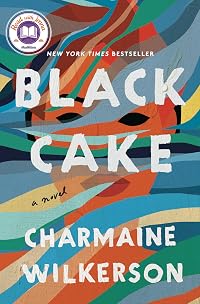
Black Cake
by Charmaine Wilkerson
On This Page
Description
"In this moving debut novel, two estranged siblings must set aside their differences to deal with their mother's death and her hidden past--a journey of discovery that takes them from the Caribbean to London to California and ends with her famous black cake. In present-day California, Eleanor Bennett's death leaves behind a puzzling inheritance for her two children, Byron and Benny: a traditional Caribbean black cake, made from a family recipe with a long history, and a voice recording. In show more her message, Eleanor shares a tumultuous story about a headstrong young swimmer who escapes her island home under suspicion of murder. The heartbreaking journey Eleanor unfolds, the secrets she still holds back, and the mystery of a long-lost child, challenge everything the siblings thought they knew about their family, and themselves. Can Byron and Benny reclaim their once-close relationship, piece together Eleanor's true history, and fulfill her final request to 'share the black cake when the time is right?' Will their mother's revelations bring them back together or leave them feeling more lost than ever? Charmaine Wilkerson's debut novel is a story of how the inheritance of betrayals, secrets, memories, and even names, can shape relationships and history. Deeply evocative and beautifully written, Black Cake is an extraordinary journey through the life of a family changed forever by the choices of its matriarch"-- show lessTags
Recommendations






Member Reviews
Black Cake is a beautifully crafted, multi-generational novel about family, identity, migration, and the secrets that shape us. When Eleanor Bennett leaves her children a voice recording and a traditional Caribbean black cake, it sets in motion a journey through hidden histories, fractured relationships, and cultural legacies.
Wilkerson’s storytelling is tender and immersive, weaving past and present with skill. The novel delves into complex themes, race, colonialism, estrangement, and forgiveness, while celebrating resilience and the quiet ways we carry love across generations.
At its heart, Black Cake is a meditation on how the stories we inherit and the ones we choose to tell define who we become. A moving, memorable debut that show more lingers long after the final page.
N.Cervone show less
Wilkerson’s storytelling is tender and immersive, weaving past and present with skill. The novel delves into complex themes, race, colonialism, estrangement, and forgiveness, while celebrating resilience and the quiet ways we carry love across generations.
At its heart, Black Cake is a meditation on how the stories we inherit and the ones we choose to tell define who we become. A moving, memorable debut that show more lingers long after the final page.
N.Cervone show less
Another three star, forgettable read. This could have been an informative fictional account of immigration - I didn't know about Chinese-Jamaicans, for example - but the flimsy characters, soap opera plots and plodding narrative, not to mention the overdose of 'issues' from rape and forced adoption to ocean pollution, made this more of a chore to read.
The story bounces all over, with short chapters jumping between present day siblings Benny and Byron, their Jamaican parents and family life back on 'the island' in the 1960s, a 'secret sister' writing about the diaspora of food (of course she is), and even a couple of local legends from the 1600s and 1700s for good measure. I might have been more engaged if the author had chosen two show more voices to tell the story - bisexual Benny and her secretive mother, perhaps - but instead she leaves a gigantic omniscient footprint in every chapter, explaining exactly how every character is feeling, rather than leaving the reader to use their imagination, and then starts lecturing on pet subjects such as identity, discrimination and the environment. Throwing in borrowed anecdotes about life in the Caribbean and the prejudice faced by the Windrush generation in London didn't really help to bring any of the characters to life, either. I would like to try a slice of black cake, however, whatever the cultural origin!
Readers with a tick list of 'woke' novels will love this pick 'n' mix of topical issues but those who read fiction to experience new lives through well-written characters will possibly feel let down by the promise of the blurb. show less
The story bounces all over, with short chapters jumping between present day siblings Benny and Byron, their Jamaican parents and family life back on 'the island' in the 1960s, a 'secret sister' writing about the diaspora of food (of course she is), and even a couple of local legends from the 1600s and 1700s for good measure. I might have been more engaged if the author had chosen two show more voices to tell the story - bisexual Benny and her secretive mother, perhaps - but instead she leaves a gigantic omniscient footprint in every chapter, explaining exactly how every character is feeling, rather than leaving the reader to use their imagination, and then starts lecturing on pet subjects such as identity, discrimination and the environment. Throwing in borrowed anecdotes about life in the Caribbean and the prejudice faced by the Windrush generation in London didn't really help to bring any of the characters to life, either. I would like to try a slice of black cake, however, whatever the cultural origin!
Readers with a tick list of 'woke' novels will love this pick 'n' mix of topical issues but those who read fiction to experience new lives through well-written characters will possibly feel let down by the promise of the blurb. show less
Debut novelist Charmaine Wilkerson says that a younger relative's request for her mother's recipe for black cake got her started "thinking about inheritance and how we choose to keep some things closer to our hearts than others -- especially in a multicultural family like mine." She “never intended to write a story with a cake in it. It just sort of walked into the story.” And inspired the novel's title. Black cake is traditionally served at celebrations in the Caribbean and in Wilkerson's story it "symbolizes family bonds and memories in the face of significant loss, but also a multicultural history. . . . It is a source of joy. But also, it is the offshoot of a less-than-sanguine past."
Black cake figures into the story from the show more outset. The prologue takes readers to the shore of an island where a bride's abandoned wedding dress is smeared with black cake and lilac icing. Wilkerson depicts a father's anguish and regret, and at least two mysteries. Why would a bride leap up from a wedding feast and disappear into the bay? And could she still be alive, even though her father seems resigned to wait for her body to wash ashore?
Wilkerson immediately whisks readers to Los Angeles in 2018 where Byron, "the African American social media darling of ocean sciences," is about to be reunited with his younger sister, Benny. They were extremely close growing up, but eight years have passed since they last saw each other. Benny didn't even attend their father's funeral, after storming out of the house on a fateful Thanksgiving Day . . . and never returning. Their mother, Eleanor Bennett, texted Benny from time to time over the years, most recently to say, "Benedetta, please come home." Benny didn't return in time. Now Eleanor is dead, and "B and B," as their mother called them, are about to learn about their family history. Their mother recorded the eight-hour story over the course of four days. Her lawyer, Charles Mitch, informs them Eleanor expressly requested that they listen to the recording together -- in its entirety -- in his presence. He warns them to "be prepared" for what they are about to hear.
Eleanor also left a short hand-written note. "B and B, there's a small black case in the freezer for you. Don't throw it out. I want you to sit down together and share the cake when the time is right. You'll know when. Love, Ma." Byron thought his mother never made another black cake after Benny stormed out on that Thanksgiving, and he is shocked when he realizes that she made at least one more. As the recording begins, Byron and Benny are both stunned to hear Eleanor reference a sister they never knew existed. What were the circumstances of her birth? Who is she? Where has she been living all of their lives?
In short chapters, Wilkerson explores the lives of Byron and Benny from their perspectives -- key events during their childhoods, their dreams and regrets, and the bases for the decisions they have made up to the point in their lives at which they have come together to mourn their mother. Benny has just lost her job, while Byron has enjoyed great success in his career as an oceanographer, despite being passed over for the job of director of the institute with which he is affiliated. Neither has found a lasting personal relationship. Lynette, Byron's girlfriend, left him and they haven't spoken in three months. Benny has had a series of relationships and Wilkerson reveals that her sexual orientation was the cause of the rift with her father that was never resolved. Eleanor deferred to him in all things, for reasons Byron and Benny have never fully appreciated.
Interspersed are chapters in which the story of a girl named Covey emerges. She is being raised by her father, Johnny "Lin" Lyncock, on a Caribbean island. Lin owns shops, but drinks and bets on cockfights, finding himself in debt to Little Man, an island gang leader. Covey's mother, Matilda, and her best friend, Pearl, made black cakes with icing flowers that were "second to none" and sold them to residents for special occasions. But many of the island's "upper crust" believed Mathilda "had shown poor judgment" by having a child with Covey's Chinese-born father. One day Covey's mother disappeared with the assistance of a customer, and although Covey believed she would return or at least send for Covey, she never did and Covey has grown into a young woman.
Wilkerson details how "in the spring of 1965, Covey's life veered onto the path that would eventually connect her to Eleanor Bennett." It's a mesmerizing and emotionally resonant tale about Covey, and her life with her father, best friend Bunny, and the boy she falls in love with, Gibbs Grant. Covey's story is punctuated by dreams of her future, devastating heartbreak and loss, abuse, and choices no young woman should ever be forced to make. Not to mention an unsolved murder that overshadows every aspect of Covey's life for decades. It is also a commentary about the time period in which Covey grew up, and an illustration of how unbreakable and affirming friendships can be. Ultimately, it is a story of survival, resilience, and second chances.
Wilkerson deftly moves the story between the past and present, introducing intriguing new characters as she returns again and again to Eleanor's narrative, unraveling mysteries involving those characters at expertly-timed junctures. Each of Wilkerson's characters is developed fully and multi-dimensional. Aside from Little Man and his gang, there are no villains in her tale of a woman who did not share her truth with her children while she still had time and the myriad ways in which hearing the truth only after her death -- as well as the death of their father six years earlier -- impacts the children she loved boundlessly.
The pace of Black Cake never slackens as Wilkerson transports readers from modern-day Los Angeles, to the Caribbean more than fifty years ago, as well as London, Scotland, and Rome. She immerses readers in each location, conjuring each distinct locale's sights, sounds, smells, and culture, always bringing attention back to the three central players in the story. Benny is a thirty-six-year-old woman who has never learned to be comfortable in her own skin, always feeling that she is not living the life she was meant to create for herself but unsure about how to manifest her desires. As her mother's life story is revealed to her, Benny questions why Eleanor didn't understand what Benny was going through and never offered her advice.
Byron, even though a highly recognizable African American man, has been subjected to social injustice but never been empowered to stand up for his rights. Being estranged from Benny, their father's death, and a disturbing incident with Eleanor shortly before her death shook the foundations upon which Bryon built his life and beliefs. His mother once asked him, "What are you willing to do? . . . Are you going to let someone else's view of who you should be, and what you should do, hold you back?" At last Bryon finds the answers to her questions.
And their sister, in whose life food has played an integral part, as well, must come to terms with a truth that she suspected all along. Mr. Mitch endures his own rediscovery of intimacy, as well as heart-wrenching loss.
Wilklerson notes that "many families have stories like these, and when they finally emerge, they often do so in the kitchen, at the table, over a meal, or with a glass in hand." Or via the submission of DNA samples to companies like Ancestry and 23andMe. Black Cake is a scintillating and moving examination of learning to adapt when one's perceptions and beliefs about family members' decisions and choices are upended by revelations of long-held secrets. It's about being willing to cast away old ideas in favor of new understandings about the people one loves -- what they have endured, what motivated the direction their life took, what inspired them to endure adversity. Wilkerson believes that learning our family history can inspire us to accept "seeming contradictions or conflicts in people and cultures without imposing the need to tie things up neatly."
Black Cake is a stunningly-crafted debut work of fiction. Wilkerson's complex and absorbing family drama is imbued with longing, insight, compassion, humor, and, finally, peace for her intriguing and memorable characters.
Thanks to NetGalley for an Advance Reader's Copy of the book. show less
Black cake figures into the story from the show more outset. The prologue takes readers to the shore of an island where a bride's abandoned wedding dress is smeared with black cake and lilac icing. Wilkerson depicts a father's anguish and regret, and at least two mysteries. Why would a bride leap up from a wedding feast and disappear into the bay? And could she still be alive, even though her father seems resigned to wait for her body to wash ashore?
Wilkerson immediately whisks readers to Los Angeles in 2018 where Byron, "the African American social media darling of ocean sciences," is about to be reunited with his younger sister, Benny. They were extremely close growing up, but eight years have passed since they last saw each other. Benny didn't even attend their father's funeral, after storming out of the house on a fateful Thanksgiving Day . . . and never returning. Their mother, Eleanor Bennett, texted Benny from time to time over the years, most recently to say, "Benedetta, please come home." Benny didn't return in time. Now Eleanor is dead, and "B and B," as their mother called them, are about to learn about their family history. Their mother recorded the eight-hour story over the course of four days. Her lawyer, Charles Mitch, informs them Eleanor expressly requested that they listen to the recording together -- in its entirety -- in his presence. He warns them to "be prepared" for what they are about to hear.
Eleanor also left a short hand-written note. "B and B, there's a small black case in the freezer for you. Don't throw it out. I want you to sit down together and share the cake when the time is right. You'll know when. Love, Ma." Byron thought his mother never made another black cake after Benny stormed out on that Thanksgiving, and he is shocked when he realizes that she made at least one more. As the recording begins, Byron and Benny are both stunned to hear Eleanor reference a sister they never knew existed. What were the circumstances of her birth? Who is she? Where has she been living all of their lives?
In short chapters, Wilkerson explores the lives of Byron and Benny from their perspectives -- key events during their childhoods, their dreams and regrets, and the bases for the decisions they have made up to the point in their lives at which they have come together to mourn their mother. Benny has just lost her job, while Byron has enjoyed great success in his career as an oceanographer, despite being passed over for the job of director of the institute with which he is affiliated. Neither has found a lasting personal relationship. Lynette, Byron's girlfriend, left him and they haven't spoken in three months. Benny has had a series of relationships and Wilkerson reveals that her sexual orientation was the cause of the rift with her father that was never resolved. Eleanor deferred to him in all things, for reasons Byron and Benny have never fully appreciated.
Interspersed are chapters in which the story of a girl named Covey emerges. She is being raised by her father, Johnny "Lin" Lyncock, on a Caribbean island. Lin owns shops, but drinks and bets on cockfights, finding himself in debt to Little Man, an island gang leader. Covey's mother, Matilda, and her best friend, Pearl, made black cakes with icing flowers that were "second to none" and sold them to residents for special occasions. But many of the island's "upper crust" believed Mathilda "had shown poor judgment" by having a child with Covey's Chinese-born father. One day Covey's mother disappeared with the assistance of a customer, and although Covey believed she would return or at least send for Covey, she never did and Covey has grown into a young woman.
Wilkerson details how "in the spring of 1965, Covey's life veered onto the path that would eventually connect her to Eleanor Bennett." It's a mesmerizing and emotionally resonant tale about Covey, and her life with her father, best friend Bunny, and the boy she falls in love with, Gibbs Grant. Covey's story is punctuated by dreams of her future, devastating heartbreak and loss, abuse, and choices no young woman should ever be forced to make. Not to mention an unsolved murder that overshadows every aspect of Covey's life for decades. It is also a commentary about the time period in which Covey grew up, and an illustration of how unbreakable and affirming friendships can be. Ultimately, it is a story of survival, resilience, and second chances.
Wilkerson deftly moves the story between the past and present, introducing intriguing new characters as she returns again and again to Eleanor's narrative, unraveling mysteries involving those characters at expertly-timed junctures. Each of Wilkerson's characters is developed fully and multi-dimensional. Aside from Little Man and his gang, there are no villains in her tale of a woman who did not share her truth with her children while she still had time and the myriad ways in which hearing the truth only after her death -- as well as the death of their father six years earlier -- impacts the children she loved boundlessly.
The pace of Black Cake never slackens as Wilkerson transports readers from modern-day Los Angeles, to the Caribbean more than fifty years ago, as well as London, Scotland, and Rome. She immerses readers in each location, conjuring each distinct locale's sights, sounds, smells, and culture, always bringing attention back to the three central players in the story. Benny is a thirty-six-year-old woman who has never learned to be comfortable in her own skin, always feeling that she is not living the life she was meant to create for herself but unsure about how to manifest her desires. As her mother's life story is revealed to her, Benny questions why Eleanor didn't understand what Benny was going through and never offered her advice.
Byron, even though a highly recognizable African American man, has been subjected to social injustice but never been empowered to stand up for his rights. Being estranged from Benny, their father's death, and a disturbing incident with Eleanor shortly before her death shook the foundations upon which Bryon built his life and beliefs. His mother once asked him, "What are you willing to do? . . . Are you going to let someone else's view of who you should be, and what you should do, hold you back?" At last Bryon finds the answers to her questions.
And their sister, in whose life food has played an integral part, as well, must come to terms with a truth that she suspected all along. Mr. Mitch endures his own rediscovery of intimacy, as well as heart-wrenching loss.
Wilklerson notes that "many families have stories like these, and when they finally emerge, they often do so in the kitchen, at the table, over a meal, or with a glass in hand." Or via the submission of DNA samples to companies like Ancestry and 23andMe. Black Cake is a scintillating and moving examination of learning to adapt when one's perceptions and beliefs about family members' decisions and choices are upended by revelations of long-held secrets. It's about being willing to cast away old ideas in favor of new understandings about the people one loves -- what they have endured, what motivated the direction their life took, what inspired them to endure adversity. Wilkerson believes that learning our family history can inspire us to accept "seeming contradictions or conflicts in people and cultures without imposing the need to tie things up neatly."
Black Cake is a stunningly-crafted debut work of fiction. Wilkerson's complex and absorbing family drama is imbued with longing, insight, compassion, humor, and, finally, peace for her intriguing and memorable characters.
Thanks to NetGalley for an Advance Reader's Copy of the book. show less
Whenever Black Cake concentrates on Covey, it is riveting. Her story - escape, loss, grief, love, happiness and family - gets a bit watered down as multiple surrounding characters are given center stage to explain themselves. There is just a bit too much of this to make me love this book. The multi-year estrangement of Benny and her family also stood out to me as very out of character for all involved, and I didn't quite buy it.
The Black Cake referenced in Charmaine Wilkerson’s debut novel represents the traditional Caribbean dessert served at weddings and other celebrations, but also the family history handed down like the recipe. When estranged siblings Benny and Byron reunite for the funeral of their mother, they must confront family secrets as well as each other. Told in short sections focused on different characters, Wilkerson moves back and forth to cover a convoluted history that follows the Bennett family from 1950s Jamaica to London in the 1960s to modern-day California and Europe. Wilkerson examines themes common to every era —immigrants, racism, family, history —with a deft touch. At times the jumping around became slightly tedious and the show more structure took over the story, but Wilkerson pulled it back together for an overall excellent book that crosses genres to include historical fiction and contemporary literature with a social justice twist. I highly recommend Black Cake for readers of Tayari Jones, Brit Bennett, Celeste Ng, and other contemporary writers exploring themes of racism, environmentalism, immigration, and family. show less
I reached the point less than half way through when I found I just couldn't put this book down---I had to keep reading. Wilkerson created a page turner of a book with her incredible family of characters. They truly come alive in her descriptions and in the evolution of so many things happening in the story--each one has his/her own story in the back and forth of small chapters. I'm so impressed with how complicated the interrelationships are and the incredible interwoven connections Wilkerson developed....just beautifully written.
There is nothing wrong with this book. The characters are personable, the pacing is brisk, the plot interesting, the storytelling competent (definitely not lyric, but competent). It’s just a bit ... formulaic, crafted from conventional building materials erected in accordance with familiar blueprints.
Like everything else, plot arcs go in and out of fashion, and this “dysfunctional family is plunged into even more dysfunction as the result of an inciting incident (typically a death that results in the revelation of a family secret), leading to chapters of drama before everyone finally communicates and harmony is restored” plot arc seems to be everywhere right now. If this plot is something you enjoy, you're likely to enjoy this show more version, in which 2nd generation Caribbean emigree siblings Benny (aspiring artist/chef/café owner) and Bryon (the Neil DeGrasse Tyson of ocean exploration) discover that their mom has been keeping all kinds of secrets about her past – not particularly shocking secrets, but secrets nonetheless. Tying the various subplots together: surfing, swimming, marine science & advocacy, racism, bisexuality, people who don’t understand their feelings/over-react/fail to communicate, and – of course – the titular black cake, a Caribbean version of plum pudding that symbolizes their Caribbean heritage and doubles as the family’s love language.
What make this formulaic, besides the plot? I could point to the format of the storytelling: brisk chapters that focus first on one character then the other, a narrative technique that seems to be everywhere these days, perhaps because of its appeal to readers with limited stamina. Or the calculated bits of foreshadowing inserted at the end of each chapter to keep folks reading, a narrative ploy reminiscent of the Nancy Drew/Hardy Boys books we all read as kids. Or how Wilkerson has ambitiously incorporated *all* the dysfunctional family tropes (guilt, resentment, miscommunication, estrangement, secret-keeping, betrayal, abuse ....), whether they're a comfortable fit or not. Or the symmetrical tidiness of plotting, in which key plot elements are carefully replicated across multiple character arcs in the name of hammering home key themes but at the cost of authenticity. Or how the author has limited herself to familiar, easily-interpreted metaphors and symbols. (Hint: life is like swimming, and every time someone emerges from the ocean, it symbolizes rebirth.) Or ... well, you get the idea.
Did I enjoy the read? I didn't *not* enjoy it. I learned a bit about Caribbean history, and who doesn’t like a tidy, competently told tale that delivers a satisfying “happily ever after”? But couldn't help feeling like the author, in executing this, was working her through some sort of "How to Write a Successful Book Club Book" checklist, meticulously checking off each box - a work of calculation rather than organic storytelling. show less
Like everything else, plot arcs go in and out of fashion, and this “dysfunctional family is plunged into even more dysfunction as the result of an inciting incident (typically a death that results in the revelation of a family secret), leading to chapters of drama before everyone finally communicates and harmony is restored” plot arc seems to be everywhere right now. If this plot is something you enjoy, you're likely to enjoy this show more version, in which 2nd generation Caribbean emigree siblings Benny (aspiring artist/chef/café owner) and Bryon (the Neil DeGrasse Tyson of ocean exploration) discover that their mom has been keeping all kinds of secrets about her past – not particularly shocking secrets, but secrets nonetheless. Tying the various subplots together: surfing, swimming, marine science & advocacy, racism, bisexuality, people who don’t understand their feelings/over-react/fail to communicate, and – of course – the titular black cake, a Caribbean version of plum pudding that symbolizes their Caribbean heritage and doubles as the family’s love language.
What make this formulaic, besides the plot? I could point to the format of the storytelling: brisk chapters that focus first on one character then the other, a narrative technique that seems to be everywhere these days, perhaps because of its appeal to readers with limited stamina. Or the calculated bits of foreshadowing inserted at the end of each chapter to keep folks reading, a narrative ploy reminiscent of the Nancy Drew/Hardy Boys books we all read as kids. Or how Wilkerson has ambitiously incorporated *all* the dysfunctional family tropes (guilt, resentment, miscommunication, estrangement, secret-keeping, betrayal, abuse ....), whether they're a comfortable fit or not. Or the symmetrical tidiness of plotting, in which key plot elements are carefully replicated across multiple character arcs in the name of hammering home key themes but at the cost of authenticity. Or how the author has limited herself to familiar, easily-interpreted metaphors and symbols. (Hint: life is like swimming, and every time someone emerges from the ocean, it symbolizes rebirth.) Or ... well, you get the idea.
Did I enjoy the read? I didn't *not* enjoy it. I learned a bit about Caribbean history, and who doesn’t like a tidy, competently told tale that delivers a satisfying “happily ever after”? But couldn't help feeling like the author, in executing this, was working her through some sort of "How to Write a Successful Book Club Book" checklist, meticulously checking off each box - a work of calculation rather than organic storytelling. show less
Members
- Recently Added By
Lists

Recommend the 20 best books you've read in the last five years
2,168 works; 606 members

Books recommended by Barack Obama
295 works; 28 members

Black Authors
384 works; 32 members

Best of 2022
30 works; 2 members

Maybe This Year? Books to Look Forward To
412 works; 9 members

Obama Reads
181 works; 3 members

Barak Obama's Summer Reads
14 works; 1 member

Fiction: Crime, Detective, Mystery
350 works; 3 members

A Smorgasbord of Culinary Fiction
221 works; 94 members

Barack Obama's Summer Reading List 2022
14 works; 2 members

Read with Jenna
91 works; 2 members
Author Information

6 Works 2,886 Members
Awards and Honors
Awards
Distinctions
Work Relationships
Has the adaptation
Common Knowledge
- Canonical title
- Black Cake
- Original publication date
- 2022
- People/Characters
- Byron Bennett; Benedetta Bennett (Benny); Eleanor Douglas; Gilbert Grant; Charles Garvey Mitch; Coventina Lyncook (Covey) (show all 17); Jian Lin (Johnny Lyncook); Mathilda Lyncook; Pearl; Cable; Clarence "Little Man" Henry; Patsy; "Short Shirt" Higgins; Etta "Bunny" Pringle; Joanie; Marble Martin; Giovanni
- Important places
- Caribbean Islands; London, England, UK; Edinburgh, Scotland, UK; Southern California, USA; Rome, Italy
- Related movies
- Black Cake (2023 | IMDb)
- Dedication
- For my parents.
All four of them. - First words
- He should have known it would come to this.
- Last words
- (Click to show. Warning: May contain spoilers.)Then Marble, Byron, and Benny take what's left of their mother's last black cake, crumble it, and let it fall into the water.
- Blurbers
- Reid, Taylor Jenkins; Keane, Mary Beth; Coster, Naima; Walton, Dawnie; May, Nikki; Sanna, Lucy
- Original language
- English
Classifications
Statistics
- Members
- 2,331
- Popularity
- 8,480
- Reviews
- 96
- Rating
- (3.93)
- Languages
- 5 — English, French, Italian, Polish, Portuguese
- Media
- Paper, Audiobook, Ebook
- ISBNs
- 20
- ASINs
- 5