On This Page
Description
"Two generations ago, Earth's colonies and space stations broke free of their home planet's tyrannical rule. Earth's Central Governance is now flexing its power to regain control of its lost assets. The Order of Saint Rita--whose mission is to provide aid and mercy to those in need--bore witness to and defied Central Governance's atrocities on the remote planet Phyosonga III. The sisters have been running ever since, staying under the radar while still trying to honor their calling. Despite show more the sisters' secrecy, the story of their defiance is spreading like wildfire, spearheaded by a growing anti-Earth religious movement calling for revolution. Faced with staying silent or speaking up, the Order of Saint Rita must decide the role they will play--and what hand they will have--in reshaping the galaxy."-- show lessTags
Recommendations






































Member Reviews
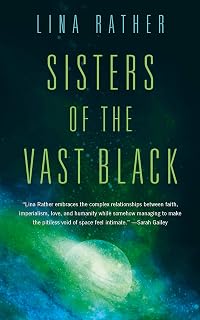
'Sisters Of The Forsaken Stars' continues the story that was started in ‘Sisters Of The Vast Black’, a book that Lina Rather described as being about ‘Nuns living in a giant slug in outer-space’.
When we met the Sisters of the Order of Saint Rita in the first book, they were a small community of nuns travelling in their convent, Our Lady of Impossible Constellations, a vast, genetically engineered mollusc called a Liveship, to tend to the sick and carry out marriages and baptisms in the outer reaches of mankind’s colonies in the stars. By the end of the book, some dark secrets about the sisters had been revealed and they’d managed to entangle themselves in a brutal covert struggle between Earth and its colonies. The ending show more was action-packed, explosive and surprising.
One way to write a sequel to a book like that is to ramp up the violence and the struggle and lead towards an even more explosive ending with even bigger consequences for humanity.
Lina Rather went a different way. She'd been writing about nuns in space, not Marines in space. The women in her story have chosen to live a religious life of service to others. Whatever their background before they joined the Order of Saint Rita, they are now women who bring peace and solace, not women who challenge governments and lead revolutions. Yet their actions have turned them into a legend that the Earth government wants to suppress and that some of the Colonists want to turn into a rallying cry of the revolution. So Lina Rather goes for the personal rather than the big-picture political. She explores how the Sisters find a path that allows them to honour their faith, to support each other and to minister to those who need them without either being killed or turned into a weapon.
The strength of the novella lies in its ability fully to imagine the reactions of the Sisters, a disparate group of women from many backgrounds and with different views on faith and responsibility but who have chosen to live as a community with a duty to serve God by ministering to others.
No one has any easy answers. Faith is tested. Trust is hard to gain. Threats keep multiplying and options keep narrowing.
I loved watching how these women thought through their problems and worked hard to maintain themselves as a community.
The story and the ending were lower-key than the first book but no less powerful for that. I hope there'll be a third book in the series. If there is, I'll be there, rooting for the Sisters in the Liveship. show less
It took me some time to get back to this future world in which living ships forge the vast interstellar distances and work as “traveling convents” for the nuns aboard, bringing help and comfort to those in need, but after the first few pages I felt again comfortable in this universe.
The sisters of the order of Saint Rita are dealing with the aftermath of the events from Sisters of the Vast Black, at the end of which they suffered heavy losses, both human and non-human, considering the death of their living ship-convent, named Our Lady of Impossible Constellations. Presently the nuns are traveling on a new ship, but it’s still a youngling so it needs constant care and nutrients, and since they broke any ties with the Church and show more Earth government funds are scarce and they have to keep a low profile and make do with what they can scrounge along the way.
Much of the story in Forsaken Stars hinges around these difficulties and the even greater threat of discovery: the nuns’ actions in revealing Earth’s responsibility in the deadly plague hitting rebellious colonies have turned them into a sort of heroic figures, taken as example and inspiration by those who are eager to shake off the yoke of Earth Governance, and they are constantly debating about how to travel the thin line separating their mission of help to those in need from the danger of becoming figureheads. The uncertainty weighing on the sisters is further enhanced by the arrival of two new people: Kristen, a young postulant asking to join the convent and Eris, the long-lost sister of Ewostatewos: the former represents the unknown factor that might unsettle the fragile balance aboard the ship, the latter is like an unwelcome spotlight shining on them because she is clearly on the run, and therefore a wanted individual.
Unlike the first book in the series, Forsaken Stars seems a little less…cohesive, for want of a better word, somewhat meandering at times, but with hindsight I can see how this uncertainty in plot is a mirror for the uncertainty plaguing the nuns who have lost their support system and have to forge a completely new way of doing things - and surviving - which might take some time before it’s ironed out into the precise mechanism it used to be with Our Lady of Impossible Constellations. Moreover, the nuns are dealing with the emotional fallout of their losses - even though not all of them are due to death, since former Sister Gemma left the convent to join her lover Vauca, an engineer on the deadship (i.e. a conventional construct) Cheng I Sao, where they try to nurture the failed shiplings in the hope of creating something new when they are not viable as future liveships.
If the plot feels a little meandering, what remains steady and strong is the sense of community among the nuns, particularly where external forces are trying to change (or co-opt) them or when personal issues threaten to intrude on their concept of faith, which here seems to be more oriented toward belief in the rightness of good works rather than adherence to dogma - and here I have to say that I appreciated how these nuns’ faith stands on the willingness to do good, to help the needy and, if possible, prevent the cruelty humans enjoy inflicting each other.
There are a few passing references to the difference between these space-faring nuns and the ones living on planets and conducting a more traditional monastic life of prayer and contemplation, references that I interpreted as respect for the kind of hands-on approach exhibited by the protagonists. It must also be said that physical distance from the Church - even before the nuns cut their ties with it and Earth - already prompted the nuns to find their own way to deal with spiritual matters, showing how doctrine cannot remain unchanged when the conditions for its applicability change due to the unpredictability of life away from humanity’s home planet.
Where the start of this second installment shows the nuns in a state of flux, the dramatic events happening toward the end of the book bring it out of the perceived middle-book syndrome and point toward a road fraught with dangers, yes, but also with great possibilities: while the short form of this novella suffers from a certain lack of development that cries out for a longer narrative span, it also leaves ample room for the expansion of the story in many possible directions. It will be interesting to see where it will lead us next…. show less
The sisters of the order of Saint Rita are dealing with the aftermath of the events from Sisters of the Vast Black, at the end of which they suffered heavy losses, both human and non-human, considering the death of their living ship-convent, named Our Lady of Impossible Constellations. Presently the nuns are traveling on a new ship, but it’s still a youngling so it needs constant care and nutrients, and since they broke any ties with the Church and show more Earth government funds are scarce and they have to keep a low profile and make do with what they can scrounge along the way.
Much of the story in Forsaken Stars hinges around these difficulties and the even greater threat of discovery: the nuns’ actions in revealing Earth’s responsibility in the deadly plague hitting rebellious colonies have turned them into a sort of heroic figures, taken as example and inspiration by those who are eager to shake off the yoke of Earth Governance, and they are constantly debating about how to travel the thin line separating their mission of help to those in need from the danger of becoming figureheads. The uncertainty weighing on the sisters is further enhanced by the arrival of two new people: Kristen, a young postulant asking to join the convent and Eris, the long-lost sister of Ewostatewos: the former represents the unknown factor that might unsettle the fragile balance aboard the ship, the latter is like an unwelcome spotlight shining on them because she is clearly on the run, and therefore a wanted individual.
Unlike the first book in the series, Forsaken Stars seems a little less…cohesive, for want of a better word, somewhat meandering at times, but with hindsight I can see how this uncertainty in plot is a mirror for the uncertainty plaguing the nuns who have lost their support system and have to forge a completely new way of doing things - and surviving - which might take some time before it’s ironed out into the precise mechanism it used to be with Our Lady of Impossible Constellations. Moreover, the nuns are dealing with the emotional fallout of their losses - even though not all of them are due to death, since former Sister Gemma left the convent to join her lover Vauca, an engineer on the deadship (i.e. a conventional construct) Cheng I Sao, where they try to nurture the failed shiplings in the hope of creating something new when they are not viable as future liveships.
If the plot feels a little meandering, what remains steady and strong is the sense of community among the nuns, particularly where external forces are trying to change (or co-opt) them or when personal issues threaten to intrude on their concept of faith, which here seems to be more oriented toward belief in the rightness of good works rather than adherence to dogma - and here I have to say that I appreciated how these nuns’ faith stands on the willingness to do good, to help the needy and, if possible, prevent the cruelty humans enjoy inflicting each other.
There are a few passing references to the difference between these space-faring nuns and the ones living on planets and conducting a more traditional monastic life of prayer and contemplation, references that I interpreted as respect for the kind of hands-on approach exhibited by the protagonists. It must also be said that physical distance from the Church - even before the nuns cut their ties with it and Earth - already prompted the nuns to find their own way to deal with spiritual matters, showing how doctrine cannot remain unchanged when the conditions for its applicability change due to the unpredictability of life away from humanity’s home planet.
Where the start of this second installment shows the nuns in a state of flux, the dramatic events happening toward the end of the book bring it out of the perceived middle-book syndrome and point toward a road fraught with dangers, yes, but also with great possibilities: while the short form of this novella suffers from a certain lack of development that cries out for a longer narrative span, it also leaves ample room for the expansion of the story in many possible directions. It will be interesting to see where it will lead us next…. show less
Sisters of the Forsaken Stars is a remarkable follow-up to Lina Rather's previous novella, Sisters of the Vast Black. I have a soft spot for stories that engage with the tensions one so often encounters in the intersections of religious faith, moral requirements, obligations to institutions, and personal dreams, desires, beliefs, and aspirations. Both novellas do so beautifully, Sisters of the Forsaken Stars building on and expanding the foundations laid in its predecessor.
If much of Sisters of the Vast Black’s focus was largely on individual choices, Sisters of the Forsaken Stars zooms out to place more consideration on the consequences choices made by both individuals and groups can have not only on those groups and individuals but show more on the futures of whole societies. The stakes grow ever greater for these spacefaring nuns and all the people they encounter, but Rather’s writing remains eloquently personal.
There are a lot of reasons I would recommend this novella. First of all, it is a pleasure to read, written in clear, unfussy prose that largely stays out of the story’s way without becoming dull. Its themes are immensely engaging, their particular combination of faith and queerness making for a truly captivating read. This is a deeply moving story, and the kind of thought-provoking that will keep readers thinking long after the last page is turned.
I received a free e-ARC of this title from the publisher via NetGalley in exchange for my review. show less
If much of Sisters of the Vast Black’s focus was largely on individual choices, Sisters of the Forsaken Stars zooms out to place more consideration on the consequences choices made by both individuals and groups can have not only on those groups and individuals but show more on the futures of whole societies. The stakes grow ever greater for these spacefaring nuns and all the people they encounter, but Rather’s writing remains eloquently personal.
There are a lot of reasons I would recommend this novella. First of all, it is a pleasure to read, written in clear, unfussy prose that largely stays out of the story’s way without becoming dull. Its themes are immensely engaging, their particular combination of faith and queerness making for a truly captivating read. This is a deeply moving story, and the kind of thought-provoking that will keep readers thinking long after the last page is turned.
I received a free e-ARC of this title from the publisher via NetGalley in exchange for my review. show less
I enjoyed this, but liked it less than Sisters of the Vast Black. To a great extent that's because this book felt a little more meandering, a little less cohesive—I've got to imagine that Lina Rather is banking on this being the middle book in an eventual trilogy, because the A plot and B plot don't really interact and Sisters of the Forsaken Stars doesn't so much "have an ending" as "end." I did like Rather's continuing emphasis on community, however, and her grappling with questions of humanity and the personal vs political and the responsibilities of myth making.
I was going to say something about how this mostly feels like a thoughtful character study, with a little bit of plot thrown in, until I was halfway through my next read, [b:Seven Down|56327556|Seven Down|David Whitton|https://i.gr-assets.com/images/S/compressed.photo.goodreads.com/books/1619568671l/56327556._SY75_.jpg|87758013], which could technically be described the same way but is a vastly inferior book (I'll hasten to qualify that I am clearly a sci-fi fan, and I venture into literary fiction with the same enthusiasm I approach vegan lasagna). At any rate, Forsaken arrived at the right mood and time (thanks, Netgalley!) and proved an enjoyable read.
I'd definitely recommend it, but there are, however, some caveats. One is a high show more tolerance for the question of authenticity in many forms. Though the sisters never set out to be heroes, in [b:Sisters of the Vast Black|44581558|Sisters of the Vast Black (Our Lady of Endless Worlds #1)|Lina Rather|https://i.gr-assets.com/images/S/compressed.photo.goodreads.com/books/1558536373l/44581558._SY75_.jpg|69197753], they found themselves taking actions that would be deemed as heroic, strictly by following their ethical dictates. Forsaken is dealing with some of the consequences of owning those actions, and choosing how they will be defined. After the fallout of Vast Black, we're also left knowing that they head of their small order was not the person they all thought she was, and some of the sisters are still coping with emotional fallout. Two, particularly now that I'm thinking about my review, though Forsaken takes place some time after the events of Vast Black, I think it would be more enjoyable to read the two closer together. I had forgotten most of Vast Black (I should have read my review, honestly), so there was a certain amount of impatience with what I saw as endless dithering. Three, and again keeping Seven Down in mind, I'd recommend one prefer the whole 'ship in space' premise.
The writing--in the 'words-strung-together' sense--is still solid. Highlights were made. The plotting felt more hesitant, and less streamlined than the first, so if you were frustrated there, you know it won't go well here. There's a secondary plot about the living ships and the ex-sister, but I don't know that it felt as integrated as I would have liked--it was rather plot adjacent. I found myself wanting to know more about what was going on in that ship, and the research they were doing. Overall, I happened to enjoy the thoughts about authenticity, responsibility and ethics and feel like that was more the point of the novella than the actual story, so take that for what you will.
[b:Sisters of the Vast Black|44581558|Sisters of the Vast Black (Our Lady of Endless Worlds #1)|Lina Rather|https://i.gr-assets.com/images/S/compressed.photo.goodreads.com/books/1558536373l/44581558._SY75_.jpg|69197753] review: https://www.goodreads.com/review/show/3038365339
Three and a half spaceships, rounding up for thoughtfulness
Many thanks to NetGalley and Macmillan-Tor/Forge for the advance reader copy! Of course all opinions are my own. show less
I'd definitely recommend it, but there are, however, some caveats. One is a high show more tolerance for the question of authenticity in many forms. Though the sisters never set out to be heroes, in [b:Sisters of the Vast Black|44581558|Sisters of the Vast Black (Our Lady of Endless Worlds #1)|Lina Rather|https://i.gr-assets.com/images/S/compressed.photo.goodreads.com/books/1558536373l/44581558._SY75_.jpg|69197753], they found themselves taking actions that would be deemed as heroic, strictly by following their ethical dictates. Forsaken is dealing with some of the consequences of owning those actions, and choosing how they will be defined. After the fallout of Vast Black, we're also left knowing that they head of their small order was not the person they all thought she was, and some of the sisters are still coping with emotional fallout. Two, particularly now that I'm thinking about my review, though Forsaken takes place some time after the events of Vast Black, I think it would be more enjoyable to read the two closer together. I had forgotten most of Vast Black (I should have read my review, honestly), so there was a certain amount of impatience with what I saw as endless dithering. Three, and again keeping Seven Down in mind, I'd recommend one prefer the whole 'ship in space' premise.
The writing--in the 'words-strung-together' sense--is still solid. Highlights were made. The plotting felt more hesitant, and less streamlined than the first, so if you were frustrated there, you know it won't go well here. There's a secondary plot about the living ships and the ex-sister, but I don't know that it felt as integrated as I would have liked--it was rather plot adjacent. I found myself wanting to know more about what was going on in that ship, and the research they were doing. Overall, I happened to enjoy the thoughts about authenticity, responsibility and ethics and feel like that was more the point of the novella than the actual story, so take that for what you will.
[b:Sisters of the Vast Black|44581558|Sisters of the Vast Black (Our Lady of Endless Worlds #1)|Lina Rather|https://i.gr-assets.com/images/S/compressed.photo.goodreads.com/books/1558536373l/44581558._SY75_.jpg|69197753] review: https://www.goodreads.com/review/show/3038365339
Three and a half spaceships, rounding up for thoughtfulness
Many thanks to NetGalley and Macmillan-Tor/Forge for the advance reader copy! Of course all opinions are my own. show less
The second in the series about the Sisters of St. Rita. It’s necessary to have read the first book, as this picks up after the events of that one and no time is wasted on filling in the reader on those past events. After finishing the two novellas in this series, I see a comparison with Becky Chambers’ Wayfarers series, but rather darker. There is more evil, though most characters are essentially good, and even most of the villains are depicted as redeemable, and characters find hope, or at least comfort or meaning, even in the direst of situations. Humanity is shown as capable of great evil but also great good, it’s very suspenseful near the end, but it’s ultimately a comforting read.
Series Info/Source: This is 2nd book in the Our Lady of Endless Worlds series. I bought this on ebook.
Thoughts: I enjoyed this continuation of this series. I absolutely love the intriguing world and living spaceships here. I didn't love that this book really delved more in to political aspects of the universe rather than the sisters' drive to help people.
The Order of Saint Rita has broken off from their parent society and are fleeing Central Governance to strike out on their own. They just want to fulfill their mission to help people in need across the galaxy. However, many people involved have other ideas. The sisters stop to resupply and make sure their new hatchling ship is healthy, but are drawn into another conspiracy full of show more traitors and plots to bring them back in to Central Governance.
I enjoyed this book, but not quite as much as the first book. The sisters are still a bit hard for me to differentiate between, and I wish their personalities were a bit more distinct. I also wish that more time was spent on the living ship and less on external parties trying to make the Order of Saint Rita some sort of revolutionary group. I also found the POV jumping between Gemma and the sisters felt disjointed and would have liked to spend more time with both groups for longer periods of time.
I do love all the space travel in here and the creative world. I would have loved to visit more planets in this intriguing galaxy. I also love the concept of the living ships and would love to learn more about them.
This was a fairly easy and quick read, but I was left feeling like I just wanted a bit more from this. I was also a bit disappointed about how political the story got.
My Summary (3.5/5): Overall I enjoyed some of the space travel and live ship aspects of this story. I was disappointed at how political this got and wished that the sisters had a bit more differentiation in personality to help tell them apart. Right now I am on the fence as to whether or not I will read more books in this series if there are more book released. They are a small time commitment to read and I do love the world here. show less
Thoughts: I enjoyed this continuation of this series. I absolutely love the intriguing world and living spaceships here. I didn't love that this book really delved more in to political aspects of the universe rather than the sisters' drive to help people.
The Order of Saint Rita has broken off from their parent society and are fleeing Central Governance to strike out on their own. They just want to fulfill their mission to help people in need across the galaxy. However, many people involved have other ideas. The sisters stop to resupply and make sure their new hatchling ship is healthy, but are drawn into another conspiracy full of show more traitors and plots to bring them back in to Central Governance.
I enjoyed this book, but not quite as much as the first book. The sisters are still a bit hard for me to differentiate between, and I wish their personalities were a bit more distinct. I also wish that more time was spent on the living ship and less on external parties trying to make the Order of Saint Rita some sort of revolutionary group. I also found the POV jumping between Gemma and the sisters felt disjointed and would have liked to spend more time with both groups for longer periods of time.
I do love all the space travel in here and the creative world. I would have loved to visit more planets in this intriguing galaxy. I also love the concept of the living ships and would love to learn more about them.
This was a fairly easy and quick read, but I was left feeling like I just wanted a bit more from this. I was also a bit disappointed about how political the story got.
My Summary (3.5/5): Overall I enjoyed some of the space travel and live ship aspects of this story. I was disappointed at how political this got and wished that the sisters had a bit more differentiation in personality to help tell them apart. Right now I am on the fence as to whether or not I will read more books in this series if there are more book released. They are a small time commitment to read and I do love the world here. show less
Members
- Recently Added By
Lists

2023 Hugo Awards -- Eligible Works -- Novellas
32 works; 8 members

Books Read in 2022
5,168 works; 114 members
Author Information

5+ Works 640 Members
Series

Common Knowledge
- Canonical title
- Sisters of the Forsaken Stars
- Original publication date
- 2022-02-15
- Original language
- English
Classifications
Statistics
- Members
- 129
- Popularity
- 253,330
- Reviews
- 13
- Rating
- (3.71)
- Languages
- English
- Media
- Paper, Audiobook, Ebook
- ISBNs
- 5
- ASINs
- 2