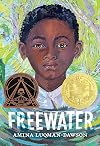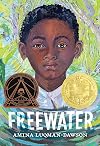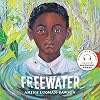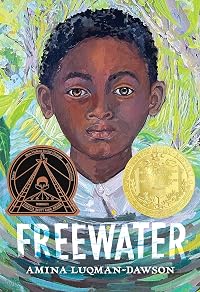
Freewater (Newbery & Coretta Scott King Award Winner)
by Amina Luqman-Dawson
On This Page
Description
After fleeing the plantation where they were enslaved, siblings Ada and Homer discover the secret community of Freewater, and work with freeborn Sanzi to protect their new home from the encroaching dangers of the outside world.Tags
Recommendations







Member Reviews
Homer and his little sister Ada run away from the plantation Southerland and into the swamp, where they are rescued and guided to the secret community of Freewater. There, they meet other free Black children: Freewater-born sisters, adventure-seeking Sanzi and capable Juna; and born-enslaved, now free gangly, stuttering Billy and proud, knife-wielding Ferdinand. But Homer and Ada arrived without Mama (Rose) and Anna, and Homer decides he has to go back for them. Ada and their new friends accompany them, planning for the day of Viola's wedding.
There are many stories set on plantations, many runaway and Underground Railroad stories, but this story of a community hidden in a swamp is unique. (2023 Newbery Medal)
Quotes
Even at seven, Ada show more holds right to her dreams. I'm the opposite. If it didn't work the first time, there was no way I'd be trying it again. (Homer, 7)
I learned how hurting can be caught, like a cold, or the pox. That's the thing about plantations: Even if you stay away from being hit, you can't keep away from the hurting. (Homer, 41)
The Big House and the fields aren't places for questions. My way was to see what needed learning. (Homer, 69)
"Out there, it's like you can't b-b-breathe. But you don't even know you can't breathe until you leave it." (Billy, 102)
It was the way Anna viewed the world. Anna didn't see things as they were - she saw them as she believed they were meant to be. That was a dangerous thing on a plantation. (108)
But what shook her to the core was the feeling she got from the [white] man's stare. It felt like he'd seen right through her. Like the Juna she'd been all her life didn't exist anymore....she was gone. (337)
There's no knowing about the light that being free brings you until you lose it. (Homer, 374)
This history is a reminder that wherever African enslavement existed in the Americas, a culture (and even communities) of extraordinary resistance was always present. (Author's note, 403) show less
There are many stories set on plantations, many runaway and Underground Railroad stories, but this story of a community hidden in a swamp is unique. (2023 Newbery Medal)
Quotes
Even at seven, Ada show more holds right to her dreams. I'm the opposite. If it didn't work the first time, there was no way I'd be trying it again. (Homer, 7)
I learned how hurting can be caught, like a cold, or the pox. That's the thing about plantations: Even if you stay away from being hit, you can't keep away from the hurting. (Homer, 41)
The Big House and the fields aren't places for questions. My way was to see what needed learning. (Homer, 69)
"Out there, it's like you can't b-b-breathe. But you don't even know you can't breathe until you leave it." (Billy, 102)
It was the way Anna viewed the world. Anna didn't see things as they were - she saw them as she believed they were meant to be. That was a dangerous thing on a plantation. (108)
But what shook her to the core was the feeling she got from the [white] man's stare. It felt like he'd seen right through her. Like the Juna she'd been all her life didn't exist anymore....she was gone. (337)
There's no knowing about the light that being free brings you until you lose it. (Homer, 374)
This history is a reminder that wherever African enslavement existed in the Americas, a culture (and even communities) of extraordinary resistance was always present. (Author's note, 403) show less
Homer and his sister Ada escape from the plantation where they are enslaved and find a community of free Black folk living in the swamp nearby. While they start to make friends in the community, Homer can't quite let go that his mother and his friend Anna were left behind.
The story is told primarily through Homer's eyes, but we also get the points of view of Sanzi, a girl born free in the swamp who dreams of adventure much to her mother's chagrin; Anna back on the plantation; Nora, the daughter of the enslavers; and a few more. The chapters are short and the pacing is fast for a 400-page historical fiction novel. There's not much known about the people and potential communities living in the marshes of North Carolina and Virginia, so show more the author has a fair amount of license to imagine what might of been, even while readers encounter the realities of slavery and racism. The writing is assured and impressive for a first novel. I greatly look forward to future books by this author. show less
The story is told primarily through Homer's eyes, but we also get the points of view of Sanzi, a girl born free in the swamp who dreams of adventure much to her mother's chagrin; Anna back on the plantation; Nora, the daughter of the enslavers; and a few more. The chapters are short and the pacing is fast for a 400-page historical fiction novel. There's not much known about the people and potential communities living in the marshes of North Carolina and Virginia, so show more the author has a fair amount of license to imagine what might of been, even while readers encounter the realities of slavery and racism. The writing is assured and impressive for a first novel. I greatly look forward to future books by this author. show less
When Homer’s family makes a run for freedom, things don’t go as planned. Separated from their mother and chased by dogs, Homer and his little sister Ada are rescued by Suleman, a mysterious wild man who leads them to Freewater, a secret settlement in the middle of the swamp. There, they meet many formerly enslaved people, and some children their own age who were born in Freewater. Sanzi is one of these, a girl about Homer’s age who longs to be a hero like Suleman, but who has never been allowed to leave the safety of Freewater. Homer and Ada are amazed at their first taste of freedom — but they long for a way to bring their mother to Freewater, too. A daring rescue plan, fraught with danger and including some unexpected show more companions, may be their best hope.
What an amazing book! This is an extraordinarily talented author, and one to watch, as this is her first novel. I was surprised at how quickly I was drawn into the story and how compelling I found it. The characters are fantastic, the writing strong, the setting fascinating, and the plot and pacing kept me on the edge of my seat. I don’t think the cover design does the book any favors, but the inside of the book is terrific. Fully deserving of the Newbery Medal, and highly recommend! show less
What an amazing book! This is an extraordinarily talented author, and one to watch, as this is her first novel. I was surprised at how quickly I was drawn into the story and how compelling I found it. The characters are fantastic, the writing strong, the setting fascinating, and the plot and pacing kept me on the edge of my seat. I don’t think the cover design does the book any favors, but the inside of the book is terrific. Fully deserving of the Newbery Medal, and highly recommend! show less
I had to do it. I had to read the book that won the Newbery Medal yet had not been mentioned anywhere. At least not that I could find ;) And at the end of the day, I think this is a very good selection to have indeed won. Especially when I think of the criteria.
Every character has a voice. From Homer who escapes from the Southerland Plantation and has no idea of where he is going. From Sanzi who longs to leave Freewater, the community/safe haven in the swamp for the "romantic" outside world. From Billy and Ferdinand and Juna--other Freewater children who still struggle with childlike issues and feelings. From Nora who is an outcast from her white family and who feels more of a connection to the slaves on her family's plantation. While I show more did struggle with the cast of characters feeling numerous at times, all of them did play a part in the story.
I felt the struggles and conflict. I literally had no idea how the book was going to end. Like was Homer going to get his mom from Southerland Plantation and go back to Freewater. I'm glad he did but legitimately, I was unsure until the final page. . I felt the mystery in the swamp location. I will confess to not knowing about Maroon Communities. How yes slaves escaped and sought to flee North on the Underground Railroad. That's the part that has been taught in schools. But I was unaware of how slaves fled into the swamp lands and made lives there. That it was very prevalent. I want to learn more about this part of our history.
It's beautifully written. A debut offering, I'll be intrigued to see what Amina Luqman-Dawson writes next. show less
Every character has a voice. From Homer who escapes from the Southerland Plantation and has no idea of where he is going. From Sanzi who longs to leave Freewater, the community/safe haven in the swamp for the "romantic" outside world. From Billy and Ferdinand and Juna--other Freewater children who still struggle with childlike issues and feelings. From Nora who is an outcast from her white family and who feels more of a connection to the slaves on her family's plantation. While I show more did struggle with the cast of characters feeling numerous at times, all of them did play a part in the story.
I felt the struggles and conflict. I literally had no idea how the book was going to end.
It's beautifully written. A debut offering, I'll be intrigued to see what Amina Luqman-Dawson writes next. show less
A young slave boy and his little sister escape from a plantation in the south. But instead of heading north, they find refuge in a community of escaped slaves living in the swamp. A good story, told from multiple perspectives. Audiobook was well done. Content considerations: some description of violence against slaves (not too graphic); some characters pray to the swamp for protection or thanksgiving. 2023 Newbery Award Winner
First sentence: Sanzi had broken yet another rule, but she didn't care.
Premise/plot: Freewater is the 2023 Newbery Award Winner. This historical novel has alternating narrators. Homer and Ada, two of our narrators, are runaway slaves; they are running for their lives, running towards freedom. They stumble into a swampy civilization comprised of former slaves and freeborn. Their community--their society--is unique. There are always those on the outside guarding the community within. Danger lurks--in general from white communities looking to chop down trees or claim/reclaim swamp lands, from those hunting slaves, from slave-hunting dogs.
The Southerland Plantation is the plantation Homer and Ada are running from. They left behind their show more mother and their friend(s). The novel also includes perspectives/voices from those--white and black--still on the plantation.
My thoughts: The subject is a heavy one for sure. It is not particularly "fun" and "enjoyable" to read about slaves, former slaves, etc. But reading doesn't always have to be fun nor enjoyable. Some books exist for the purpose of education or instruction. Or perhaps in this case to build empathy and understanding.
Would I have personally enjoyed this one more if there were fewer voices? fewer narrators? Perhaps. It's definitely possible. When the cast of characters is large, when there are so many voices, so many stories, so much going on with each character...it can be more difficult to connect and stay connected with the narrative as a whole. While I cared--in general--about what happened and if the community would be safe and continue to thrive, I didn't care as much about individuals telling the story. So I wanted to keep reading because of needing closure in general, but not because I was so invested in one person's story that I had to keep turning pages.
I am glad overall that I read this one. show less
Premise/plot: Freewater is the 2023 Newbery Award Winner. This historical novel has alternating narrators. Homer and Ada, two of our narrators, are runaway slaves; they are running for their lives, running towards freedom. They stumble into a swampy civilization comprised of former slaves and freeborn. Their community--their society--is unique. There are always those on the outside guarding the community within. Danger lurks--in general from white communities looking to chop down trees or claim/reclaim swamp lands, from those hunting slaves, from slave-hunting dogs.
The Southerland Plantation is the plantation Homer and Ada are running from. They left behind their show more mother and their friend(s). The novel also includes perspectives/voices from those--white and black--still on the plantation.
My thoughts: The subject is a heavy one for sure. It is not particularly "fun" and "enjoyable" to read about slaves, former slaves, etc. But reading doesn't always have to be fun nor enjoyable. Some books exist for the purpose of education or instruction. Or perhaps in this case to build empathy and understanding.
Would I have personally enjoyed this one more if there were fewer voices? fewer narrators? Perhaps. It's definitely possible. When the cast of characters is large, when there are so many voices, so many stories, so much going on with each character...it can be more difficult to connect and stay connected with the narrative as a whole. While I cared--in general--about what happened and if the community would be safe and continue to thrive, I didn't care as much about individuals telling the story. So I wanted to keep reading because of needing closure in general, but not because I was so invested in one person's story that I had to keep turning pages.
I am glad overall that I read this one. show less
This year's Newbery medalist tells the story of Freewater, a refuge for escaped slaves in the antebellum south. Two children run away from their plantation and are saved by the inhabitants of Freewater. They come to know what it means to be free, and go back to rescue their mother and friends.
A gripping narrative with great characters, I loved that this story was based on the actual existence of such communities in the swamps. I can easily see the book becoming a favorite for middle graders for its story and then leading them to learn more about slavery and the ways black people resisted it. Definitely recommended.
A gripping narrative with great characters, I loved that this story was based on the actual existence of such communities in the swamps. I can easily see the book becoming a favorite for middle graders for its story and then leading them to learn more about slavery and the ways black people resisted it. Definitely recommended.
Members
- Recently Added By
Lists

Best Newbery Medal Winners
97 works; 54 members

Newbery Medal Winners - By Year
105 works; 7 members

Youth: BLM
265 works; 1 member

SYES Library Wishlist
1,080 works; 4 members

Summer Reading 2023
14 works; 1 member

Books Read in 2023
5,547 works; 145 members

Top Five Books of 2023
767 works; 317 members
Author Information

2 Works 443 Members
Some Editions
Awards and Honors
Awards
Distinctions
Notable Lists
Common Knowledge
- People/Characters
- Homer; Ada; Sanzi; Rose; Two Shoes/Turner; Old Joe (show all 24); Suleman; Anna; Mrs. Petunia; Nora Crumb; Viola Crumb; Sherline Crumb; Mr. Crumb; Stokes; Rick; Ron; David; Ibra; Daria; Billy; Juna; Mrs. Light; Sky; Ferdinand
- Important places
- Great Dismal Swamp, USA
- Dedication
- To Zach, and to generations of enslaved children each of whom deserves a voice in this world
- Blurbers
- Appelt, Kathi; Diouf, Sylviane A.; Harris, Meena; Park, Linda Sue
Classifications
- Genres
- Children's Books, Kids, Tween, Fiction and Literature
- DDC/MDS
- 813.6 — Literature & rhetoric American literature in English American fiction in English 2000-
- LCC
- PZ7.1 .L865 .F — Language and Literature Fiction and juvenile belles lettres Fiction and juvenile belles lettres Juvenile belles lettres
- BISAC
Statistics
- Members
- 442
- Popularity
- 69,395
- Reviews
- 24
- Rating
- (4.37)
- Languages
- English, Korean
- Media
- Paper, Audiobook, Ebook
- ISBNs
- 13
- ASINs
- 2