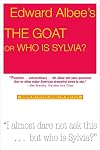
The Goat, or Who is Sylvia?
by Edward Albee
On This Page
Description
"In the play, Martin - a hugely successful architect who has just turned fifty - leads an ostensibly ideal life with his loving wife and gay teenage son. But when he confides to his best friend that he is also in love with a goat (named Sylvia), he sets in motion events that will destroy his family and leave his life in tatters."--BOOK JACKET.Tags
Recommendations








Member Reviews
The goat is an object of protagonist's amatory longings. If that's not your cup of tea, I'd suggest you don't read this. Otherwise, this is one of the best plays about a marriage riven by one man's love for a goat and the woman repelled by the thought of man-on-caprine-beast coupling that I've ever read, even if it's also the only play I've read about such things. That means I liked it.
EDWARD ALBEE. THE GOAT OR WHO IS SYLVIA: NOTES TOWARD A DEFINITION OF TRAGEDY. 2000
SUMMARY:
Scene One:
As the play opens, Martin seems disoriented and forgetful or perhaps just plain preoccupied. He’s preparing to be interviewed by his old friend Ross. Martin and Stevie, his wife, are obviously still in love after many years together, although today their conversation seems disjointed....they don’t seem to be on the same wavelength. While in a play acting mode, Martin tells Stevie that he’s been unfaithful to her with a goat, which she naturally takes as a joke. After Ross arrives, there’s some talk of aging between the old friends and during the soon to be aborted interview, we learn that Martin is a prize winning architect who show more has been selected to construct the World City of the Future. We also learn that it’s his birthday (he’s 50). Martin’s responses during the interview seem ironic or perhaps he is just distracted, but the result is a funny scene although it results in the interview being scuttled. Ross senses something is bothering Martin and he finally elicits a confession from Martin that he has indeed been having an affair with a goat. Martin’s constant refrain through the rest of the play is “You don’t understand.”
Scene Two:
Stevie gets Ross’ letter and she winds up in a turmoil of jealousy and confusion. She feels betrayed and their openly gay son, Billy, seems to have lost respect for his father. During their argument, Stevie is in a rage and winds up destroying vases and lamps, before she exits the scene, threatening to bring Martin down.
Scene Three:
Although, it appears that the revelation about Martin has succeeded in destroying his marriage, this scene has some very touching moments between Billy and his father, which in fact culminate in a sensual embrace and a kiss which is witnessed by Ross who is shocked and contemptuous of such sensuality between father and son, calling it sick. Martin boldly speaks of how, as human beings, we have little control over what arouses a sensual response and how it can happen in any situation, however inappropriate it may be. He mentions examples of babies on laps and St Sebastian being penetrated by arrows. In Martin’s view what is truly sick is Ross’ betrayal of confidence and he’s appalled that Ross’ outrage seems to be contingent on whether or not people will find out the facts. The play ends in an outrageous scene in which a bloodied Stevie returns dragging a dead goat, apparently Sylvia. Martin cries in anguish: “What did she ever do?” Stevie says: “She loved you as much as I do.” The curtain falls.
CRITIQUE
Well, this play gives us a lot to chew on and first off, we would have to acknowledge that something is always lost in the reading of a play as opposed to attending a performance, especially when dealing with a metaphorical play of ideas, such as this one. To me the play seems to be about the many ways that love expresses itself through us as human beings and how our conventional perceptions and judgements can destroy relationships when such ways are revealed.
The complex play seems rich with ideas and probably generates more questions than answers. Questions such as:
Are there limits to whom or what we should love?
Are we mere vehicles for the expression of love beyond our personal and collective judgements, thus making jealousy an exercise in futility?
Are there certain sexual passions that should remain forbidden, however natural they might be for an individual?
Should certain sexual expressions be considered wrong or evil because they don’t conform to societal conventions?
On the level of acceptability, how does homosexuality come off in this play where bestiality is presented as the extreme? From this perspective, can this play in essence really be all about attitudes regarding homosexuality?
All these rather profound questions have failed to convey, however, my delight in reading what at times I found to be a very funny, moving, and entertaining play.
Thumbs up!!
LCB show less
SUMMARY:
Scene One:
As the play opens, Martin seems disoriented and forgetful or perhaps just plain preoccupied. He’s preparing to be interviewed by his old friend Ross. Martin and Stevie, his wife, are obviously still in love after many years together, although today their conversation seems disjointed....they don’t seem to be on the same wavelength. While in a play acting mode, Martin tells Stevie that he’s been unfaithful to her with a goat, which she naturally takes as a joke. After Ross arrives, there’s some talk of aging between the old friends and during the soon to be aborted interview, we learn that Martin is a prize winning architect who show more has been selected to construct the World City of the Future. We also learn that it’s his birthday (he’s 50). Martin’s responses during the interview seem ironic or perhaps he is just distracted, but the result is a funny scene although it results in the interview being scuttled. Ross senses something is bothering Martin and he finally elicits a confession from Martin that he has indeed been having an affair with a goat. Martin’s constant refrain through the rest of the play is “You don’t understand.”
Scene Two:
Stevie gets Ross’ letter and she winds up in a turmoil of jealousy and confusion. She feels betrayed and their openly gay son, Billy, seems to have lost respect for his father. During their argument, Stevie is in a rage and winds up destroying vases and lamps, before she exits the scene, threatening to bring Martin down.
Scene Three:
Although, it appears that the revelation about Martin has succeeded in destroying his marriage, this scene has some very touching moments between Billy and his father, which in fact culminate in a sensual embrace and a kiss which is witnessed by Ross who is shocked and contemptuous of such sensuality between father and son, calling it sick. Martin boldly speaks of how, as human beings, we have little control over what arouses a sensual response and how it can happen in any situation, however inappropriate it may be. He mentions examples of babies on laps and St Sebastian being penetrated by arrows. In Martin’s view what is truly sick is Ross’ betrayal of confidence and he’s appalled that Ross’ outrage seems to be contingent on whether or not people will find out the facts. The play ends in an outrageous scene in which a bloodied Stevie returns dragging a dead goat, apparently Sylvia. Martin cries in anguish: “What did she ever do?” Stevie says: “She loved you as much as I do.” The curtain falls.
CRITIQUE
Well, this play gives us a lot to chew on and first off, we would have to acknowledge that something is always lost in the reading of a play as opposed to attending a performance, especially when dealing with a metaphorical play of ideas, such as this one. To me the play seems to be about the many ways that love expresses itself through us as human beings and how our conventional perceptions and judgements can destroy relationships when such ways are revealed.
The complex play seems rich with ideas and probably generates more questions than answers. Questions such as:
Are there limits to whom or what we should love?
Are we mere vehicles for the expression of love beyond our personal and collective judgements, thus making jealousy an exercise in futility?
Are there certain sexual passions that should remain forbidden, however natural they might be for an individual?
Should certain sexual expressions be considered wrong or evil because they don’t conform to societal conventions?
On the level of acceptability, how does homosexuality come off in this play where bestiality is presented as the extreme? From this perspective, can this play in essence really be all about attitudes regarding homosexuality?
All these rather profound questions have failed to convey, however, my delight in reading what at times I found to be a very funny, moving, and entertaining play.
Thumbs up!!
LCB show less
Strange, funny, and sad by turns... I'll have to think about this one some more.
Hilarious, brilliant dialogue… but what the everloving hell?? Still reeling. Sex sucks.
one of those plays that makes you feel not so all alone. way out there story about a successful dude who's mid-life crisis is falling in love with a goat. that's right, the animal. a surreal story tries to be a modern day Shakespeare type drama/tragedy funny bits overall kind of a toss away. in 20 years it may be important.
Strange, funny, and sad by turns... I'll have to think about this one some more.
Pretty ingenius...language is extremely impressive...
Members
- Recently Added By
Lists

My Play Collection
769 works; 3 members

Next Plays / 2025
352 works; 1 member
Author Information

105+ Works 11,156 Members
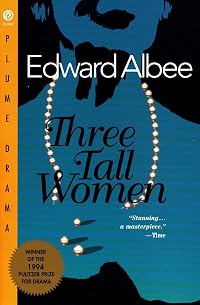
Edward Albee was born in Virginia on March 12, 1928. His first produced play, The Zoo Story, opened in Berlin in 1959 before playing at the Provincetown Playhouse in Greenwich Village the following year. In 1960, it won the Vernon Rice Memorial Award. In 1962, his Broadway debut, Who's Afraid of Virginia Woolf?, won a Tony Award for best play. It show more was adapted into a film starring Richard Burton and Elizabeth Taylor in 1966. He wrote about 30 plays during his lifetime including The Sandbox, The American Dream, The Death of Bessie Smith, All Over, and The Play About the Baby. He won the Pulitzer Prize three times for A Delicate Balance in 1966, Seascape in 1975, and Three Tall Women in 1991. Three Tall Women also received Best Play awards from the New York Drama Critics Circle and Outer Critics Circle. He won another Tony Award for The Goat, or Who Is Sylvia? and a Lifetime Achievement Tony Award in 2005. He had died after a short illness on September 16, 2016 at the age of 88. (Bowker Author Biography) show less
Some Editions
Awards and Honors
Series
Belongs to Publisher Series
Modern Classics {Methuen Drama} (Albee)
Common Knowledge
- Canonical title*
- The goat or Who is Sylvia?
- Original title
- The Goat, or Who Is Sylvia?
- Original publication date
- 2000
- People/Characters*
- Martin; Stevie; Billy; Ross; Sylvia (the goat)
- Important events*
- The Pritzker Price
- Dedication*
- for Liz McCann - because
- First words*
- Stevie (on stage, arranging flowers) (calling off-stage) What time are they coming?
- Last words*
- (Click to show. Warning: May contain spoilers.)Billy - (To Martin) Dad? (To Stevie) Mom? (no reaction of them).
Tableau - Original language
- English
- Disambiguation notice
- 1350184772 2021 Methuen Drama Modern Classics
1585676470 2004 Abrams Press
*Some information comes from Common Knowledge in other languages. Click "Edit" for more information.
Classifications
Statistics
- Members
- 464
- Popularity
- 65,849
- Reviews
- 8
- Rating
- (3.93)
- Languages
- English, Portuguese, Spanish
- Media
- Paper, Ebook
- ISBNs
- 7
- ASINs
- 11