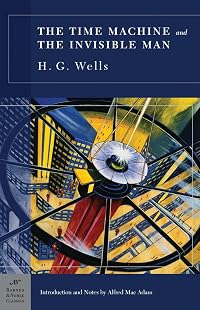
The Time Machine / The Invisible Man
by H. G. Wells
On This Page
Description
In the first of these two science fiction stories a scientist invents a machine that transports him into the future. In the second story a man watches his body slowly become invisible.Tags
Recommendations
















Member Reviews
This is a reread and is as good as I remember it when I discovered it as an undergraduate in - where else? - a bar. A Viking bar, no less.
My respect for Wells both as an author and a philosopher deepens with every read and reread. His style is a lot less florid than other writers of his generation, and I wonder now if this is one of the reasons he stood out then. The anti-hero had probably been used before as the protagonist in a novel, but Wells doesn't bother to make him sympathetic. Instead he just gives you a good yarn that has stood the test of time.
I haven't gotten around to rereading The Time Machine yet, but I will soon.
My respect for Wells both as an author and a philosopher deepens with every read and reread. His style is a lot less florid than other writers of his generation, and I wonder now if this is one of the reasons he stood out then. The anti-hero had probably been used before as the protagonist in a novel, but Wells doesn't bother to make him sympathetic. Instead he just gives you a good yarn that has stood the test of time.
I haven't gotten around to rereading The Time Machine yet, but I will soon.
Not my favorite. Wells has a stilted style that comes across as snobbish. But I did admire some of his tactics.
I've been on a tiny Invisible Man streak, "Memoirs of an Invisible Man" and then Wells' version. I enjoyed the former much more than the latter - just find it difficult to get into Wells era's mindset. Nevertheless, it was interesting to look at the perils and contrasts between the two stories. In Memoirs, the protagonist has invisibility thrust upon him, whereas Wells' main character achieves invisibility through his own efforts. Both protagonists have big problems with their new-found "power", much of which follows from trying to remain undetected. Interesting to contemplate the practical difficulties (food, shelter, etc.) that come along with invisibility. It still feels like there are many more possible takes on this mini-genre.
Most children think of invisibility as a super power, so this book’s protagonist being both invisible and hobbled was an ingenious idea. Invisibility is only a superpower if one can become visible again at will. Then the parallels to subjective invisibility are also easy to come to…
It was also interesting that Wells "protagonist" has no redeeming qualities. If Wells had a point to make I can’t help but wonder how he was accomplishing it with an angry, crazy main character.
It was also interesting that Wells "protagonist" has no redeeming qualities. If Wells had a point to make I can’t help but wonder how he was accomplishing it with an angry, crazy main character.
The first of these short novels represents what Wells thought might be outcome of the gap in class differences in the distant future from his perspective in 1899. It was rather a startling scenario of a childlike, carefree, lethargic elite who are given over completely to pleasure, and an industrious, brutish lower class who prey upon the elite for food.
The second is about what happens when a man attains a scientific marvel, and how it not only changes him physically, but how it changes his personality as well, and how it eventually destroys him.
I loved both of these books, even though I am no sci-fi fan.
The second is about what happens when a man attains a scientific marvel, and how it not only changes him physically, but how it changes his personality as well, and how it eventually destroys him.
I loved both of these books, even though I am no sci-fi fan.
I really enjoyed The Time Machine. What I love most about the book is the time traveler is never given a name only a gender. It is also left open as to what was the final end of the traveler. So for all we know, he is anywhere on the time spectrum. How excellent! I usually don't like books that do not provide me with a conclusion. I guess that makes me linear, but I like a beginning, climax, and end to a story. When I tell a story I tell them that way, so I guess I like to read or listen to them that way.
Though I have indulged in many classical as well as modern books I had never read an H.G. Wells book before. I saw the movie "The Time Machine" when I was just a little girl, but never thought to read the book. I can't wait to get more show more of Wells. show less
Though I have indulged in many classical as well as modern books I had never read an H.G. Wells book before. I saw the movie "The Time Machine" when I was just a little girl, but never thought to read the book. I can't wait to get more show more of Wells. show less
The Time Machine is the classic novella that birthed one the world’s most famous science fiction authors, H.G. Wells. It tells the story of “The Time Traveler” and the adventures he has using the time machine he invented. The novella begins with the Time Traveler briefly explaining space and time and how traveling between the two is possible to a small group of friends during an apparent weekly gathering. The following week, the group gathers again and The Time Traveler explains his adventures while using the Time Machine. He describes watching the time pass quickly before his eyes as he sits in his machine and what he sees when he stops in the year 802,701. He describes what he believes to be a Utopian society of human-like show more creatures called Eloi. The Eloi are peaceful people, living their lives harmoniously together with all their needs somehow mysteriously met. They are complete vegetarians and The Time Traveler notes that there appears to be no animals whatsoever. They have no known leadership and seem to have no worries and no fear. However, he is deceived by his initial impression. The Eloi do fear one thing; darkness. The Time Traveler discovers why when he spots a creature completely unlike the Eloi; a white human-like creature called a Morlock. The Time Traveler chases one of these Morlocks into what he believes to be a well of some kind. He soon discovers that the Morlocks are subterranean creatures and that they have taken his time machine. A brief battle ensues when The Time Traveler attempts to retrieve his machine and he is saved by using the machine. He goes several hundreds of thousands more years into the future and sees what can only be the eventual destruction of the earth by the sun.
In my opinion, the key parts of this book are The Time Travelers commiserations on the Eloi and the Morlocks. He thinks that at some point the human species split, some living above ground know as the Eloi and others living below ground, the Morlocks. He hypothesizes that over the generations, the well-to-do committed the poorer classes to the subterranean depths as laborers. I found this part particularly poignant given the current trend in America of the gradual diminishment of the middle class. Could it be that the book tells what the future truly holds for the human race? Anything is possible. However, I hope that we do not diminish in our humanity to the level of the things the Morlock’s did in order to survive.
The Time Machine is a great short read and definitely deserves it’s place in the 1001 Books You Must Read Before You Die list.
The Invisible Man is another classic H.G. Wells novella. It tells the story of Griffin, a scientist who doses himself with a serum he created that causes invisibility. Griffin discovers that being invisible has its benefits, but it also has downfalls. Griffin eventually goes mad and believes that with his new power of invisibility he can rule the town of Port Burdock. It is unclear whether Griffin was the typical “mad scientist” before taking the serum or whether it is a result of the serum. My wager would be the former.
I did not find The Invisible Man as good as The Time Traveler but it still deserves it’s place on the 1001 Books You Must Read Before You Die list. show less
In my opinion, the key parts of this book are The Time Travelers commiserations on the Eloi and the Morlocks. He thinks that at some point the human species split, some living above ground know as the Eloi and others living below ground, the Morlocks. He hypothesizes that over the generations, the well-to-do committed the poorer classes to the subterranean depths as laborers. I found this part particularly poignant given the current trend in America of the gradual diminishment of the middle class. Could it be that the book tells what the future truly holds for the human race? Anything is possible. However, I hope that we do not diminish in our humanity to the level of the things the Morlock’s did in order to survive.
The Time Machine is a great short read and definitely deserves it’s place in the 1001 Books You Must Read Before You Die list.
The Invisible Man is another classic H.G. Wells novella. It tells the story of Griffin, a scientist who doses himself with a serum he created that causes invisibility. Griffin discovers that being invisible has its benefits, but it also has downfalls. Griffin eventually goes mad and believes that with his new power of invisibility he can rule the town of Port Burdock. It is unclear whether Griffin was the typical “mad scientist” before taking the serum or whether it is a result of the serum. My wager would be the former.
I did not find The Invisible Man as good as The Time Traveler but it still deserves it’s place on the 1001 Books You Must Read Before You Die list. show less
Members
- Recently Added By
Lists

Best Sellers / Popular 1968
237 works; 5 members
Author Information

1,563+ Works 109,364 Members
H. G. Wells was born in Bromley, England on September 21, 1866. After a limited education, he was apprenticed to a draper, but soon found he wanted something more out of life. He read widely and got a position as a student assistant in a secondary school, eventually winning a scholarship to the Royal College of Science in South Kensington, where show more he studied biology. He graduated from London University in 1888 and became a science teacher. He also wrote for magazines. When his stories began to sell, he left teaching to write full time. He became an author best known for science fiction novels and comic novels. His science fiction novels include The Time Machine, The War of the Worlds, The Wonderful Visit, The Island of Doctor Moreau, The Invisible Man, The First Men in the Moon, and The Food of the Gods. His comic novels include Love and Mr. Lewisham, Kipps: The Story of a Simple Soul, The History of Mr. Polly, and Tono-Bungay. He also wrote several short story collections including The Stolen Bacillus, The Plattner Story, and Tales of Space and Time. He died on August 13, 1946 at the age of 79. (Bowker Author Biography) show less
Some Editions
Series
Belongs to Publisher Series
Work Relationships
Contains
Common Knowledge
- Canonical title
- The Time Machine / The Invisible Man
- Original title
- The Time Machine / The Invisible Man
- Original publication date
- 1895
- People/Characters
- The Time Traveller; Weena; Invisible Man; Invisible Man (Griffin); Griffin (Invisible Man); Dr. Kemp (show all 13); Mr. Hall; Mrs. Hall; Thomas Marvel; Col. Adye; Dr. Cuss; Mr. Bunting; J.A. Jaffers
- Important places
- Iping, West Sussex, England, UK; Coach and Horses
- Important events
- Victorian Era; End of the World
- Related movies
- The Time Machine (1960 | IMDb); The Time Machine (2002 | IMDb); The Invisible Man (1933 | IMDb)
- First words
- The Time Traveller (for so it will be convenient to speak of him) was expounding a recondite matter to us. (The Time Machine)
- Last words
- (Click to show. Warning: May contain spoilers.)And none other will know of them until he dies.
Classifications
Statistics
- Members
- 2,302
- Popularity
- 8,698
- Reviews
- 17
- Rating
- (4.00)
- Languages
- Dutch, English, Spanish
- Media
- Paper, Audiobook, Ebook
- ISBNs
- 28
- ASINs
- 20