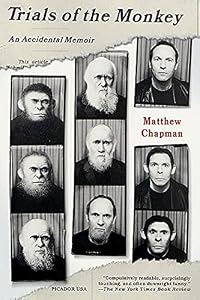
Trials of the Monkey: An Accidental Memoir
by Matthew Chapman
On This Page
Description
"When Darwin called his second book The Descent of Man instead of The Ascent of Man, he was thinking of his progeny." "So declares Darwin's great-great-grandson Matthew Chapman as he leaves behind his stressful career as a Hollywood screenwriter and travels to Dayton, Tennessee, where in 1925 creationist opposition to the teaching of evolution in schools was played out in a famous legal drama, the so-called Scopes Monkey Trial." "The purpose of this journey is to see if opinions have changed show more in the seventy-five intervening years. A defiant atheist, Chapman records his encounters in the South, where he is confronted not only by fundamentalists still trying to banish the theory of evolution but also, ironically, by his own spiritual malaise. The outward journey becomes an inward quest, a tragicomic accidental memoir."--Jacket. show lessTags
Recommendations










Member Reviews
Matthew Chapman is the great-great-grandson of Charles Darwin. He's also a screenwriter and director of some note — at least to his lights. He's also an avowed atheist who decided to investigate the site of the famous "monkey trial," the infamous battle between religion and science in Dayton, Tennessee immortalized in the wonderful film Inherit the Wind. The book becomes a combination historical narrative/ memoir/personal voyage. He explains his interest in the Scopes trial this way: After a bus driver explains he belongs to the Pentecostal Church, where people speak in tongues and "fall over backwards" — 'It's amazin,' I ain't never seen one git hurt' — using that as incontrovertible evidence of the existence of God, Chapman is show more compelled to observe that "It requires so little proof on the one hand and so much on the other. People will inform you that Jesus was born of an angel-impregnated virgin and walked on water 'because it's in the Bible,' but think nothing of telling you with a sniff of contempt that evolution is 'just a theory, ain't no proof.' The inherent unfairness of this double standard is one of the things that attracts me to the Scopes Trial."
There are books about the Scopes trial that provide much more detail of how George Rappleyea, a Dayton resident, wanted to take advantage of the controversy surrounding passage of the Tennessee law that forbade the teaching of evolution, by hosting a trial in Dayton, a town that had suffered a severe economic downturn after a local mine closed. Inherit the Wind provides a good feel for the climate (pun intended) of the trial and community, but simplifies tremendously. The defense and prosecution each had four to five lawyers and one of the famous speeches for the defense was actually given by Dudley Malone rather than by Charles Darrow, one of my heroes — but those are minor quibbles.
Chapman, an open-minded, good-humored fellow, recounts his delinquent childhood and his musings about life in general as he visits with the Bryan College professor who teaches "proof" of creation and with a local minister, attending his church. He confronts his preconceptions of the South, his "neurotic city-dweller" northernness — fearing the banjo-toting violent, redneck with the gun rack in the truck. What he finds most disturbing, however is the pervasive religiosity. "I feel adrift. It makes me uneasy. What I find disturbing is not so much the belief in God, but the habit of credulity which it engenders. If they can believe in God --who never shows his face — simply because it makes them feel good, what else might they be persuaded to believe in? What's the difference between religious evangelism and political propaganda? Might one prepare you for the other? Was it not credulity as much as 'evil' which made the attempted extermination of the Jews possible?
Chapman goes on a field trip with some of the Bryan College geology students to visit a cave that their professor explains has evidence of the creationist theory of creation. On the way back in the van, he engages in a discussion with the students about hell, and they reveal a certainty that those who do not accept Jesus as their personal savior will be consigned to an everlasting hell. "I'm not saying these kids are Nazis — I like them, in fact — but . . . believing in a literal hell, a burning lake, an inferno of unimaginable suffering, they accept with equanimity that seven-eighths of the world, including me, will end up in it. Forever. . . "Either they don't really believe this or in fact there is something Nazi-like about them: their Final Solution is one of extraordinary scope and brutality; a holocaust of souls which makes the Führer's merely physical extermination of the Jews seem positively amateur. 'Our Father' is far more ambitious: he's going for the eternal destruction of not just Jews, but Hindus, Homos, Muslims, Buddhists, Catholics, atheists, agnostics, and presumably Scientologists and others on the lunatic fringe. Seven-eighths of the people He creates, He then destroys. The only place you get worse odds is the abattoir. The girl I'm looking at as I'm thinking this is an accounting major. How on earth can she become an accountant? Then what? A mother? Little League? A nice home? One of those vans with a sliding door down the side? Knowing what she knows, how can she even contemplate this? How could you enjoy the comforts of a suburban life knowing that your God is going to flambé just about everyone you meet? But there she sits, as optimistic and contented as any teenager I ever met." show less
There are books about the Scopes trial that provide much more detail of how George Rappleyea, a Dayton resident, wanted to take advantage of the controversy surrounding passage of the Tennessee law that forbade the teaching of evolution, by hosting a trial in Dayton, a town that had suffered a severe economic downturn after a local mine closed. Inherit the Wind provides a good feel for the climate (pun intended) of the trial and community, but simplifies tremendously. The defense and prosecution each had four to five lawyers and one of the famous speeches for the defense was actually given by Dudley Malone rather than by Charles Darrow, one of my heroes — but those are minor quibbles.
Chapman, an open-minded, good-humored fellow, recounts his delinquent childhood and his musings about life in general as he visits with the Bryan College professor who teaches "proof" of creation and with a local minister, attending his church. He confronts his preconceptions of the South, his "neurotic city-dweller" northernness — fearing the banjo-toting violent, redneck with the gun rack in the truck. What he finds most disturbing, however is the pervasive religiosity. "I feel adrift. It makes me uneasy. What I find disturbing is not so much the belief in God, but the habit of credulity which it engenders. If they can believe in God --who never shows his face — simply because it makes them feel good, what else might they be persuaded to believe in? What's the difference between religious evangelism and political propaganda? Might one prepare you for the other? Was it not credulity as much as 'evil' which made the attempted extermination of the Jews possible?
Chapman goes on a field trip with some of the Bryan College geology students to visit a cave that their professor explains has evidence of the creationist theory of creation. On the way back in the van, he engages in a discussion with the students about hell, and they reveal a certainty that those who do not accept Jesus as their personal savior will be consigned to an everlasting hell. "I'm not saying these kids are Nazis — I like them, in fact — but . . . believing in a literal hell, a burning lake, an inferno of unimaginable suffering, they accept with equanimity that seven-eighths of the world, including me, will end up in it. Forever. . . "Either they don't really believe this or in fact there is something Nazi-like about them: their Final Solution is one of extraordinary scope and brutality; a holocaust of souls which makes the Führer's merely physical extermination of the Jews seem positively amateur. 'Our Father' is far more ambitious: he's going for the eternal destruction of not just Jews, but Hindus, Homos, Muslims, Buddhists, Catholics, atheists, agnostics, and presumably Scientologists and others on the lunatic fringe. Seven-eighths of the people He creates, He then destroys. The only place you get worse odds is the abattoir. The girl I'm looking at as I'm thinking this is an accounting major. How on earth can she become an accountant? Then what? A mother? Little League? A nice home? One of those vans with a sliding door down the side? Knowing what she knows, how can she even contemplate this? How could you enjoy the comforts of a suburban life knowing that your God is going to flambé just about everyone you meet? But there she sits, as optimistic and contented as any teenager I ever met." show less
Enjoyed learning about the Scopes trial, and the background of Chapman. The book is well-written, easy to follow and interesting. The problem I have with the book is that I just don't like Chapman (at least how he has written about himself) I don't understand people who drink to an excess esp when they have seen what it had done to his mother. And the masturbation, is that what all boys are like? I've raised two and I can't believe that they spend every waking moment thinking about sex. I don't know if Chapman was exaggerating or what, but I don't think it added anything to the story to hear him continually talk about his sexual urges.
So I'm not saying I didn't like the book, I did in many ways. The writing was good, the story was show more mostly interesting, and the people he met were just incredible. (sadly I doubt they were unusual) I just didn't like Chapman.
There have been many classic books with characters that I don't like, Fahrenheit 451, Catcher in the Rye, Clockwork Orange, all terrific books, but with a man character I do not like. I could not relate to them and felt no sympathy. But still all great stories. show less
So I'm not saying I didn't like the book, I did in many ways. The writing was good, the story was show more mostly interesting, and the people he met were just incredible. (sadly I doubt they were unusual) I just didn't like Chapman.
There have been many classic books with characters that I don't like, Fahrenheit 451, Catcher in the Rye, Clockwork Orange, all terrific books, but with a man character I do not like. I could not relate to them and felt no sympathy. But still all great stories. show less
The author, a descendant of Charles Darwin, travels back to Dayton, Tennessee to visit the site of the now famous Scopes "monkey" trial. Overall a good story, but not as much about evolution as it is about the life of the author.
Ratings
Members
- Recently Added By
Author Information

9+ Works 614 Members
Matthew Chapman lives in Manhattan. This is his first book. (Bowker Author Biography)
Common Knowledge
- People/Characters
- William Jennings Bryan; Clarence Darrow; Dudley Malone; H. L. Mencken; John Thomas Scopes
- Important places
- Dayton, Tennessee, USA; Tennessee, USA
- Important events
- Scopes Trial (1925-07)
Classifications
- Genres
- Science & Nature, Biography & Memoir, Fiction and Literature, Religion & Spirituality
- DDC/MDS
- 808.23 — Literature & rhetoric Literature, rhetoric & criticism Composition Rhetoric of drama Scriptwriting for film
- LCC
- PS3553 .H2915 .Z476 — Language and Literature American literature American literature Individual authors 1961-
- BISAC
Statistics
- Members
- 137
- Popularity
- 237,901
- Reviews
- 3
- Rating
- (3.89)
- Languages
- English
- Media
- Paper, Ebook
- ISBNs
- 4
- ASINs
- 1