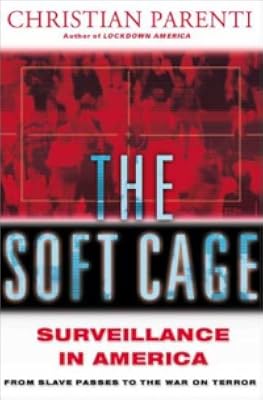
The Soft Cage: Surveillance in America From Slavery to the War on Terror
by Christian Parenti
On This Page
Description
"The Soft Cage explores the hidden history of surveillance - from controlling slaves in the old South to implementing early criminal justice, tracking immigrants, and closely monitoring the poor as part of modern social work. It also explores the role computers play in creating a whole new world of seemingly benign technologies - such as credit cards, website "cookies," electronic toll collection, "data mining," and iris scanners at airports." "With fears of personal and national security at show more an all-time high, this ever-growing infrastructure of high-tech voyeurism is shifting the balance of power between individuals and the state in groundbreaking - and very dangerous - ways. From closed-circuit television cameras to the Department of Homeland Security, The Soft Cage offers a compelling, vitally important history lesson for every American concerned about the expansion of surveillance into our public and private lives."--Jacket. show lessTags
Recommendations













Member Reviews
As a U.S. historian and someone very interested in issues related to surveillance, privacy, and personal identity, I was hoping for a nice, comprehensive examination of state intrusions on personal privacy in America. Alas, I got something far less interesting and far less useful than that.
I had high hopes for the book because the first chapter uses a number of Michel Foucault's concepts (from "Discipline and Punish" and elsewhere). That's all to the good, as Foucault has some fascinating and ground-breaking things to say about the topic of privacy and state surveillance of the individual. But it goes downhill from there. A layman's discussion of Foucault as a centralizing principle for the book would have worked, but Parenti fails to show more return to the ideas he raises in the first chapter. At times, the various chapters seem like interesting case studies or digressions that are never strung together or connected into a meaningful whole. We get some nice info on antebellum slave passes, early attempts at collecting biometric data, and surveillance as a tool to exclude Asian immigration, but what does it all mean?
When we finally got to the last chapter, the one concerning the post-9/11 world, I thought we would finally get a really nice, solid analysis of the PATRIOT Act and the Total Information Awareness program. I wanted to see someone objectively analyze the government's efforts to increase its domestic intelligence collection capabilities and examine what the impact of these efforts is on the average citizen's privacy. After all, the author promised to do as much. We often hear a loud outcry that the PATRIOT Act, TIA, DHS, FISA, and various governmental "watchlists" are eroding US citizens' privacy and civil rights, and I wanted to see someone take that on and argue one way or the other. But no. We didn't get that here. Parenti ought to be ashamed of himself in this chapter.
What I wanted: an analysis of the PATRIOT Act.
What I got: "An analysis of the USA Patriot Act could go on for many pages. [It does not; the book discusses it for two and a half pages.] The point for our purposes is that it liberalizes the legal environment in which federal cops will be gathering and processing the routine informational detritus of the digital age." (p. 202)
Nope, sorry Parenti, that's not just a self-evident fact; a pronouncement like that has to be proven through careful examination and analysis of the facts. There are a lot of ideas in that sentence and it needs to be unpacked and explored, piece-by-piece, with evidence brought to bear to support the author's contentions. If one of my college students wrote that on a paper, I'd give them a failing grade. (Well, OK, probably not, given the rampant grade inflaton, I'd probably give them a C, but I'd sure *want* to give them an F.)
This book is sorely lacking in a thesis; heck, some connective tissues for the various chapters would have gone a long way. In the end, it's written fairly journalistically and without a well-formed argument that is discussed and proven. A comprehensive history of privacy in America needs to be written. Unfortunately, this book isn't it.
Review copyright 2008 J. Andrew Byers show less
I had high hopes for the book because the first chapter uses a number of Michel Foucault's concepts (from "Discipline and Punish" and elsewhere). That's all to the good, as Foucault has some fascinating and ground-breaking things to say about the topic of privacy and state surveillance of the individual. But it goes downhill from there. A layman's discussion of Foucault as a centralizing principle for the book would have worked, but Parenti fails to show more return to the ideas he raises in the first chapter. At times, the various chapters seem like interesting case studies or digressions that are never strung together or connected into a meaningful whole. We get some nice info on antebellum slave passes, early attempts at collecting biometric data, and surveillance as a tool to exclude Asian immigration, but what does it all mean?
When we finally got to the last chapter, the one concerning the post-9/11 world, I thought we would finally get a really nice, solid analysis of the PATRIOT Act and the Total Information Awareness program. I wanted to see someone objectively analyze the government's efforts to increase its domestic intelligence collection capabilities and examine what the impact of these efforts is on the average citizen's privacy. After all, the author promised to do as much. We often hear a loud outcry that the PATRIOT Act, TIA, DHS, FISA, and various governmental "watchlists" are eroding US citizens' privacy and civil rights, and I wanted to see someone take that on and argue one way or the other. But no. We didn't get that here. Parenti ought to be ashamed of himself in this chapter.
What I wanted: an analysis of the PATRIOT Act.
What I got: "An analysis of the USA Patriot Act could go on for many pages. [It does not; the book discusses it for two and a half pages.] The point for our purposes is that it liberalizes the legal environment in which federal cops will be gathering and processing the routine informational detritus of the digital age." (p. 202)
Nope, sorry Parenti, that's not just a self-evident fact; a pronouncement like that has to be proven through careful examination and analysis of the facts. There are a lot of ideas in that sentence and it needs to be unpacked and explored, piece-by-piece, with evidence brought to bear to support the author's contentions. If one of my college students wrote that on a paper, I'd give them a failing grade. (Well, OK, probably not, given the rampant grade inflaton, I'd probably give them a C, but I'd sure *want* to give them an F.)
This book is sorely lacking in a thesis; heck, some connective tissues for the various chapters would have gone a long way. In the end, it's written fairly journalistically and without a well-formed argument that is discussed and proven. A comprehensive history of privacy in America needs to be written. Unfortunately, this book isn't it.
Review copyright 2008 J. Andrew Byers show less
Ratings
Members
- Recently Added By
Lists

History is a Weapon Recommended Reading List
43 works; 3 members
Author Information

6+ Works 700 Members
Christian Parenti is a professor at the School for International Training Graduate Institute and a contributing editor at The Nation. He has a PhD in sociology from the London School of Economics. His books include Lockdown America, The Soft Cage, and The Freedom: Shadows and Hallucinations in Occupied Iraq.
Classifications
- Genres
- Nonfiction, Sociology, History, Politics and Government, General Nonfiction, Technology
- DDC/MDS
- 303.330973 — Society, government, & culture Social sciences, sociology & anthropology Social processes Coordination and control Social control
- LCC
- HN57 .P35 — Social sciences Social history and conditions. Social problems. Social reform Social history and conditions. Social problems. By region or country
- BISAC
Statistics
- Members
- 120
- Popularity
- 270,706
- Reviews
- 1
- Rating
- (3.50)
- Languages
- English
- Media
- Paper, Ebook
- ISBNs
- 4
- UPCs
- 1
- ASINs
- 2