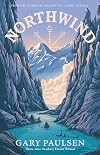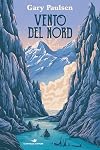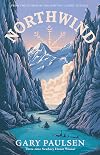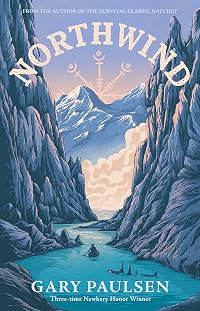
Northwind
by Gary Paulsen
On This Page
Description
When sickness decimates his fishing village, an orphan named Leif flees north in a cedar canoe, journeying along a brutal but beautiful coastline.Tags
Recommendations











Member Reviews
I really enjoy Paulsen's writing and his stories; and even though I am not the target demographic, I am always able to glean a lesson from him. I didn't realize until I started reading it that this was his last book before he died - a disappointing loss for readers. It is a fitting conclusion to his legacy, however. With hints of Norse mythology he tells the story of Leif, an orphan who is the sole survivor of a contagion the takes the liives of the people in the small fishing camp where he lives. Old Carl, a mentor, puts him a good sturdy canoe and tells him to head north, always north. Leif sets out on a journey of discovery, about nature, about the ocean, and about himself. With no destination, only a direction, he settles into the show more journey, learning and growing along the way, filled with wonder even amid diversity. It is a reminder for too many of us who are so focused on the destination, we do not enjoy the wonder of the journe. There is a quote that speaks to me from the book: "It was all up to him. He could eat or starve, depending on his own actions, his own thoughts, his own plans. The same as the whales. Or the ravens. Or any living thing. From whales down to mice. All thinking. All taking care of themselves, by themselves, for themselves." Leif learns from nature as he crosses boundaries again and again between worlds. The other quote I would share really sums up this journey of discovery, it is the realization of our interconnection with one another and with all of creation. Through his journey, Leif finally understands hismself as part of a whole. Not an orphan but a child of the divine, joined to all things: “Now there is no line that separates me from the canoe, from what I have become. The boat is my skin and body and mind and I am the water and wood and the sun and the birds. All one. All together as one. I am part of it now. Part of all of it. I have become.”
Mr. Paulsen, you will be missed. show less
Mr. Paulsen, you will be missed. show less
To be honest, I really don't know what to make of this book.
On the one hand -- did I enjoy reading it? Yes, very much. It's got the survival feel of Hatchet combined with a truly magical love of being on the water that shines through. It's also extraordinarily meditative and keeps that core acknowledgement of oneness with nature that is distinct to Paulsens's writing. It's a great book.
On the other hand -- what is even happening here? I can't orient in space and time. It is so clearly and completely set on the Pacific Northwest coast -- from the cedar canoe, to the Orcas, to the small islands in channels and fjords further north, to the distinct black and grizzly bears and the ravens and salmon and the blackberries. Yet the character show more experiencing all of this is a former thrall on Viking ship, steeped in Nordic mythology. The timeframe wanders between early Viking/ Exploration of the Americas to some kind of whaling venture that comes across as 19th century. And I have to say, I just can't make it make sense.
Is the Norwegian coast/climate/fauna so similar to the Pacific Northwest? Is there any evidence of Vikings on the West Coast? Were there thralls in the time of large wooden ships? Ships that were big enough to carry smaller ships? Were there early Whaling vessels in the Viking era? Did they do a lot of Arctic exploration in the Bering Sea?
And even more troubling, where are the people? If this is a historical novel set in the Pacific Northwest, then the entire thriving Indigenous population that should have been up and down the coast is nowhere to be found. If this is set in Norway, why are there no settlements at all? The Vikings went a-Viking because their population exceeded their space. Aside from the fish camp and the ships, there is no mention of humans or their structures.
It says something about me that I just can't sit back and enjoy the book when the history is so unclear, but there it is. And truly, I know very little about Norway, so perhaps this does have a Norwegian setting. I'm extremely interested to hear what other people think about this.
Advanced Reader's Copy provided by Edelweiss. show less
On the one hand -- did I enjoy reading it? Yes, very much. It's got the survival feel of Hatchet combined with a truly magical love of being on the water that shines through. It's also extraordinarily meditative and keeps that core acknowledgement of oneness with nature that is distinct to Paulsens's writing. It's a great book.
On the other hand -- what is even happening here? I can't orient in space and time. It is so clearly and completely set on the Pacific Northwest coast -- from the cedar canoe, to the Orcas, to the small islands in channels and fjords further north, to the distinct black and grizzly bears and the ravens and salmon and the blackberries. Yet the character show more experiencing all of this is a former thrall on Viking ship, steeped in Nordic mythology. The timeframe wanders between early Viking/ Exploration of the Americas to some kind of whaling venture that comes across as 19th century. And I have to say, I just can't make it make sense.
Is the Norwegian coast/climate/fauna so similar to the Pacific Northwest? Is there any evidence of Vikings on the West Coast? Were there thralls in the time of large wooden ships? Ships that were big enough to carry smaller ships? Were there early Whaling vessels in the Viking era? Did they do a lot of Arctic exploration in the Bering Sea?
And even more troubling, where are the people? If this is a historical novel set in the Pacific Northwest, then the entire thriving Indigenous population that should have been up and down the coast is nowhere to be found. If this is set in Norway, why are there no settlements at all? The Vikings went a-Viking because their population exceeded their space. Aside from the fish camp and the ships, there is no mention of humans or their structures.
It says something about me that I just can't sit back and enjoy the book when the history is so unclear, but there it is. And truly, I know very little about Norway, so perhaps this does have a Norwegian setting. I'm extremely interested to hear what other people think about this.
Advanced Reader's Copy provided by Edelweiss. show less
Gr 4–8—An orphan named Leif finds himself alone in a canoe fleeing northward along a rugged and untamed
shoreline to escape a deadly plague, discovering a deep connection with the wilderness along the way. Readers will
be swept away by the beauty of Paulsen's final gift, which is so much more than a survival story.
shoreline to escape a deadly plague, discovering a deep connection with the wilderness along the way. Readers will
be swept away by the beauty of Paulsen's final gift, which is so much more than a survival story.
So survivalist fiction was a staple of mine growing up. Or rather survivalist movies were. Some days I felt like my mom wanted to abandon everything and go live in the woods. However, after one or two terrifying to a ten year old incidents involving literature set in the wild......let's just say they are not what I gravitate towards.
However, Gary Paulsen has written another book that I think will be enjoyed by fans of the adventure genre. Instead of the mountains, we are instead along the sea. I pictured the Pacific Northwest and Alaska as I read these pages. Leif's encounters with bears, whales, whirlpools....his fishing with a man made spear and gathering berries to survive.....many will enjoy this story. Indeed, it is a love story to show more the wild.
For me, it is not my favorite genre to read. I also struggled that Leif was the lone character and there was not a bit of dialogue to be found. Indeed, Northwind read like a David Attenborough voiced documentary with Leif's occasional inner dialogue read by Morgan Freeman. LOL So if you want a book with an actual plot (as opposed to just embracing nature and continuing to flee sickness and Man), this isn't it. But will I recommend it to readers looking for adventure tales? Survival tales? You bet! show less
However, Gary Paulsen has written another book that I think will be enjoyed by fans of the adventure genre. Instead of the mountains, we are instead along the sea. I pictured the Pacific Northwest and Alaska as I read these pages. Leif's encounters with bears, whales, whirlpools....his fishing with a man made spear and gathering berries to survive.....many will enjoy this story. Indeed, it is a love story to show more the wild.
For me, it is not my favorite genre to read. I also struggled that Leif was the lone character and there was not a bit of dialogue to be found. Indeed, Northwind read like a David Attenborough voiced documentary with Leif's occasional inner dialogue read by Morgan Freeman. LOL So if you want a book with an actual plot (as opposed to just embracing nature and continuing to flee sickness and Man), this isn't it. But will I recommend it to readers looking for adventure tales? Survival tales? You bet! show less
The target audience is unclear. There's violence for adults yet it's for preteen audiences. Many scenes have a Life of Pi energy but then it turns simple. There's great terms and grisly ones. "Covered in released stomach and anal gore" as they lay dying.
This entire book is one long poem, and being finished before Gary Paulsen died, it feels like his last message from the grave. But I'm not sure what his message is supposed to be. A positive one? Or of humans plagued by a disease that consumes all they love? What were we supposed to feel here, Gary?
But it's not fun to read. It's fun, but it has to be read out loud. All the nuances of the word play and writing needs to be said out loud.
That's a pretty steep requirement for enjoyment. show more When I first read it, I felt nothing. But when I read parts out to my wife, it was magical and prose. Thus your mileage is effected by if you heard it read to you or if you read it alone.
A terrible catch to put into a book. Children won't know what they're experiencing and adults will be confused.
(And most of the GR reviews are every stage of confusion.)
Especially one that's for a vague age range higher than children who normally get read to. Gary has shared his final book into a quagmire of messy experiences with Northwind. And it's hamstrung him.
There's a huge focus on the person, not the surroundings. A poetic story that requires the reader see it as poetry.
3.5 stars. show less
This entire book is one long poem, and being finished before Gary Paulsen died, it feels like his last message from the grave. But I'm not sure what his message is supposed to be. A positive one? Or of humans plagued by a disease that consumes all they love? What were we supposed to feel here, Gary?
But it's not fun to read. It's fun, but it has to be read out loud. All the nuances of the word play and writing needs to be said out loud.
That's a pretty steep requirement for enjoyment. show more When I first read it, I felt nothing. But when I read parts out to my wife, it was magical and prose. Thus your mileage is effected by if you heard it read to you or if you read it alone.
A terrible catch to put into a book. Children won't know what they're experiencing and adults will be confused.
(And most of the GR reviews are every stage of confusion.)
Especially one that's for a vague age range higher than children who normally get read to. Gary has shared his final book into a quagmire of messy experiences with Northwind. And it's hamstrung him.
There's a huge focus on the person, not the surroundings. A poetic story that requires the reader see it as poetry.
3.5 stars. show less
Gary Paulsen delivers once again. This survival tale is set on the water and a world that is clearly reminiscent of the northwest. Leif, an orphan finds himself alone after a cholera outbreak. As Leif heads north, he begins his journey disoriented, but as the travels and encounters orcas, bears, and other challenges he develops a sense of purpose and learns about himself through keen natural observation. Paulsen's last novel is less grounded than his classic Hatchet, but he does give the readers a sense of the magic and wonder of the landscape (Leif is often amazed by his surroundings) and some of his own approach to life.
The author's note is wonderful - Paulsen talks directly to his younger readers and treats them with respect.
The author's note is wonderful - Paulsen talks directly to his younger readers and treats them with respect.
A lone boy against the wilderness, having a sort of spiritual awakening and bildungsroman. Typical Paulsen. But this one is better, imo, than the others that I have read. Author's note relays how life influenced art.
Members
- Recently Added By
Lists

Boy/girl trees/nature/water etc cover--children's/YA fiction
316 works; 5 members

Books recommended by Calgary Public Library staff
1,588 works; 4 members

AR Level 6 in cloudLibrary
77 works; 1 member
Author Information

235+ Works 100,417 Members
Gary Paulsen was born on May 17, 1939 in Minnesota. He was working as a satellite technician for an aerospace firm in California when he realized he wanted to be a writer. He left his job and spent the next year in Hollywood as a magazine proofreader. His first book, Special War, was published in 1966. He has written more than 175 books for young show more adults including Brian's Winter, Winterkill, Harris and Me, Woodsong, Winterdance, The Transall Saga, Soldier's Heart, This Side of Wild, and Guts: The True Stories Behind Hatchet and the Brian Books. Hatchet, Dogsong, and The Winter Room are Newbery Honor Books. He was the recipient of the 1997 Margaret A. Edwards Award for his lifetime achievement in writing for young adults. (Bowker Author Biography) show less
Some Editions
Awards and Honors
Awards
Distinctions
Notable Lists
Classifications
- Genres
- Kids, Fiction and Literature, Tween, Children's Books
- DDC/MDS
- 813.54 — Literature & rhetoric American literature in English American fiction in English 1900-1999 1945-1999
- LCC
- PZ7 .P2843 .N — Language and Literature Fiction and juvenile belles lettres Fiction and juvenile belles lettres Juvenile belles lettres
- BISAC
Statistics
- Members
- 276
- Popularity
- 117,138
- Reviews
- 9
- Rating
- (3.73)
- Languages
- English, Italian
- Media
- Paper, Audiobook, Ebook
- ISBNs
- 13
- ASINs
- 3