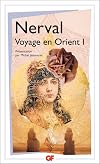
The Women of Cairo, Volume 1
by Gérard de Nerval
On This Page
Description
Voyage en Orient by Grard de Nerval (1980)Tags
Recommendations















































Member Reviews
The Women of Cario, Scenes of Life in the Orient is a travel book by French Romanticist Gerard de Nerval, first published in 1846. It describes a 1-year trip to Cairo, Egypt and other places in the Ottoman Empire. In the 18th and 19th centuries the Islamic Orient was a great mystery to Europeans giving rise to myths fueled by tales in the Arabian Nights. There were myths about the Harem, the oriental despot, the mysteries of Egypt ("Look Upon My Works, Ye Mighty, And Despair"), the stories of the Crusades, oriental virgins and slaves, etc. Romantic-era authors such as Lord Byron, Shelley, Walter Scott, Coleridge, Thomas Quincey (opium eater) and so on lived out the myth of the Orient in works and person. Nerval was central in that show more tradition and his journey is revealing for its myth-making and myth-busting.
The first volume of this unabridged translation centers mostly on Cairo. Before leaving Europe, Nerval had been dumped by his love interest, an actress. Arriving in Egypt, Nerval begins searching for a new female companion, which legally could only be achieved through marriage. He ends up buying a slave woman who is from India, but not before going on one adventure after the next trying to find (or buy) his new mate in the warrens of Cairo. It's a fascinating look at old customs, largely hidden from public view, some of which are funny (Nerval has been compared with Charlie Chaplin) and other scenes are disturbing (the sale of pre-pubescent girls to amuse the buyers "darkest desires"). Nerval describes scenes in flowery romanticized imagery, but also dispels some myths about harems and slaves. As it turns out women have much more control over their lives, even the slave girl pushes Nerval around and balks at the idea she might be set free (a terrible fate in her mind since she would then have to actually work for a living). Other memorable scenes are climbing the Great Pyramids with the help of four Bedouins, two on top who pulled your arms and two on bottom who push upward, block after block, until you reach the top. There were no other tourists around. The Sphinx still laid mostly buried in the sand. A book filled with fascinating details of Egypt and the Orient before the modern era written by one of the great French romanticists.
--Review by Stephen Balbach, via CoolReading (c) 2011 cc-by-nd show less
The first volume of this unabridged translation centers mostly on Cairo. Before leaving Europe, Nerval had been dumped by his love interest, an actress. Arriving in Egypt, Nerval begins searching for a new female companion, which legally could only be achieved through marriage. He ends up buying a slave woman who is from India, but not before going on one adventure after the next trying to find (or buy) his new mate in the warrens of Cairo. It's a fascinating look at old customs, largely hidden from public view, some of which are funny (Nerval has been compared with Charlie Chaplin) and other scenes are disturbing (the sale of pre-pubescent girls to amuse the buyers "darkest desires"). Nerval describes scenes in flowery romanticized imagery, but also dispels some myths about harems and slaves. As it turns out women have much more control over their lives, even the slave girl pushes Nerval around and balks at the idea she might be set free (a terrible fate in her mind since she would then have to actually work for a living). Other memorable scenes are climbing the Great Pyramids with the help of four Bedouins, two on top who pulled your arms and two on bottom who push upward, block after block, until you reach the top. There were no other tourists around. The Sphinx still laid mostly buried in the sand. A book filled with fascinating details of Egypt and the Orient before the modern era written by one of the great French romanticists.
--Review by Stephen Balbach, via CoolReading (c) 2011 cc-by-nd show less
Ratings
Members
- Recently Added By
Lists

Just Kids by Patti Smith
43 works; 1 member
Author Information

282+ Works 2,700 Members
Gérard de Nerval was the pen name of the French poet, essayist and translator Gérard Labrunie, one of the most essential Romantic French poets. He was born on May 22, 1808, in Paris, France. Nerval first became noted because of his translation of Goethe's Faust (1828). Gérard de Nerval's first nervous breakdown occurred during 1841. In a series show more of novellas, collected as Les Illuminés, ou les précurseurs du socialisme (1852), he described feelings that followed his third breakdown. Increasingly poverty-stricken and disoriented, he committed suicide in 1855, hanging himself from a window grating. (Bowker Author Biography) show less
Some Editions
Series
Belongs to Publisher Series
Work Relationships
Is contained in
Common Knowledge
- Canonical title
- The Women of Cairo, Volume 1
- Original title
- Voyage en Orient, tome 1
- Alternate titles
- Journey to the Orient (abridged single volume) (abridged single volume)
- Original publication date
- 1846
- Important places
- Cairo, Egypt
- Canonical DDC/MDS
- 915.6
- Canonical LCC
- DS57.G4
- Disambiguation notice
- Do not combined 'Women of Cairo' with 'Journey to the Orient', the later is an abridged version, the former is unabridged.
Classifications
- Genres
- Nonfiction, Travel, Literature Studies and Criticism, Biography & Memoir, History, General Nonfiction
- DDC/MDS
- 915.6 — History & geography Geography & travel Geography of and travel in Asia Middle East
- LCC
- DS57 .G4 — History of Europe, Asia, Africa and Oceania Asia History of Asia Middle East. Southwestern Asia. Ancient Orient.
- BISAC
Statistics
- Members
- 34
- Popularity
- 839,445
- Reviews
- 1
- Rating
- (4.13)
- Languages
- English, French
- Media
- Paper, Ebook
- ISBNs
- 7
- ASINs
- 3