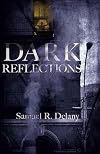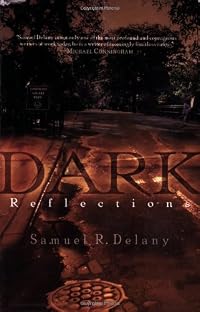
Dark Reflections
by Samuel R. Delany
On This Page
Description
Arnold Hawley, a gay, African-American poet, has lived in NYC for most of his life. Dark Reflections traces Hawley's life in three sections -- in reverse order. Part one: Hawley, at 50 years old, wins the an award for his sixth book of poems. Part two explores Hawley's unhappy marriage, while the final section recalls his college days. Dark Reflections, moving back and forth in time, creates an extraordinary meditation on social attitudes, loneliness, and life's triumphs.Tags
Recommendations













Member Reviews
This book is centered on Arnold Hawley, an aging Black gay poet living alone in New York. Divided in three parts, the first part titled The Prize shows the very unsavoury side of publishing and the disappointments and struggles of being a writer and artist, Arnold is in his 50s and later 70s in near-poverty/poverty. The second part entitled Vashti in The Dark is about the bizarre, short-lived and , in the end, traumatic marriage Arnold gets in in his mid thirties, and the third part The Book of Pictures about the suppression of sexuality and developing insecurities and self-hatred Arnold experiences in his young age. With the development of the story and each segment, brings more understanding to the protagonist.
Aunt Bea becomes show more Arnold’s guardian when his parents die, she’s a caring woman whose search for knowledge and love for the arts inspires the same in Arnold. Yet there’s an environment of decorum and respectability which at the time of Arnold’s youth cannot give Arnold the answers and knowledge that he needs. As a child, precocious as he is, Arnold asks a doctor about the frequency of homosexuality to which he is answered that the case is one in five thousand and non-existent in Black people and although he reads from the books available to him in libraries, the information he finds is insufficient. All this is before the Stonewall riots of the late 1960s and when Arnold finally finds the answers he needs that might have remedied the loneliness and repression he has carried for years leads to this rather painful truth and sad observation:
“One night, when he leaned the book against the lamp’s bronze base and turned off the light on his bedside table, Arnold lay awake thinking: “How … cruel! Even if it is the most debilitating of conditions (which, were it anywhere near as common as Dr. Kinsey said, made it seem unlikely): how cruel , to take us as children and impose such isolating loneliness. Tonight, Arnold thought, in Pittsfield and in Queens and in Appleton and in Fishtown and God-knows-where-else, children are awake, in bed, as I am now, pondering their approaching deaths from this … disease, in the midst of a loneliness sharp enough to clog their ears and scatter their eyes and cloy their throat with grave dust. And, as he had not in a while, Arnold began to cry. Why, why, why lie to them as I was lied to?”
Perhaps in a way Arnold Hawley is the answer to the question which is difficult to think about, let alone reflect on: What and who would I be if the knowledge that was crucial in my development arrived late, or even worse, never arrived at all?
Delany has written an incredible book, the complexity of its protagonist, the structure of the novel and the revelations in it among them what it means to be a Black writer in the literary world, sexual repression and homophobia, and the loneliness and the struggles of an artist, I’m still reeling from this. What a wonderful journey discovering more and more with a writer that’s fast becoming a favourite. show less
Aunt Bea becomes show more Arnold’s guardian when his parents die, she’s a caring woman whose search for knowledge and love for the arts inspires the same in Arnold. Yet there’s an environment of decorum and respectability which at the time of Arnold’s youth cannot give Arnold the answers and knowledge that he needs. As a child, precocious as he is, Arnold asks a doctor about the frequency of homosexuality to which he is answered that the case is one in five thousand and non-existent in Black people and although he reads from the books available to him in libraries, the information he finds is insufficient. All this is before the Stonewall riots of the late 1960s and when Arnold finally finds the answers he needs that might have remedied the loneliness and repression he has carried for years leads to this rather painful truth and sad observation:
“One night, when he leaned the book against the lamp’s bronze base and turned off the light on his bedside table, Arnold lay awake thinking: “How … cruel! Even if it is the most debilitating of conditions (which, were it anywhere near as common as Dr. Kinsey said, made it seem unlikely): how cruel , to take us as children and impose such isolating loneliness. Tonight, Arnold thought, in Pittsfield and in Queens and in Appleton and in Fishtown and God-knows-where-else, children are awake, in bed, as I am now, pondering their approaching deaths from this … disease, in the midst of a loneliness sharp enough to clog their ears and scatter their eyes and cloy their throat with grave dust. And, as he had not in a while, Arnold began to cry. Why, why, why lie to them as I was lied to?”
Perhaps in a way Arnold Hawley is the answer to the question which is difficult to think about, let alone reflect on: What and who would I be if the knowledge that was crucial in my development arrived late, or even worse, never arrived at all?
Delany has written an incredible book, the complexity of its protagonist, the structure of the novel and the revelations in it among them what it means to be a Black writer in the literary world, sexual repression and homophobia, and the loneliness and the struggles of an artist, I’m still reeling from this. What a wonderful journey discovering more and more with a writer that’s fast becoming a favourite. show less
Samuel R Delaney does mainstream fiction. I'm afraid to say anything about this book because whatever I say might make it sound boring, which it profoundly isn't. So ignore this review and just go read it for yourself.
Still reading? OK, then. The protagonist is a shy, black, gay poet who reminisces about his youth and navigates aging in a world he is keenly observant of and emotionally distant from. The novel is compassionate, tragic, heroic, ordinary, chastely erotic, wickedly funny, vividly descriptive, playfully serious, intellectual, historical. His memories are twined non-chronologically with observations and opinions about poetry, black history, gay history, small press publishing, poverty, New York City, and more.
Still reading? OK, then. The protagonist is a shy, black, gay poet who reminisces about his youth and navigates aging in a world he is keenly observant of and emotionally distant from. The novel is compassionate, tragic, heroic, ordinary, chastely erotic, wickedly funny, vividly descriptive, playfully serious, intellectual, historical. His memories are twined non-chronologically with observations and opinions about poetry, black history, gay history, small press publishing, poverty, New York City, and more.
Arnold Hawley, black poet, lives through a lot, particularly in New York City, where he lives most of his life. Most of his career he is able to support himself on a college professor's salary (adjunct - no benefits), but when he retires he has to stretch his limited income. But this is just a subtheme of the book.
In this book, Delany explores the experience of being black in a world, and in a field, where whites make the rules and where expectations differ. He is told not to use his photo on his books because it might turn people away. In spite of his living without monetary success and suffering fools gladly, Hawley seems to take it all in stride. He's curious. He's interested. He's a poet.
In this book, Delany explores the experience of being black in a world, and in a field, where whites make the rules and where expectations differ. He is told not to use his photo on his books because it might turn people away. In spite of his living without monetary success and suffering fools gladly, Hawley seems to take it all in stride. He's curious. He's interested. He's a poet.
I've been a fan of Delany's work for at least 30 years, a great admirer of his courage and imagination, and his dense, poetic writing style. His latest novel is not his usual science fiction or fantasy, but the spare, almost painfully realistic story of a black poet who bears many similarities to Delany himself. It was not always a pleasant or easy read, but it was beautiful and affecting.
At times depressing, this is a novel about loneliness and how it can completely invade our lives if we allow it to do so, and how growing old can make it even worse. Also about "tapes" and how we run them in our lives and how they can run us...
Ratings
Members
- Recently Added By
Lists

Read These Too
458 works; 9 members
Author Information

196+ Works 28,843 Members
Samuel R. Delany Jr. was born in Harlem, New York on April 1, 1942. He is a science fiction and short story writer. His first novel, The Jewels of Aptor, was published in 1962. He has written more than 20 novels and collections of short stories, memoirs, and critical essays. He has received numerous awards including the Nebula Award for best novel show more for Babel-17 in 1966 and The Einstein Intersection in 1967, the Nebula Award for best short story for Aye, and Gomorrah and Time Considered as a Helix of Semi-Precious Stones, the Hugo Award for best short story for Time Considered as a Helix of Semi-Precious Stones in 1970 and for his non-fiction book, The Motion of Light in Water, and the Bill Whitehead Award for Lifetime Achievement in Gay Literature in 1993. He is as a professor in the department of English at the University at Buffalo, Buffalo, New York. (Bowker Author Biography) Samuel R. Delany is a professor of English & Creative Writing at Temple University in Philadelphia. (Publisher Provided) show less
Awards and Honors
Awards
Notable Lists
Common Knowledge
- Original publication date
- 2007
Classifications
- Genres
- Fiction and Literature, General Fiction, LGBTQ+, Science Fiction
- DDC/MDS
- 813.54 — Literature & rhetoric American literature in English American fiction in English 1900-1999 1945-1999
- LCC
- PS3554 .E437 .D37 — Language and Literature American literature American literature Individual authors 1961-
- BISAC
Statistics
- Members
- 194
- Popularity
- 168,221
- Reviews
- 5
- Rating
- (4.02)
- Languages
- English, German
- Media
- Paper, Ebook
- ISBNs
- 5
- UPCs
- 2
- ASINs
- 2