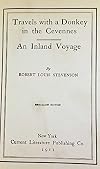
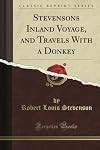
Travels with a Donkey in the Cevennes / An Inland Voyage
by Robert Louis Stevenson
On This Page
Description
Also included in this volume are "Underwoods" and "A Childs' Garden of Verses."Tags
Recommendations






























Member Reviews
These non-fiction accounts of camping and canoeing in France and Belgium were written in the refined and polished prose we have come to expect from Robert Louis Stevenson. With humor and irritation he describes his interactions with locals and reflects on their class consciousness. In some places he encounters hospitality, in others fear and hostility, but everywhere, curiosity. Rebuffed by innkeepers, who take him for a peddler or worse, he decides that "trees are the most civil society" and rediscovers in nature "those truths which are revealed to savages and hid from political economists." At Our Lady of the Snows monastery he is hospitably received but "annoyed beyond endurance" by proselytizing. In the end he concludes that the show more journey was "very agreeable and fortunate for me."
A slow and mellow read. Not everyone will appreciate the elegance of the writing and philosophizing here; not everyone will find it clear or even intelligible. But this is must reading for Stevenson fans as it gives unique insights into the author, his thoughts and his lifestyle, even his diet. I found it strange that he felt the need to carry a revolver! I felt no such need when I hitchhiked through that part of Europe with a pup tent. But I was good at making myself invisible; that is not so easily done when traveling with a donkey. Wolves were an issue in Stevenson’s day, but they didn’t even occur to me.
I thought Stevenson was a semi-invalid, but in this book he survives some very arduous travel, even to an elevation of 5,600 feet above sea level, while smoking tobacco, drinking brandy, and eating a substandard diet. Being pelted with rain was “revivifying” to the youthful RLS.
Maps would have been helpful to the reader. This book occasionally digresses into local history and uses foreign words and phrases without translation. Even some English words that I had not seen before. The author’s treatment of his donkey may displease some readers, but at least he is honest about it.
I preferred the travels with a donkey to the inland voyage. It is more readable, less convoluted in its philosophizing. The author’s donkey companion was more interesting than his canoeing partner. show less
A slow and mellow read. Not everyone will appreciate the elegance of the writing and philosophizing here; not everyone will find it clear or even intelligible. But this is must reading for Stevenson fans as it gives unique insights into the author, his thoughts and his lifestyle, even his diet. I found it strange that he felt the need to carry a revolver! I felt no such need when I hitchhiked through that part of Europe with a pup tent. But I was good at making myself invisible; that is not so easily done when traveling with a donkey. Wolves were an issue in Stevenson’s day, but they didn’t even occur to me.
I thought Stevenson was a semi-invalid, but in this book he survives some very arduous travel, even to an elevation of 5,600 feet above sea level, while smoking tobacco, drinking brandy, and eating a substandard diet. Being pelted with rain was “revivifying” to the youthful RLS.
Maps would have been helpful to the reader. This book occasionally digresses into local history and uses foreign words and phrases without translation. Even some English words that I had not seen before. The author’s treatment of his donkey may displease some readers, but at least he is honest about it.
I preferred the travels with a donkey to the inland voyage. It is more readable, less convoluted in its philosophizing. The author’s donkey companion was more interesting than his canoeing partner. show less
study texts
Ratings
Members
- Recently Added By
Lists

Merrill's English Texts
59 works; 3 members
Author Information

Novelist, poet, and essayist Robert Louis Stevenson was born in Edinburgh, Scotland. A sickly child, Stevenson was an invalid for part of his childhood and remained in ill health throughout his life. He began studying engineering at Edinburgh University but soon switched to law. His true inclination, however, was for writing. For several years show more after completing his studies, Stevenson traveled on the Continent, gathering ideas for his writing. His Inland Voyage (1878) and Travels with a Donkey (1878) describe some of his experiences there. A variety of essays and short stories followed, most of which were published in magazines. It was with the publication of Treasure Island in 1883, however, that Stevenson achieved wide recognition and fame. This was followed by his most successful adventure story, Kidnapped, which appeared in 1886. With stories such as Treasure Island and Kidnapped, Stevenson revived Daniel Defoe's novel of romantic adventure, adding to it psychological analysis. While these stories and others, such as David Balfour and The Master of Ballantrae (1889), are stories of adventure, they are at the same time fine studies of character. The Master of Ballantrae, in particular, is a study of evil character, and this study is taken even further in The Strange Case of Dr. Jekyll and Mr. Hyde (1886). In 1887 Stevenson and his wife, Fanny, went to the United States, first to the health spas of Saranac Lake, New York, and then on to the West Coast. From there they set out for the South Seas in 1889. Except for one trip to Sidney, Australia, Stevenson spent the remainder of his life on the island of Samoa with his devoted wife and stepson. While there he wrote The Wrecker (1892), Island Nights Entertainments (1893), and Catriona (1893), a sequel to Kidnapped. He also worked on St. Ives and The Weir of Hermiston, which many consider to be his masterpiece. He died suddenly of apoplexy, leaving both of these works unfinished. Both were published posthumously; St. Ives was completed by Sir Arthur Quiller-Couch, and The Weir of Hermiston was published unfinished. Stevenson was buried on Samoa, an island he had come to love very much. Although Stevenson's novels are perhaps more accomplished, his short stories are also vivid and memorable. All show his power of invention, his command of the macabre and the eerie, and the psychological depth of his characterization. (Bowker Author Biography) show less
Some Editions
Series
Belongs to Publisher Series
Tusitala (volume xvii)
Work Relationships
Common Knowledge
Classifications
Statistics
- Members
- 213
- Popularity
- 153,247
- Reviews
- 2
- Rating
- (3.25)
- Languages
- English, German
- Media
- Paper, Ebook
- ISBNs
- 14
- ASINs
- 40