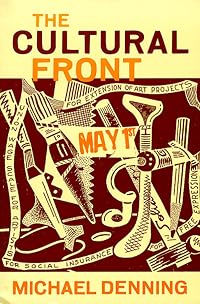
The Cultural Front: the Laboring of American Culture in the Twentieth Century
by Michael Denning
On This Page
Description
As garment workers, longshoremen, autoworkers, sharecroppers and clerks took to the streets, striking and organizing unions in the midst of the Depression, artists, writers and filmmakers joined the insurgent social movement by creating a cultural front. Disney cartoonists walked picket lines, and Billie Holiday sand 'Strange Fruit' at the left-wing cabaret, Cafe Society. Duke Ellington produced a radical musical, "Jump for Joy," New York garment workers staged the legendary Broadway revue show more "Pins and Needles," and Orson Welles and his Mercury players took their labor operas and anti-fascist Shakespeare to Hollywood and made "Citizen Kane." A major reassessment of US cultural history, "The Cultural Front" is a vivid mural of this extraordinary upheaval which reshaped American culture in the twentieth century. show lessTags
Recommendations





Member Reviews
Michael Denning’s The Cultural Front: The Laboring of American Culture in the Twentieth Century synthesizes much of the historiography of the Popular Front into a larger narrative, drawing upon Lizabeth Cohen and others’ work. Denning argues, “The cultural front reshaped American culture. Just as the radical movements of abolition, utopian socialism, and women’s rights sparked the antebellum American Renaissance, so the communisms of the depression triggered a deep and lasting transformation of American modernism and mass culture, what [Denning] will call the laboring of American culture” (pg. xvi). Further, Denning writes, “The culture of the Popular Front represented a larger laboring of American culture, which political show more adversaries often shared in shaping” (pg. 26). He continues, “The state of popular culture was the state of the culture generally, particularly in the United States, which had an overdeveloped set of culture industries and an underdeveloped established high culture: indeed, for Europeans, Americanism was mass culture” (pg. 43). According to Denning, “The cultural apparatus became a contested terrain between the Popular Front and the Advertising Front, as working-class styles, stars, and characters emerged alongside the sales plug” (pg. 47). Denning argues, “The cultural front is thus the terrain where the Popular Front social movement met the cultural apparatus during the age of the CIO. From that conflict and conjuncture came the Popular Front ‘flavor’ of American mass culture, what [Denning] will call the laboring of American culture” (pg. 50).
Denning writes, “By the mid 1930s, the cultural front was sustained by a movement culture, a world of working-class education, recreation, and entertainment built by the Communist Party, the new industrial unions, and the fraternal benefit lodges, particularly those of the International Workers Order (IWO)” (pg. 67). He continues, “It was the peculiar combination of the corporate liberalism of the media corporations, the internal labor relations of the culture industries, and the working-class audience of the film, broadcasting, and music industries that resulted in a remarkable and contradictory politics of mass culture, producing the phenomena of left-wing ‘stars’ and ‘socially conscious’ nightclubs, radio broadcasts, and picture magazines” (pg. 83). Denning further argues, “The aesthetic innovations of the cultural front wrestled with the cultural contradictions of modernity, and led to a laboring of American culture. The characteristic narratives, tropes, and forms of the cultural front – the satiric newsreels, ghetto pastorals, proletarian grotesques, and cabaret blues – informed the most powerful and lasting works of twentieth-century American fiction, music, theater, and film, as well as the cultural criticism and theory that surrounded them” (pg. 118). He adds, “The politics of the Popular Front social movements were rarely populist; rather, the Popular Front combined three distinctive political tendencies: a social democratic laborism based on a militant industrial unionism; an anti-racist ethnic pluralism imagining the United States as a ‘nation of nations’; and an anti-fascist politics of international solidarity” (pg. 125).
Addressing literature, Denning argues, “The renaissance ignited by the proletarian avant-garde was responsible for two key developments in American literary history: the emergence of a generation of plebian ethnic writers who represented – in several senses of the word – the new working-class cultures of America and who were to transform American letters in the decades to follow; and the creation of a genre – the ghetto or tenement pastoral – that is still at the heart of the American novel” (pg. 201). Of theatre, Denning writes, “The cabaret blues of Café Society was the product of a complex alliance between jazz and the Popular Front that had its political origins in the campaign to free the Scottsboro Nine and its social origins in the working-class musical culture of hot jazz and swing. This alliance between jazz and the Popular Front movement permanently altered the shape of American music” (pg. 323-324). He continues, “Café Society represented a remarkable synthesis of the radical political cabarets of Belgium and Paris with the African American jazz clubs and revues of Harlem” (pg. 324).
Denning concludes, “The Cold War anti-Communist purge of the culture industries and state cultural apparatuses left a deep cultural amnesia, as radical intellectuals were jailed, lost jobs, were deported or went into exile, were unable to publish, reedited their earlier work and downplayed their earlier affiliations, or, in some cases, killed themselves” (pg. 425). show less
Denning writes, “By the mid 1930s, the cultural front was sustained by a movement culture, a world of working-class education, recreation, and entertainment built by the Communist Party, the new industrial unions, and the fraternal benefit lodges, particularly those of the International Workers Order (IWO)” (pg. 67). He continues, “It was the peculiar combination of the corporate liberalism of the media corporations, the internal labor relations of the culture industries, and the working-class audience of the film, broadcasting, and music industries that resulted in a remarkable and contradictory politics of mass culture, producing the phenomena of left-wing ‘stars’ and ‘socially conscious’ nightclubs, radio broadcasts, and picture magazines” (pg. 83). Denning further argues, “The aesthetic innovations of the cultural front wrestled with the cultural contradictions of modernity, and led to a laboring of American culture. The characteristic narratives, tropes, and forms of the cultural front – the satiric newsreels, ghetto pastorals, proletarian grotesques, and cabaret blues – informed the most powerful and lasting works of twentieth-century American fiction, music, theater, and film, as well as the cultural criticism and theory that surrounded them” (pg. 118). He adds, “The politics of the Popular Front social movements were rarely populist; rather, the Popular Front combined three distinctive political tendencies: a social democratic laborism based on a militant industrial unionism; an anti-racist ethnic pluralism imagining the United States as a ‘nation of nations’; and an anti-fascist politics of international solidarity” (pg. 125).
Addressing literature, Denning argues, “The renaissance ignited by the proletarian avant-garde was responsible for two key developments in American literary history: the emergence of a generation of plebian ethnic writers who represented – in several senses of the word – the new working-class cultures of America and who were to transform American letters in the decades to follow; and the creation of a genre – the ghetto or tenement pastoral – that is still at the heart of the American novel” (pg. 201). Of theatre, Denning writes, “The cabaret blues of Café Society was the product of a complex alliance between jazz and the Popular Front that had its political origins in the campaign to free the Scottsboro Nine and its social origins in the working-class musical culture of hot jazz and swing. This alliance between jazz and the Popular Front movement permanently altered the shape of American music” (pg. 323-324). He continues, “Café Society represented a remarkable synthesis of the radical political cabarets of Belgium and Paris with the African American jazz clubs and revues of Harlem” (pg. 324).
Denning concludes, “The Cold War anti-Communist purge of the culture industries and state cultural apparatuses left a deep cultural amnesia, as radical intellectuals were jailed, lost jobs, were deported or went into exile, were unable to publish, reedited their earlier work and downplayed their earlier affiliations, or, in some cases, killed themselves” (pg. 425). show less
Ratings
Members
- Recently Added By
Lists

Works Cited in The History of White People by Nell Irvin Painter
321 works; 2 members

Author Information
9+ Works 397 Members
Michael Denning is William R. Kenan Jr. Professor of American Studies at Yale University
Series
Belongs to Publisher Series
Common Knowledge
- Canonical title
- The Cultural Front: the Laboring of American Culture in the Twentieth Century
- Original publication date
- 1996
- Important events
- African-American Civil Rights Movement
Classifications
- Genres
- Nonfiction, History, General Nonfiction, Art & Design, Literature Studies and Criticism
- DDC/MDS
- 306.4 — Society, government, & culture Social sciences, sociology & anthropology Social Behavior - Dating, Marriage, Divorce Specific aspects of culture
- LCC
- E169 .D425 — History of the United States United States General
- BISAC
Statistics
- Members
- 202
- Popularity
- 162,682
- Reviews
- 1
- Rating
- (3.91)
- Languages
- English
- Media
- Paper
- ISBNs
- 3
- ASINs
- 2