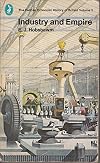
Industry and Empire: From 1750 to the Present Day
by Eric Hobsbawm
The Pelican Economic History of Britain (3)
On This Page
Description
"In Industry and Empire, Hobsbawm explores the origin and dramatic course of the industrial Revolution over two hundred and fifty years and its influence on social and political institutions. He describes and accounts for Britain's rise as the first industrial power, its decline from domination its special relation with the rest of the world, and the effects of this trajectory on the lives of its ordinary citizens." "This new edition includes a fascinating summary of events of the last show more twenty years, and an illuminating new conclusion."--Jacket. show lessTags
Recommendations




















Member Recommendations

Member Reviews
I read this book hoping that it might serve as an anchor for a class on technological change. I cannot in good conscience advise this book for anyone. Hobsbawn offers an account of an industrial revolution that is almost absent of technology, or of change. Rather he describes Britain's preeminance as a result of its martime power, leveraging historical dominance in textiles to absolutely superiority in all manners of shipping and goods.
Britain undoubtedly won the first industrial revolution of water-powered spinning jennies and automated looms, but fared less well in the second industrial revolution of steam-engines and railroads, losing in relatives terms to America and Germany. For a supposed Marxist, Hobsawm seems fuzzy on the show more generational shift from rural agricultural laborers to an urban and industrial proletariat, or the relationship between scientific knowledge and technological progress.
Decent charts, and a mass of words that signify little and explain less.
Maybe I just don't like economists. show less
Britain undoubtedly won the first industrial revolution of water-powered spinning jennies and automated looms, but fared less well in the second industrial revolution of steam-engines and railroads, losing in relatives terms to America and Germany. For a supposed Marxist, Hobsawm seems fuzzy on the show more generational shift from rural agricultural laborers to an urban and industrial proletariat, or the relationship between scientific knowledge and technological progress.
Decent charts, and a mass of words that signify little and explain less.
Maybe I just don't like economists. show less
So, why did the industrial revolution first happened in Britain, and not somewhere else? This is a hotly debated topic among a subset of historians, and has puzzled me for a long time. Is it due to the geography and natural resources of the Isles, the character of its people, or was it just one of those accidents of history? More than that, how do you properly formulate such a question, and what methods can be used to arrive at a sensible answer?
Hobsbawm is probably as well equipped as anyone to try to answer this question, and does a pretty good job of it, I think. At least his method, to concentrate on the antecedent macro-economic setting, and to compare its more or less unique features with other competing regions, rather than such show more vague and elusive possibilities of a superior political system or a certain theological proclivity toward work or something, appears to be sound. His focus seldom refers to personalities, nor, surprisingly, the technological inventions that were so important--he seems to assumes that they were made as a matter of course, given the business climate of the times.
The book covers much more than the industrial revolution-- it carries the narrative into the last half of the twentieth century, and covers the same ground in Wales and Scotland, too. His writing style is a pleasure to read and the book is accompanied by 52 graphs in an appendix that brings some additional meat to the table. This is quite possibly the best book around for understanding this critical period in the progress of man, and rewards time well spent. show less
Hobsbawm is probably as well equipped as anyone to try to answer this question, and does a pretty good job of it, I think. At least his method, to concentrate on the antecedent macro-economic setting, and to compare its more or less unique features with other competing regions, rather than such show more vague and elusive possibilities of a superior political system or a certain theological proclivity toward work or something, appears to be sound. His focus seldom refers to personalities, nor, surprisingly, the technological inventions that were so important--he seems to assumes that they were made as a matter of course, given the business climate of the times.
The book covers much more than the industrial revolution-- it carries the narrative into the last half of the twentieth century, and covers the same ground in Wales and Scotland, too. His writing style is a pleasure to read and the book is accompanied by 52 graphs in an appendix that brings some additional meat to the table. This is quite possibly the best book around for understanding this critical period in the progress of man, and rewards time well spent. show less
Historia de Gran Bretaña desde 1750 hasta nuestros días
Oct 15, 2019Spanish
Ratings
Members
- Recently Added By
Author Information

159+ Works 18,758 Members
Eric Hobsbawm is a neo-Marxist historian of the Industrial Revolution who pays particular attention to the inequities toward the lower classes, especially in law and politics. (Bowker Author Biography)
Series

Belongs to Publisher Series
Common Knowledge
- Canonical title
- Industry and Empire: From 1750 to the Present Day
Classifications
- Genres
- History, Nonfiction, Economics, General Nonfiction
- DDC/MDS
- 330.942 — Society, government, & culture Economics Jobs & Careers Economic geography and history Europe England, Wales
- LCC
- HC253 .H57 — Social sciences Economic history and conditions Economic history and conditions By region or country
- BISAC
Statistics
- Members
- 665
- Popularity
- 43,113
- Reviews
- 4
- Rating
- (3.71)
- Languages
- English, Italian, Portuguese, Spanish
- Media
- Paper, Ebook
- ISBNs
- 14
- ASINs
- 20