The Abolitionist Legacy
by James M. McPherson
On This Page
Description
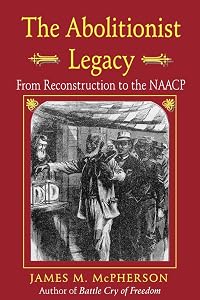
Building on arguments presented in The Struggle for Equality, James McPherson shows that many abolitionists did not retreat from Reconstruction, as historical accounts frequently lead us to believe, but instead vigorously continued the battle for black rights long after the Civil War. Tracing the activities of nearly 300 abolitionists and their descendants, he reveals that some played a crucial role in the establishment of schools and colleges for southern blacks, while others formed the show more vanguard of liberals who founded the NAACP in 1910. The author's examination of the complex and unhappy fate of Reconstruction clarifies the uneasy partnership of northern and southern white liberals after 1870, the tensions between black activists and white neo-abolitionists, the evolution of resistance to racist ideologies, and the origins of the NAACP. show lessTags
Recommendations










Member Reviews
The Abolitionist Legacy: from Reconstruction to the NAACP is a solid, thorough, scholarly history. However, several times I skimmed through longish sections without doing real harm to my understanding of what I was reading. McPherson points out that the abolitionists did not disappear at the end of the Civil War because, in part, the ongoing problems with the former slaves did not go away. The thinking on how to deal with voting, holding of office, education, segregation/integration, owning of property, violence changed over time as did the circumstances. McPherson ends with the establishment of the NAACP which broke away from the approach espoused by Booker T. Washington. This history is a needed reminder of the struggles of our show more forefathers that still colors what is happening today.
Quotes: (page 35) “...Democrats won control of the House in 1874 for the first time in 18 years. Some Republicans began to talk of jettisoning the dead weight of Reconstruction to avoid sinkng in 1876. A consensus began to emerge that the federal government must leave the South alone to work out the race problem in its own way. 'Our people are tired out with this worn out cry of 'Southern outrages'!!!' wrote one politician in 1875...'The whole public are tired of these annual outbreaks in the South,' said the U.S. Attorney general as he refused a request from the governor of Mississippi for federal troupes to protect black voters in 1875. The Democrats carried Mississippi, and the attorney general's remark symbolized indifference of most northerners to that event...Frederick Douglass told a reunion meeting of Philadelphia abolitionists in 1875 that 'we need you, my friends, almost as much as ever.' Gilbert Haven wanted 'the old Anti-Slavery Society revived. Let the old Abolitionists ring[the] bell in pulpit or platform, through the press, by revived organization, and through political parties,' he said, 'until we completely save the union.'”
(pages 196-197) “In his book The Mis-Education of the Negro (1933) Carter G. Woodson indicted the mission societies for giving blacks a white-oriented education unsuited to their needs. Founder of the Association for the study of Negro Life and History and of The Journal of Negro History, Woodson stressed the African culture heritage of black Americans and the need for Negro education to inculcate race pride. The missionary colleges, he said, had ignored the black man's heritage, constructed a curriculum centered on European languages and history and imposed white middle-class values on the black elite, producing graduates who ' do not like to hear such expressions as 'Negro literature,' 'Negro poetry,' 'African art,' or 'thinking black.' The chief shortcoming of missionary education, he asserted, was that, 'it had been largely imitation' of white education 'resulting in the enslavement of [the Negro's] mind.' It sought to 'transform the Negroes, not to develop them.'”
(page 387) In 1906 Frances Kellor, a white social worker who was angered by the exploitation of black women migrants by unscrupulous employment agencies, founded in New York the National League for the Protection of Colored Women. In the same year several black and white reformers formed the Committee for Improving the Industrial Conditions of Negroes in New York. The chairman of the Committee was William Jay Schieffelin, a third-generation heir of the Jay abolitionist family. In 1910 a third organization, the Committee on Urban Conditions among Negoes, was established to sponsor social research and train black social workers. All three merged in 1911 to form the National League on Urban Conditions among Negroes (later shortened to National Urban League). In many ways the Urban League tried to do for Negroes in the North what Booker T. Washington was attempting in the rural South. This was fine so far as it went, but for the more radical progressives, especially neo-aboltionists and socialists, it did not go far enough. From their desire for an organization that would fight disfranchisement, Jim Crow, and lynching came the impulse for the NAACP.” show less
Quotes: (page 35) “...Democrats won control of the House in 1874 for the first time in 18 years. Some Republicans began to talk of jettisoning the dead weight of Reconstruction to avoid sinkng in 1876. A consensus began to emerge that the federal government must leave the South alone to work out the race problem in its own way. 'Our people are tired out with this worn out cry of 'Southern outrages'!!!' wrote one politician in 1875...'The whole public are tired of these annual outbreaks in the South,' said the U.S. Attorney general as he refused a request from the governor of Mississippi for federal troupes to protect black voters in 1875. The Democrats carried Mississippi, and the attorney general's remark symbolized indifference of most northerners to that event...Frederick Douglass told a reunion meeting of Philadelphia abolitionists in 1875 that 'we need you, my friends, almost as much as ever.' Gilbert Haven wanted 'the old Anti-Slavery Society revived. Let the old Abolitionists ring[the] bell in pulpit or platform, through the press, by revived organization, and through political parties,' he said, 'until we completely save the union.'”
(pages 196-197) “In his book The Mis-Education of the Negro (1933) Carter G. Woodson indicted the mission societies for giving blacks a white-oriented education unsuited to their needs. Founder of the Association for the study of Negro Life and History and of The Journal of Negro History, Woodson stressed the African culture heritage of black Americans and the need for Negro education to inculcate race pride. The missionary colleges, he said, had ignored the black man's heritage, constructed a curriculum centered on European languages and history and imposed white middle-class values on the black elite, producing graduates who ' do not like to hear such expressions as 'Negro literature,' 'Negro poetry,' 'African art,' or 'thinking black.' The chief shortcoming of missionary education, he asserted, was that, 'it had been largely imitation' of white education 'resulting in the enslavement of [the Negro's] mind.' It sought to 'transform the Negroes, not to develop them.'”
(page 387) In 1906 Frances Kellor, a white social worker who was angered by the exploitation of black women migrants by unscrupulous employment agencies, founded in New York the National League for the Protection of Colored Women. In the same year several black and white reformers formed the Committee for Improving the Industrial Conditions of Negroes in New York. The chairman of the Committee was William Jay Schieffelin, a third-generation heir of the Jay abolitionist family. In 1910 a third organization, the Committee on Urban Conditions among Negoes, was established to sponsor social research and train black social workers. All three merged in 1911 to form the National League on Urban Conditions among Negroes (later shortened to National Urban League). In many ways the Urban League tried to do for Negroes in the North what Booker T. Washington was attempting in the rural South. This was fine so far as it went, but for the more radical progressives, especially neo-aboltionists and socialists, it did not go far enough. From their desire for an organization that would fight disfranchisement, Jim Crow, and lynching came the impulse for the NAACP.” show less
Ratings
Members
- Recently Added By
Author Information

67+ Works 16,564 Members
James M. McPherson is the author of Battle Cry of Freedom: The Civil War Era, which won a Pulitzer Prize in history, and For Cause and Comrades: Why Men Fought in the Civil War, a Lincoln Prize winner. He is the George Henry Davis Professor of American History at Princeton University in New Jersey, where he also lives. His newest book, entitled show more Abraham Lincoln, celebrates the 200th anniversary of Lincoln's birth with a short, but detailed look at this president's life. (Bowker Author Biography) James M. McPherson, McPherson was born in 1936 and received a Ph.D. from Johns Hopkins University in 1963. He began teaching at Princeton University in the mid 1960's and is the author of several articles, reviews and essays on the Civil War, specifically focusing on the role of slaves in their own liberation and the activities of the abolitionists. His earliest work, "The Struggle for Equality," studied the activities of the Abolitionist movement following the Emancipation Proclamation. "Battle Cry of Freedom" won the Pulitzer Prize for History in 1989. "Drawn With the Sword" (1996) is a collection of essays, with one entitled "The War that Never Goes Away," that is introduced by a passage from Abraham Lincoln's second inaugural address on March 4, 1865 from which its title came: "Fondly do we hope - and fervently do we pray - that this mighty scourge of war may speedily pass away. Yet, if God wills that it continue, until all the wealth piled by the bond-man's two hundred and fifty years of unrequited toil shall be sunk, and until every drop of blood drawn with the lash, shall be paid by another drawn with the sword, as was said three thousand years ago, so still it must be said, 'the judgments of the Lord, are true and righteous altogether.'" "From Limited to Total War: 1861-1865" shows the depth of the political and social transformation brought about during the Civil War. It told how the human cost of the Civil War exceeded that of any country during World War I and explains the background to Lincoln's announcement of the Emancipation Proclamation, in 1862. The book also recounts the exploits of the Fifty-fourth Massachusetts Volunteer Infantry, one of the first black regiments organized in the Civil War, and their attack on Fort Wagner in July 1863. It pays tribute to Robert Gould Shaw, the white commanding officer of the regiment, who died in the attack and was buried in a mass grave with many of his men. Professor McPherson's writings are not just about the middle decades of the nineteenth century but are also about the last decades of the twentieth century. The political turmoil prior to the Civil War, the violence of the war, Lincoln's legacy and the impeachment of Andrew Johnson shed some light on contemporary events. (Bowker Author Biography) show less
Classifications
- Genres
- Nonfiction, History, Politics and Government, General Nonfiction
- DDC/MDS
- 322.4 — Society, government, & culture Political science Relation of the state to organized groups and their members Political action groups
- LCC
- E185.61 .M18 — History of the United States United States Elements in the population Afro-Americans Status and development since emancipation
- BISAC
Statistics
- Members
- 46
- Popularity
- 650,499
- Reviews
- 1
- Rating
- (4.25)
- Languages
- English
- Media
- Paper
- ISBNs
- 2