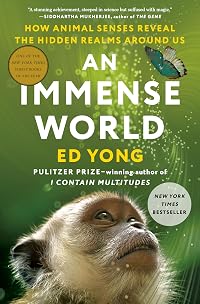
An Immense World: How Animal Senses Reveal the Hidden Realms Around Us
by Ed Yong
On This Page
Description
"The Earth teems with sights and textures, sounds and vibrations, smells and tastes, electric and magnetic fields. But every animal is enclosed within its own unique sensory bubble, perceiving but a tiny sliver of an immense world.This book welcomes us into a previously unfathomable dimension-the world as it is truly perceived by other animals. We encounter beetles that are drawn to fires (and fireworks), songbirds that can see the Earth's magnetic fields, and brainless jellyfish that show more nonetheless have complex eyes. We discover that a crocodile's scaly face is as sensitive as a lover's fingertips, that the eyes of a giant squid evolved to see sparkling whales, and that even fingernail-sized spiders can make out the craters of the moon. We meet people with unusual senses, from women who can make out extra colors to blind individuals who can navigate using reflected echoes like bats. Yong tells the stories of pivotal discoveries in the field, and also looks ahead at the many mysteries which lie unsolved"-- show lessTags
Recommendations
















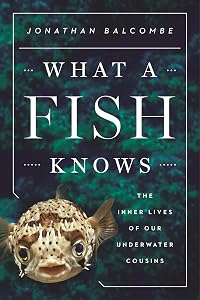
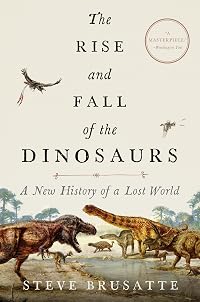
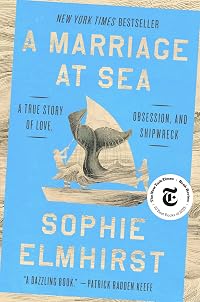
Member Recommendations

Member Reviews
Science fiction offers a glimpse into potential alien cultures, alien biology, alternative lifeways. Each of these holds up a mirror to our actual experience, casting our various Aristotelian accidents into high relief. Of course, science fact can do much the same, such as when a careful survey is taken from a field of scientific knowledge.
Yong takes this approach with respect to how creatures sense the world around them, latching onto the concept of Umwelten, as conceived by zoologist Jakob von Uexküll. "Earth teems with sights and textures, sounds and vibrations, smells and tastes, electric and magnetic fields. But every animal can only tap into a small fraction of reality's fullness." [5] Each specific Umwelt evolved peculiar to show more that species' environment such that species' members are capable of surviving (which is to say, reproducing) in its niche. "Nothing can sense everything, and nothing needs to. That is why Umwelten exist at all. It is also why the act of contemplating the Umwelt of another creature is so deeply human and so utterly profound. Our senses filter in what we need. We must choose to learn about the rest." [9]
Corresponding to the Umwelten concept, Yong's text is divided then not into sections corresponding to human senses, rather into chapters proceeding from "the most ancient and universal" chemical senses (taste, smell); on to radiation perception (vision, colour); diverting briefly to consider nociception -- sensing damage to tissue -- and the associated neural translation of such stimulus into pain; then returning to the main track with an inventory of the mechanical senses (heat, touch, vibration, sound, echolocation); and closing finally by reviewing the sensation of electric and magnetic fields, which senses humans lack but various other creatures rely upon as much as they do vision.
Yong ends by considering how different creatures unify their available sensory stimuli, using internal neurology to combine or blend stimuli: flavour of foods a familiar example to us, combining our senses of smell and taste. Less familiar examples include proprioception (kinesthesia), equilibrioception, synaesthesia. So a careful inventory of possible sensory information in itself is only a hint at the range of Umwelten, to some extent these are merely the foundations of a creature's perception of their world, and their combination allow for still more possibilities.
Then, too, each creature must be able to distinguish between stimuli produced outside the self (exafference) or by the self (reafference): the crucial difference between a branch moving in the wind outside my window, and a branch moving in my field of vision as I walk by the window. Intriguingly, my brain figures the difference by running a simulation of sensory reafference for every move I make, and subtracting that message from the message built from received stimuli. "This is largely what sentience is. And perhaps it's why sentience is: It's the process of sorting perceptual experiences into self-generated and other-generated." [Neuroscientist Michael Hendricks, 328]
We actually are living in a simulation, and it's we who are running it. Only it's not one simulation for all of us, we each make our own. show less
Yong takes this approach with respect to how creatures sense the world around them, latching onto the concept of Umwelten, as conceived by zoologist Jakob von Uexküll. "Earth teems with sights and textures, sounds and vibrations, smells and tastes, electric and magnetic fields. But every animal can only tap into a small fraction of reality's fullness." [5] Each specific Umwelt evolved peculiar to show more that species' environment such that species' members are capable of surviving (which is to say, reproducing) in its niche. "Nothing can sense everything, and nothing needs to. That is why Umwelten exist at all. It is also why the act of contemplating the Umwelt of another creature is so deeply human and so utterly profound. Our senses filter in what we need. We must choose to learn about the rest." [9]
Corresponding to the Umwelten concept, Yong's text is divided then not into sections corresponding to human senses, rather into chapters proceeding from "the most ancient and universal" chemical senses (taste, smell); on to radiation perception (vision, colour); diverting briefly to consider nociception -- sensing damage to tissue -- and the associated neural translation of such stimulus into pain; then returning to the main track with an inventory of the mechanical senses (heat, touch, vibration, sound, echolocation); and closing finally by reviewing the sensation of electric and magnetic fields, which senses humans lack but various other creatures rely upon as much as they do vision.
Yong ends by considering how different creatures unify their available sensory stimuli, using internal neurology to combine or blend stimuli: flavour of foods a familiar example to us, combining our senses of smell and taste. Less familiar examples include proprioception (kinesthesia), equilibrioception, synaesthesia. So a careful inventory of possible sensory information in itself is only a hint at the range of Umwelten, to some extent these are merely the foundations of a creature's perception of their world, and their combination allow for still more possibilities.
Then, too, each creature must be able to distinguish between stimuli produced outside the self (exafference) or by the self (reafference): the crucial difference between a branch moving in the wind outside my window, and a branch moving in my field of vision as I walk by the window. Intriguingly, my brain figures the difference by running a simulation of sensory reafference for every move I make, and subtracting that message from the message built from received stimuli. "This is largely what sentience is. And perhaps it's why sentience is: It's the process of sorting perceptual experiences into self-generated and other-generated." [Neuroscientist Michael Hendricks, 328]
We actually are living in a simulation, and it's we who are running it. Only it's not one simulation for all of us, we each make our own. show less
Every species on earth experiences the world in a different way. They all have different senses and those senses are the only way they gather information about their environment, so in a way each species lives in a different world. The word for this is Umwelt, German for “environment”, according to the early 1900s zoologist [[Jakob von Uexkull]]. Other animals can never experience the same Umwelt as humans, and humans can never experience the same Umwelt as others. But we can try. This book explores many of the senses we share (even if only slightly): smell, taste, light, color, pain, contact, and sound; and many senses humans don’t have: flow, surface vibrations, heat, echoes, electric fields, and magnetic fields. The sensitivity show more of each of these senses comes at the expense of others, and so no one animal can experience every part of the world, just different slices.
The thing everyone says about this book is that it will permanently change the way you see the world around you, both your own senses and those of other animals, and they are not wrong. I learned so much about what other animals experience that we can’t (I always knew that birds could see more colors than humans can but it’s not just that they can see ultraviolet color, they can also see colors in-between the ones that we see!) and gained more understanding for animals that can’t experience the world the way we can (most insects can’t see more than a blurry few inches in front of them, and naked mole rats can survive much higher carbon dioxide levels than other animals because they can’t feel pain).
I love Ed Yong’s focus on how animals experience their own world and not on what they can do for humans or how they are affected by humans (though there is a chapter on how human behavior unnecessarily interrupts the Umwelten of animals and how we can fix it). He appreciates them for what they are. He also appreciates scientists and experts, and talks to as many as possible. He explains their work but also has conversations with them to highlight their personalities and ensure he is representing them accurately. I even found out through this book that someone I went to high school with is now a leading expert in animal color vision. This is an absolute must read for anyone who appreciates animal biology, and I can’t wait to read what Yong writes next.. show less
The thing everyone says about this book is that it will permanently change the way you see the world around you, both your own senses and those of other animals, and they are not wrong. I learned so much about what other animals experience that we can’t (I always knew that birds could see more colors than humans can but it’s not just that they can see ultraviolet color, they can also see colors in-between the ones that we see!) and gained more understanding for animals that can’t experience the world the way we can (most insects can’t see more than a blurry few inches in front of them, and naked mole rats can survive much higher carbon dioxide levels than other animals because they can’t feel pain).
I love Ed Yong’s focus on how animals experience their own world and not on what they can do for humans or how they are affected by humans (though there is a chapter on how human behavior unnecessarily interrupts the Umwelten of animals and how we can fix it). He appreciates them for what they are. He also appreciates scientists and experts, and talks to as many as possible. He explains their work but also has conversations with them to highlight their personalities and ensure he is representing them accurately. I even found out through this book that someone I went to high school with is now a leading expert in animal color vision. This is an absolute must read for anyone who appreciates animal biology, and I can’t wait to read what Yong writes next.. show less
Humankind has a nasty habit of assuming that our world view is the only world view, and an animal’s experience is somehow “less than” our own. In An Immense World, science writer Ed Yong shows who wrong we all are by exploring all of the senses that exist in the animal kingdom. He begins with those most familiar to humans like sight, hearing, and touch. But even these familiar abilities manifest themselves in ways that differ from humans. For example, some animals see more colors than humans; we can only imagine their experience. Birdsong has more variations than we can detect. And then there are senses humans do not have, like using echolocation, electrical field, or the earth’s vibrations to hunt and navigate.
Each chapter show more introduces the reader to scientists who have made it their life’s work to research a specific sense. Yong’s science writing is accessible and easy to understand, although it does take considerable attention and reading stamina to get through the entire book. In the final chapters, Yong makes a sobering call to action by explaining how humans, through their domination and ignorance, have caused harm to certain species (and sometimes their extinction) by limiting their ability to use the senses that are so important to their survival. This issue is only beginning to gain traction, through efforts like “lights out” campaigns during migratory bird season. But in many cases the damage is already done. Books such as this do a valuable service by increasing our knowledge, but will we change our ways? show less
Each chapter show more introduces the reader to scientists who have made it their life’s work to research a specific sense. Yong’s science writing is accessible and easy to understand, although it does take considerable attention and reading stamina to get through the entire book. In the final chapters, Yong makes a sobering call to action by explaining how humans, through their domination and ignorance, have caused harm to certain species (and sometimes their extinction) by limiting their ability to use the senses that are so important to their survival. This issue is only beginning to gain traction, through efforts like “lights out” campaigns during migratory bird season. But in many cases the damage is already done. Books such as this do a valuable service by increasing our knowledge, but will we change our ways? show less
Science journalist Ed Yong dives into the wild world of animal senses. Many of us may remember learning about the five senses growing up - smell, sight, sound, taste, and touch. But we're just a small part of a wild and woolly world out there, with animals that perceive the world differently from us.
Yong takes us through the familiar senses and explores how they are perceived in unfamiliar ways, such as dogs' and elephants' abilities to smell, and then turns his attention to less familiar senses that animals have, such as echolocation or the ability to sense electric field of the earth. There are lot of scientific concepts and studies, and a plethora of notes grounding it in fact, but each dive into an animal's sensory experience - its show more Umwelt - breaks it down clearly for the layperson and gave me a greater appreciation for the incredible world around us. There are so many neat tidbits included, from the details about what birds listen to in their own song (there's even a hummingbird that can't hear all the noises it makes!), to the fact that some humans can echolocate. This will most likely be one of my favorite books of the year. show less
Yong takes us through the familiar senses and explores how they are perceived in unfamiliar ways, such as dogs' and elephants' abilities to smell, and then turns his attention to less familiar senses that animals have, such as echolocation or the ability to sense electric field of the earth. There are lot of scientific concepts and studies, and a plethora of notes grounding it in fact, but each dive into an animal's sensory experience - its show more Umwelt - breaks it down clearly for the layperson and gave me a greater appreciation for the incredible world around us. There are so many neat tidbits included, from the details about what birds listen to in their own song (there's even a hummingbird that can't hear all the noises it makes!), to the fact that some humans can echolocate. This will most likely be one of my favorite books of the year. show less
Virtually every species experiences the world in a unique way, in most cases a very different from the way humans experience it. Ed Yong gives us countless examples of this in his eye-opening 2022 book “An Immense World.”
Each species has the sensory perception it needs to survive and reproduce. If it doesn't need to see, because it lives where there is no light, then it is blind. Orher animals need strong vision. Some may need a powerful sense of smell or a powerful sense of hearing. Others have senses human beings can only imagine, such dolphins, which can use sonar to detect buried objects, and bumblebees, which can sense the electric fields of flowers.
Yong offers up one jaw-dropping natural science fact after another. Mice sing, show more though our ears cannot hear it. Catfish are, in effect, "swimming tongues" because of their ability to taste with their entire bodies. Some insects can hear with virtually every part of their bodies.
Yong points out that earlier scientists have been dead wrong time and again about what animals can sense. Fish don't feel pain, for example. Well, yes they do. But if earlier scientists can be wrong, so can the scientists represented here. If any of them are wrong, however, chances are the real truth is even more amazing than the amazing information gathered here. show less
Each species has the sensory perception it needs to survive and reproduce. If it doesn't need to see, because it lives where there is no light, then it is blind. Orher animals need strong vision. Some may need a powerful sense of smell or a powerful sense of hearing. Others have senses human beings can only imagine, such dolphins, which can use sonar to detect buried objects, and bumblebees, which can sense the electric fields of flowers.
Yong offers up one jaw-dropping natural science fact after another. Mice sing, show more though our ears cannot hear it. Catfish are, in effect, "swimming tongues" because of their ability to taste with their entire bodies. Some insects can hear with virtually every part of their bodies.
Yong points out that earlier scientists have been dead wrong time and again about what animals can sense. Fish don't feel pain, for example. Well, yes they do. But if earlier scientists can be wrong, so can the scientists represented here. If any of them are wrong, however, chances are the real truth is even more amazing than the amazing information gathered here. show less
Just a really fantastically written pop science book, giving you a look at the sense-worlds of dozens of species in as clear a way as I can imagine it done. Every page had something new for me to say "what the fuck" about. So many things that seem almost unbelievable and make you think in a completely different way about the world right outside your door and all the different signals going through everything you think of as inert. Makes me want to read a ton more on basically everything covered
Had some time to think about how I would describe this book.
As someone who is already infatuated with the natural world I feel this book is a fresh and accessible look at redefining how we conceptualize the senses. As familiar as I am with nature this book still managed to flip my perception on its head with just how broad the senses are, and the ways in which we as humans have managed to miss out on huge swaths of that information by assuming that we experiences the senses the same way as everything else. We are not the default and learning about how we get it wrong on a day-to-day basis is both humbling and fascinating. It’s a bit like looking through a new pair of glasses. Now I want to go back and try experiences again with my show more new understanding. I think sight will be the big one that blows a lot of minds. The idea that a creature like a dart frog could be so colorful and yet unable to see it is a bit wild from our perspective where color means so much.
Highly recommend this book. show less
As someone who is already infatuated with the natural world I feel this book is a fresh and accessible look at redefining how we conceptualize the senses. As familiar as I am with nature this book still managed to flip my perception on its head with just how broad the senses are, and the ways in which we as humans have managed to miss out on huge swaths of that information by assuming that we experiences the senses the same way as everything else. We are not the default and learning about how we get it wrong on a day-to-day basis is both humbling and fascinating. It’s a bit like looking through a new pair of glasses. Now I want to go back and try experiences again with my show more new understanding. I think sight will be the big one that blows a lot of minds. The idea that a creature like a dart frog could be so colorful and yet unable to see it is a bit wild from our perspective where color means so much.
Highly recommend this book. show less
Members
- Recently Added By
Lists

Best Science Books for Non-Scientists
113 works; 57 members

Top Five Books of 2022
736 works; 272 members

Books recommended by Barack Obama
295 works; 28 members

Recommend the 20 best books you've read in the last five years
2,168 works; 606 members

Non-Fiction Worth Reading
1,015 works; 261 members

al.vick-wishlist-science and nature
83 works; 1 member

Science: Zoology
107 works; 1 member

Obama Reads
181 works; 3 members
Books That Changed Our Perspective
423 works; 168 members

ClubRead 2026 Category Challenge NON FICTION Reads Suggestions
12 works; 1 member

Top Five Books of 2025
954 works; 303 members

Books in the Bibliography of Humans: A Monstrous History by Surekha Davies
346 works; 1 member

Vlogbrothers Book Recommendations
307 works; 4 members

Books Read in 2022
5,168 works; 114 members

Habitat Hero books
37 works; 1 member

Books recommended by Calgary Public Library staff
1,588 works; 4 members

Books Read in 2024
4,623 works; 126 members

Favorite Animal Non-Fiction
293 works; 144 members

Top Five Books of 2023
767 works; 317 members

2023 Notable Books for Adults
26 works; 2 members

Books Read in 2023
5,547 works; 145 members
GraceCollection TBR/To Buy List
106 works; 1 member
Author Information

8+ Works 4,575 Members
Some Editions
Awards and Honors
Work Relationships
Common Knowledge
- Original publication date
- 2022-06-21
- Epigraph
- How do you know but ev'ry Bird
tha cuts the airy way,
Is an immense delight,
clos'd by your senses five?
--William Blake - Dedication
- For Liz Neeley, who sees me
- First words
- Imagine an elephant in a room.
- Quotations*
- "There are more than 1,400 species of bats. All of them fly. Most of them echo locate. Echolocation differs from the senses we have met so far, because it involves putting energy into the environment. Eyes scan, noses sniff, ... (show all)whiskers whisk, and fingers press, but these sense organs are always picking up stimuli that already exist in the wider world. By contrast, an echolocating bat creates the stimulus that it later detects. Without the call, there is no echo. As bat researcher James Simmons explained to me, echolocation is a way of tricking your surroundings into revealing themselves. A bat says, 'Marco,' and its surroundings can't help but say, 'Polo.' The bat speaks, and a silent world shouts back.
"The basic process seems straightforward. The bat's call is scattered and reflected by whatever's around it, and the animal detects and interprets the portion that rebounds. But to successfully do this, a bat must cope with many challenges. I count at least 10.
"First, distance is an issue. A bat's call must be strong enough to make the outward journey to a target and the return journey back to its ears. But sounds quickly lose energy as they travel through air, especially when they're high in frequency, so echolocation only works over short ranges. An average bat can only detect small moths from around 6 to 9 yards away, and larger ones from around 11 to 13 yards. Anything farther away is probably imperceptible, unless it's very large, like a building or a tree. Even within the detectable zone, objects on the periphery are fuzzy. That's because bats concentrate the energy of their calls into a cone, which extends from their heads like the beam of a flashlight; this helps the sounds to carry farther before petering out.
"Volume helps, too. Annemarie Surlykke showed that the sonar call of the big brown bat can leave its mouth at 138 decibels -- roughly as loud as a siren or jet engine. Even the so-called whispering bats, which are meant to be quiet, will emit no-decibel shrieks, comparable to chainsaws and leaf blowers. These are among the loudest sounds of any land animal, and it's a huge mercy that they're too high-pitched for us to hear. If our ears could detect ultrasound, I would have recoiled in pain while listening to Zipper, and Donald Griffin probably would have fled from the unbearable hubbub of his Ithaca pond.
"But bats can hear their own calls, which creates an obvious second challenge: They must avoid deafening themselves with every scream. They do so by contracting the muscles of their middle ears in time with their calls. This desensitizes their hearing while they shout and restores it in time for the echo. More subtly, bats can adjust the sensitivity of their ears as they approach a target so that they perceive the returning echoes at the same steady loudness, no matter how loud the echoes actually are. This is called acoustic gain control, and it likely stabilizes the bat's perception of its target.
"The third problem is one of speed. Every echo provides a snapshot. Bats fly so quickly that they must update those snapshots regularly to detect fast-approaching obstacles or fast-escaping prey. John Ratcliffe showed that they do so with vocal muscles that can contract up to 200 times a second-the fastest speeds of any mammalian muscle. Those muscles don't always contract so quickly. But in the final moments of a hunt, when bats are bearing down upon their targets and need to sense every dodge and dive, they produce as many pulses as their superfast muscles will allow. This is the so-called terminal buzz.... It is the sound of a bat sensing its prey as sharply as possible, and of an insect likely losing its life.
"Fast pulses address the third challenge while creating a fourth. For echolocation to work, a bat must match every outgoing call to its respective echo. If it's calling very quickly, it risks creating a jumbled stream of overlapping calls and echoes that can't be separated and thus can't be interpreted. Most bats avoid this problem by making their calls very short -- a few milliseconds long for the big brown. They also space their calls, so that each goes out only after the echo from the preceding one has returned. The air between a big brown bat and its target is only ever filled by a call or an echo, and never both. The bat's control is so fine that even during its rapid terminal buzz, there's no overlap.
"After receiving the echoes, the bat must now make sense of them. This fifth challenge is the hardest yet. Consider a simple scenario where a big brown bat is echolocating on a moth. It hears its own call on the way out. After a delay, it hears the echo. The length of that delay tells the bat about its distance to the insect. And as James Simmons and Cindy Moss have shown, the bat's nervous system is so sensitive that it can detect differences in echo delay of just one or two millionths of a second, which translates to a physical distance of less than a millimeter. Through sonar, it gauges the distance to a target with far more precision than any human can with our sharp eyes.
"But echolocation reveals more than just distance. A moth has a complex shape, so its head, body, and wings will all return echoes after slightly different delays. Complicating matters further, a hunting big brown bat produces a call that sweeps across a broad band of frequencies, falling over an octave or two. All of these frequencies bounce off the moth's body parts in subtly different ways, and provide the bat with disparate pieces of information. Lower frequencies tell it about large features; higher frequencies fill in finer detail. The bat's auditory system somehow analyzes all this information -- the time gaps between the call and the various echoes, at each of their constituent frequencies -- to build a sharper and richer acoustic portrait of the moth. It knows the insect's position, but maybe also its size, shape, texture, and orientation.
"All of this would be hard enough if the bat and the moth were staying still. Usually, both are in motion. Hence, the sixth challenge: A bat must constantly adjust its sonar. To even find a moth in the first place, it must scour wide expanses of open air. During this search phase, it makes calls that carry as far as possible -- loud, long, infrequent pulses whose energy is concentrated within a narrow frequency band. Once the bat hears a promising echo and approaches the possible target, its strategy changes. It broadens the frequencies of its call to capture more detail about the target and to more accurately estimate its distance. It calls more frequently to get faster updates about the target's position. And it shortens each call to avoid overlapping with the echoes. Finally, once the bat goes in for the kill, it produces the terminal buzz to claim as much information as possible as quickly as possible. Some bats will also broaden the beam of their sonar at this point, widening their sensory zone to better catch moths that try to bank to the side.
"The entire hunting sequence, from initial search to terminal buzz, might occur over a matter of seconds. Again and again, bats adjust the length, number, intensity, and frequencies of their calls to strategically control their perception. Handily, this means that a bat's voice reveals its intent. If its call is long and loud, it's focusing on something far away. If the call is soft and short, it's homing in on something close. If it produces faster pulses, it is paying more attention to a target. By measuring these calls in real time, researchers can almost read a bat's mind." - Blurbers
- Mukherjee, Siddhartha; Orlean, Susan; Skloot, Rebecca; Roach, Mary; Ackerman, Jennifer; Smith, Clint (show all 11); VanderMeer, Jeff; Horowitz, Alexandra; Quammen, David; Gibson, William; Wulf, Andrea
- Original language
- English
*Some information comes from Common Knowledge in other languages. Click "Edit" for more information.
Classifications
Statistics
- Members
- 2,194
- Popularity
- 9,242
- Reviews
- 72
- Rating
- (4.34)
- Languages
- 7 — Dutch, English, French, German, Italian, Portuguese, Spanish
- Media
- Paper, Audiobook, Ebook
- ISBNs
- 24
- ASINs
- 11