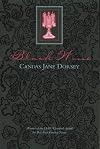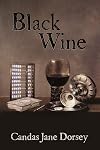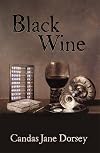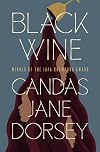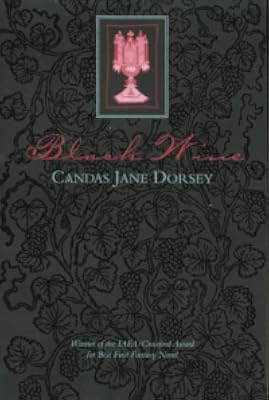
Black Wine
by Candas Jane Dorsey
On This Page
Description
"Those who enjoy the work of such popular feminist speculative fiction writers as Joanna Russ and Ursula K. Le Guin will find much to admire here." --Publishers Weekly Winner of the IAFA Crawford, and the James Tiptree, Jr., and the Aurora awards, Black Wine beckons readers into a stark and richly realized world similar to yet very different from our own, to explore the many ways a woman can be cut off from her own history. How does a woman survive, maintain her sense of self in show more such a place? An amnesiac slave girl struggles to learn about her past--and secure a future outside the oppressive society that binds her. A female adventurer confronts danger as she searches for her lost mother. A wife struggles within a marriage to a man she does not want. A world of female characters whose emotional journeys are intimately intertwined, where identity and history, language and perception, sexuality and oppression, unite them in their search for meaning, human connection, and ultimately, freedom. "The careful braiding of self, places, and times insidiously pulls you in.--Elisabeth Vonarburg, author of The Silent City and The Maerlande Chronicles "Like its title, Black Wine is rare and darkly glowing with iridescence. A taut, spare, wonderful creation." --Edmonton Journal "A tantalizing, distinctive, sexy, and beautifully rendered first novel." --Kirkus Reviews show lessTags
Recommendations












Member Reviews
This work of feminist sci fi has a palindromic structure, weaving together the stories of several women in a complex way. Gradually we come to understand how the women's stories are related - and to see the common themes which join them, themes of freedom and dependence, love and maternal responsibility, the nature of home and the need to travel. Another major theme is what different languages are able to express - there are cruel languages in which it's impossible to say that you are free, and gentle languages which can't explain slavery.
It's a story which is sometimes hard to follow - after three chapters I turned back to the beginning and took notes, which is something I've never done before - but I felt that I needed to do that to show more get the most out of the book. I enjoyed the challenge of making the pieces fit together, as well as meeting the smart, intrepid women and their friends who feature in the book. The worldbuilding was good too - an interesting range of societies, sketched vividly without too much description.
It's not a perfect book. Some of the ideas were a bit clunky (there's a chapter actually titled "Women who transgress", for example), although not bad by the standards of the genre. A bigger problem for me was the utopianism - even though I know that it's ridiculous to criticise feminist SF for being utopian, that's what it's there for! But I guess I just don't believe in human nature being any better than what we see around us - and certainly not in a culture which doesn't even have words for nastiness. And I was more interested in the build-up than the resolution of the stories. But I enjoyed reading it, and would recommend it to someone interested in the genre. show less
It's a story which is sometimes hard to follow - after three chapters I turned back to the beginning and took notes, which is something I've never done before - but I felt that I needed to do that to show more get the most out of the book. I enjoyed the challenge of making the pieces fit together, as well as meeting the smart, intrepid women and their friends who feature in the book. The worldbuilding was good too - an interesting range of societies, sketched vividly without too much description.
It's not a perfect book. Some of the ideas were a bit clunky (there's a chapter actually titled "Women who transgress", for example), although not bad by the standards of the genre. A bigger problem for me was the utopianism - even though I know that it's ridiculous to criticise feminist SF for being utopian, that's what it's there for! But I guess I just don't believe in human nature being any better than what we see around us - and certainly not in a culture which doesn't even have words for nastiness. And I was more interested in the build-up than the resolution of the stories. But I enjoyed reading it, and would recommend it to someone interested in the genre. show less
 This review was written for LibraryThing Early Reviewers.
This book really blew my mind. Dorsey is one of those authors that should be appreciated more - I had no idea. She uses beautiful and truly moving language. Her story is complex and just carries you along like any good story should. I felt she really captured the emotional ebb and flow of real women who struggle through life, in the context of a thought-provoking world (our own or another?) Her treatment of gender and sexuality is nuanced and really carries the story through its complicated twists and turns. One of my new favorite authors!
I got this book as a birthday present from my sister.
As soon as I was done reading it (with that shuddering pleasure that only the absolute best books give you), I passed it back to her to read... and I still haven't got it back, because when she was done, she gave it to her boyfriend to read (someone who is not the biggest fantasy fan), and he won't read the very end, because "But once I finish it, it'll be over!"
I'm considering buying another copy, to re-read it and pass it on again to someone else.
It's amazing that 'Black Wine' is a first novel. The characters are complex enough to fully immerse yourself in their lives. The world is not some faux-medieval wish-fulfillment daydream, but a real, gritty and harsh land - that still show more somehow has the feel of one of your deepest dreams.
Recommended for fans of Ursula LeGuin, Margaret Atwood, and Sheri S. Tepper. (But having said that, I feel I should add that the "feminist" undercurrent of the book is neither distracting, nor does it leave you with that nasty "agenda" taste in your mouth.)
(oh, and they play Scrabble! Yay! (as Scrabble fanatics, both me & my sister got a big kick out of that!) show less
As soon as I was done reading it (with that shuddering pleasure that only the absolute best books give you), I passed it back to her to read... and I still haven't got it back, because when she was done, she gave it to her boyfriend to read (someone who is not the biggest fantasy fan), and he won't read the very end, because "But once I finish it, it'll be over!"
I'm considering buying another copy, to re-read it and pass it on again to someone else.
It's amazing that 'Black Wine' is a first novel. The characters are complex enough to fully immerse yourself in their lives. The world is not some faux-medieval wish-fulfillment daydream, but a real, gritty and harsh land - that still show more somehow has the feel of one of your deepest dreams.
Recommended for fans of Ursula LeGuin, Margaret Atwood, and Sheri S. Tepper. (But having said that, I feel I should add that the "feminist" undercurrent of the book is neither distracting, nor does it leave you with that nasty "agenda" taste in your mouth.)
(oh, and they play Scrabble! Yay! (as Scrabble fanatics, both me & my sister got a big kick out of that!) show less
Black Wine by Candas Jane Dorsey I found to be an interesting, if frustrating in places, read. Interesting in terms of the themes and the clear feminist ideology being espoused and frustrating in terms of the structure – a cycle of three intertwined stories of different generations of women from the same matrilineal family (as I came to understand it) where the names and relationships are not explicitly delineated and must be teased out by inference and implication.
I can see why it won the Tiptree Award – as well as the feminist backbone and its examination of institutionalised (?) rape and slavery topics, it’s the first book I remember reading which explicitly described FGM. And there are some lovely descriptive touches – the show more non-verbal language of the mute slaves was both evocative and profoundly believable.
Stylistically, it felt very much a ‘literary’ and contemplative work. But overall, I found it confusing and uneven – the pacing varied from overly languid in places to the other extreme where action flew past so fast I had to re-read multiple sections to actually catch what happened.
I’d assess it as an ambitious and challenging work which didn’t quite hit its intended targets. show less
I can see why it won the Tiptree Award – as well as the feminist backbone and its examination of institutionalised (?) rape and slavery topics, it’s the first book I remember reading which explicitly described FGM. And there are some lovely descriptive touches – the show more non-verbal language of the mute slaves was both evocative and profoundly believable.
Stylistically, it felt very much a ‘literary’ and contemplative work. But overall, I found it confusing and uneven – the pacing varied from overly languid in places to the other extreme where action flew past so fast I had to re-read multiple sections to actually catch what happened.
I’d assess it as an ambitious and challenging work which didn’t quite hit its intended targets. show less
This review was written for LibraryThing Early Reviewers.I adored this book, even if i'm not sure how to talk about it. It's an endlessly circling narrative, almost threatening in the sense of closing in on you. It gives the impression of an incredibly clever knot, where if you know which string to tug, everything unravels, but if you tug the wrong string, everything just gets more and more snarled. There's thoughtprovoking stuff about the nature of language, of possession, of sex, of cruelty, of privilege, of how people's lives interweave, of music, of social structures. It's dense, and creepy, and almost sexy, but not in the obvious places.
https://nwhyte.livejournal.com/3392910.html
An intricate, interesting novel, which actually reminded me of some of Iain M. Banks' work more than anything, with interlacing narrative perspectives in a dangerously diverse but mimimally portrayed world. There is good sex, and very bad sex, and power wielded against those who are divergent or deviant, and there is some brutal violence which I admit I found a bit of a deterrent from following the main plot. I am rather surprised that the author hasn't written a lot more.
An intricate, interesting novel, which actually reminded me of some of Iain M. Banks' work more than anything, with interlacing narrative perspectives in a dangerously diverse but mimimally portrayed world. There is good sex, and very bad sex, and power wielded against those who are divergent or deviant, and there is some brutal violence which I admit I found a bit of a deterrent from following the main plot. I am rather surprised that the author hasn't written a lot more.
This was a strange and difficult novel. Not difficult to read the way that words are read, but difficult to process, emotionally.
It's very strong on feminism by way of how much crap women go through in these pages. It's ostensibly a fantasy with lots of adventure and traveling, but through different characterizations, we're subject to tons of slavery, abuse, acceptance in the midst of horror, and sex.
I can see where people might call this a literary novel as much as they might call it a fantasy. The question of sexuality takes the forefront with LGBT featured. On top of that, the difficult narrative drive of abuse shows up in all shapes and sizes. I've read a lot of mightily difficult novels in this vein.
One particular novel that was show more written long after Black Wine, in particular, comes to mind. [b:The Book of the Unnamed Midwife|29806086|The Book of the Unnamed Midwife (The Road to Nowhere #1)|Meg Elison|https://images.gr-assets.com/books/1465976614s/29806086.jpg|41858562] is just as emotional to read and while one is fantasy and the other is dystopian SF, they both have a LOT in common.
The strangeness of this novel has nothing to do with sex or abuse, however. It mostly has to do with questioning the nature of the characters in relation to the narrator. Confusing? Not quite spelled out except perhaps it is at the end? Yes to both. We're meant to re-evaluate all of the text, and it pretty much worked. Except where it didn't, quite, for me. A little too arty perhaps. I'm worried it cheapened rather than deepened the full experience.
It IS, however, well worth reading for all of us interested in the nastiness of the human condition and what steps we take to survive and find happiness despite it. show less
It's very strong on feminism by way of how much crap women go through in these pages. It's ostensibly a fantasy with lots of adventure and traveling, but through different characterizations, we're subject to tons of slavery, abuse, acceptance in the midst of horror, and sex.
I can see where people might call this a literary novel as much as they might call it a fantasy. The question of sexuality takes the forefront with LGBT featured. On top of that, the difficult narrative drive of abuse shows up in all shapes and sizes. I've read a lot of mightily difficult novels in this vein.
One particular novel that was show more written long after Black Wine, in particular, comes to mind. [b:The Book of the Unnamed Midwife|29806086|The Book of the Unnamed Midwife (The Road to Nowhere #1)|Meg Elison|https://images.gr-assets.com/books/1465976614s/29806086.jpg|41858562] is just as emotional to read and while one is fantasy and the other is dystopian SF, they both have a LOT in common.
The strangeness of this novel has nothing to do with sex or abuse, however. It mostly has to do with questioning the nature of the characters in relation to the narrator. Confusing? Not quite spelled out except perhaps it is at the end? Yes to both. We're meant to re-evaluate all of the text, and it pretty much worked. Except where it didn't, quite, for me. A little too arty perhaps. I'm worried it cheapened rather than deepened the full experience.
It IS, however, well worth reading for all of us interested in the nastiness of the human condition and what steps we take to survive and find happiness despite it. show less
Members
- Recently Added By
Lists

Favorite Science Fiction by Women Authors
737 works; 196 members

What Makes This Book So Great
102 works; 16 members

Books whose title names an object usually found in the kitchen
171 works; 14 members
Author Information

19+ Works 765 Members
Candas Jane Dorsey is a writer, editor, and publisher. Dorsey was the president of the Writing Guild of Alberta, and editor of Edmonton Bullet, and one of the founding editors of the River Books imprint of the Books Collective of Edmonton. Dorsey is currently a member of the editorial advising committee for OnSpec SF magazine, and publisher of show more Tesseract Books, Canada's oldest speculative fiction imprint. Various pieces of Dorsey's short fiction have been awarded the Canadian Science Fiction and Fantasy Award for Best Short-Form Work in English. "Johnny Appleseed on the New World" was chosen for the Visions of Mars CD-ROM included aboard in the 1994 launch of the U. S.-Russian exploration. (Bowker Author Biography) show less
Awards and Honors
Awards
Common Knowledge
- Original publication date
- 1996
- People/Characters
- Essa; Gata; Lowlyn; Minh; The Carrier of Spirits (Diety); Annalise (show all 11); Escape-from-Bondage; Fierce-Frightened; The Regent; Ea; F
- Important places
- The Fjord of Tears; The Remarkable Mountains; Trader Town; The Black Ship; The Dark Isles
- Dedication
- To all those who taught me how to listen to the children -- and when to speak for the voiceless
- First words
- There is a scarred, twisted old madwoman in a cage in the courtyard.
- Last words
- (Click to show. Warning: May contain spoilers.)It was the rush of joy she felt which woke her fully up.
- Blurbers
- Vonarburg, Elisabeth; LeGuin, Ursula K.
Classifications
Statistics
- Members
- 302
- Popularity
- 106,070
- Reviews
- 17
- Rating
- (3.68)
- Languages
- English
- Media
- Paper, Audiobook, Ebook
- ISBNs
- 6
- ASINs
- 3