When She Was White: The True Story of a Family Divided by Race
by Judith Stone
On This Page
Description
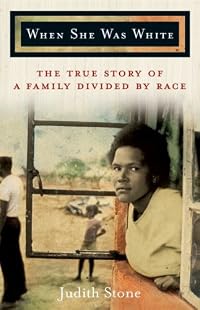
During the worst years of official racism in South Africa, the story of one young girl came to symbolize the injustice, corruption, and arbitrary nature of apartheid. Born in 1955 to a pro-apartheid white couple, Sandra Laing was officially registered and raised as a white child. But at a school for whites, she was mercilessly persecuted because of her dark skin and frizzy hair. Her parents attributed her appearance to an interracial union far back in family history. Their neighbors, show more however, thought Mrs. Laing had committed adultery with a black man. The family was shunned. When Sandra was ten, she was reclassified as "coloured." As a teenager, she eloped with a black man, her parents disowned her, and having known only the privileged world of the whites, she chose to begin again in a poor, all-black township, where life was a desperate struggle against a legal system designed to enslave.--From publisher description. show lessTags
Recommendations




Member Reviews
Sandra Laing was a dark skinned girl born to a white family. This would raise many questions and potentially cause minor problems in many nations through out the world. But the nation she was born in was not any country. It was 1950's South Africa. And her parents were Afrikaners, members of the National Party and residents of a rural town, sending their children to an ultra conservative white school near the border between Swaziland and South Africa. This tore the family apart, nearly ruined a woman's life and became the poster story for the flaws of the apartheid system.
Born with frizzy hair and darker skin, Sandra was always viewed as "coloured" by many in her neighborhood and school, though she says that she never noticed or show more realized this. This distinction in South Africa in the 1950's was an enourmous distinction, because even though she was born to white parents, she was of "appearance and general acceptance" coloured, which made her, legally a second class citizen. Her race was changed from white to coloured, and she was removed from her school, where she was tormented.
Her race was eventually changed back to white, but the damage was already done. She was clearly dramatized by her treatment. She was ostracized by her community, unjustly punished, threatened by her father, who seemed to love her, but never forgive her for her or her mother's potential transgressions (no one is ever 100% sure her father is her blood father), abandoned by her white family (though she was taken in by the black family of her first husband, and many men afterwards) and never seems to function as an adult. She doesn't trust people unless they give her money, she feels an endless amount of guilt for her past, and she never seems happy in her skin.
Overall, the book is an interesting story of one of the most famous victims of Apartheid. Judith Stone's voice is clear and concise. She supplements many hours of personal interviews with Sandra and her family and friends with news articles from her government file.
Although Judith's voice is clear, sadly, Sandra's voice is not, nor are the voices of many of the people she interviews. Many people have forgotton the past or, in the case of her white brothers, don't want to talk about their history. In the case of Sandra, she seems to have deliberately forgotton many things or simply doesn't want to talk about them, possiblely because they cause her pain. This leaves some holes in the story, and the book does suffer because of this. That said, it was a good effort by Stone to write this book as an outsider. show less
Born with frizzy hair and darker skin, Sandra was always viewed as "coloured" by many in her neighborhood and school, though she says that she never noticed or show more realized this. This distinction in South Africa in the 1950's was an enourmous distinction, because even though she was born to white parents, she was of "appearance and general acceptance" coloured, which made her, legally a second class citizen. Her race was changed from white to coloured, and she was removed from her school, where she was tormented.
Her race was eventually changed back to white, but the damage was already done. She was clearly dramatized by her treatment. She was ostracized by her community, unjustly punished, threatened by her father, who seemed to love her, but never forgive her for her or her mother's potential transgressions (no one is ever 100% sure her father is her blood father), abandoned by her white family (though she was taken in by the black family of her first husband, and many men afterwards) and never seems to function as an adult. She doesn't trust people unless they give her money, she feels an endless amount of guilt for her past, and she never seems happy in her skin.
Overall, the book is an interesting story of one of the most famous victims of Apartheid. Judith Stone's voice is clear and concise. She supplements many hours of personal interviews with Sandra and her family and friends with news articles from her government file.
Although Judith's voice is clear, sadly, Sandra's voice is not, nor are the voices of many of the people she interviews. Many people have forgotton the past or, in the case of her white brothers, don't want to talk about their history. In the case of Sandra, she seems to have deliberately forgotton many things or simply doesn't want to talk about them, possiblely because they cause her pain. This leaves some holes in the story, and the book does suffer because of this. That said, it was a good effort by Stone to write this book as an outsider. show less
The story of Sandra Laing, born to two white pro-aparthid parents in South Africa in the 1960s. A must read.
Ratings
Members
- Recently Added By
Author Information
6+ Works 191 Members
Common Knowledge
- People/Characters
- Sandra Laing
Classifications
- Genres
- Nonfiction, Biography & Memoir, General Nonfiction, History
- DDC/MDS
- 305.48 — Society, Government, and Culture Social sciences, sociology & anthropology Social group - Age, Gender, Ethnicity Women Specific groups of women
- LCC
- DT1768 .C65 .S76 — History of Europe, Asia, Africa and Oceania Africa History of Africa South Africa Ethnography
- BISAC
Statistics
- Members
- 96
- Popularity
- 334,378
- Reviews
- 2
- Rating
- (3.73)
- Languages
- English
- Media
- Paper
- ISBNs
- 2
- ASINs
- 2