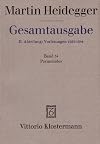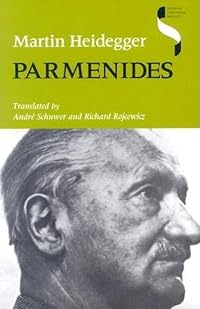
Parmenides
by Martin Heidegger
On This Page
Description
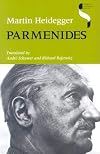
Parmenides, a lecture course delivered by Martin Heidegger at the University of Freiburg during the winter semester of 1942-1943, presents a highly original interpretation of ancient Greek philosophy. A major contribution to Heidegger's provocative dialogue with the pre-Socratics, the book challenges some of the most firmly established notions about Greek thinking and the Greek world. The central theme is the question of truth and the primordial understanding of truth to be found in show more Parmenides' ""didactic poem"". Heidegger highlights the contrast between Greek and Roman thought and the reflection of that contrast in language. He analyzes the decline in the primordial understanding of truth -- and, just as importantly, of untruth -- that began in later Greek philosophy and that continues, by virtue of the Latinization of the West, down to the present day. Beyond an interpretation of Greek philosophy, Parmenides (volume 54 of Heidegger's collected works) offers a strident critique of the contemporary world, delivered during a time that Heidegger described as ""out of joint"". show lessTags
Recommendations










Member Reviews
This is not always treated as one of Heidegger's core works. It is a series of lectures given in 1942-1943, ostensibly on Parmenides and Heraclitus, but I found it to be a very helpful historical account of key themes in Heidegger's later thought: unconcealment, the open, language, and technology.
He doesn't argue for a position here -- he sets out a history. A history of truth, really a history of the corruption of truth. He takes as his starting point Paremenides' poem, and in particular "The Way of Truth", where "truth" is a translation of "aletheia".
Heidegger reconstructs aletheia through an examination of the word's history and its use in Greek literature and philosophy. His high level claim is that truth has undergone a transition show more and corruption. In the early Greek world, aletheia, more faithfully translated as "unconcealment", inherently reveals and "withdraws" at the same time. Truth isn't the kind of full understanding or mirroring of reality conveyed by the modern conception of truth as "correctness", correspondence between idea or word and reality.
Truth for the Greeks, in Heidegger's account, maintains a kind of autonomy. His treatment here brings together consistent themes in his later thought, in which language and art participate in the revealing of the world to us, granted to us but not exhausted by that revealing. Although not his term, I always find myself coming back to the "autonomy" of reality as something that has been banished by modern thought and technology.
Heidegger in one passage discusses the related notion of the "mysterious", saying that what is mysterious has been reduced to the "unexplained" by modern thought. Modern thought works within a way of understanding that it takes for THE way of understanding. Anything that doesn't yield to it is not inherently mysterious, just not yet explained. What is lost is the acceptance that not everything yields itself to explanation, that the very idea of understanding anything means also leaving behind a mystery, that is, anything that doesn't yield itself to that understanding -- whatever reveals also conceals.
The fatal modern mistake here is to suppose that what is mysterious is just what is currently beyond our knowledge (beyond the current reach of science). It's not that our methods haven't reached what is mysterious because our knowledge just hasn't progressed that far. It is that no matter how far we progress with our methods, precisely because of our methods, the mysterious will remain. Absolute knowledge, full transparency of reality is an illusion, an illusion born of the arrogance to think that reality fully yields itself to our understanding.
You can see here as well the connection between this sense that all can be explained and understood and the attitude of technology, that all is here for our use. Reality, in yielding itself to us, is what it is for us and nothing more. It loses its inherency in losing its mystery.
These are consistent themes through Heidegger's later writing, and the great advantage here is the coherent presentation of them via a history of truth.
In addition to elucidating his own thoughts on technology and the degradation of thinking, there is a great deal here of interest in Heidegger's account of the history of philosophy.
During the second half of the book, Heidegger presents an interpretation of Plato's Myth of Er. He understands the River Lethe in Plato's myth in the light of the contrast between aletheia as unconcealing and lethe (often translated as "forgetfulness") as "withdrawing concealment". If we understand Plato's myth in this way, his "doctrine of recollection" (which Heidegger doesn't discuss directly here) becomes something very different from the pyschological movement through knowing, forgetting, and recalling. The demonstration of recollection in the Meno then would not be understood as a recovering of innate knowledge so much as a demonstration of the dialectic as how what is true reveals itself.
This is an important book to read, I think, if we want to understand Heidegger's later thought. Taking an historical perspective allows us to see those main themes of his later thought from a different angle than some of the later more purely thematic treatments such as The Question Concerning Technology, On the Way to Language, or the Discourse on Thinking. show less
He doesn't argue for a position here -- he sets out a history. A history of truth, really a history of the corruption of truth. He takes as his starting point Paremenides' poem, and in particular "The Way of Truth", where "truth" is a translation of "aletheia".
Heidegger reconstructs aletheia through an examination of the word's history and its use in Greek literature and philosophy. His high level claim is that truth has undergone a transition show more and corruption. In the early Greek world, aletheia, more faithfully translated as "unconcealment", inherently reveals and "withdraws" at the same time. Truth isn't the kind of full understanding or mirroring of reality conveyed by the modern conception of truth as "correctness", correspondence between idea or word and reality.
Truth for the Greeks, in Heidegger's account, maintains a kind of autonomy. His treatment here brings together consistent themes in his later thought, in which language and art participate in the revealing of the world to us, granted to us but not exhausted by that revealing. Although not his term, I always find myself coming back to the "autonomy" of reality as something that has been banished by modern thought and technology.
Heidegger in one passage discusses the related notion of the "mysterious", saying that what is mysterious has been reduced to the "unexplained" by modern thought. Modern thought works within a way of understanding that it takes for THE way of understanding. Anything that doesn't yield to it is not inherently mysterious, just not yet explained. What is lost is the acceptance that not everything yields itself to explanation, that the very idea of understanding anything means also leaving behind a mystery, that is, anything that doesn't yield itself to that understanding -- whatever reveals also conceals.
The fatal modern mistake here is to suppose that what is mysterious is just what is currently beyond our knowledge (beyond the current reach of science). It's not that our methods haven't reached what is mysterious because our knowledge just hasn't progressed that far. It is that no matter how far we progress with our methods, precisely because of our methods, the mysterious will remain. Absolute knowledge, full transparency of reality is an illusion, an illusion born of the arrogance to think that reality fully yields itself to our understanding.
You can see here as well the connection between this sense that all can be explained and understood and the attitude of technology, that all is here for our use. Reality, in yielding itself to us, is what it is for us and nothing more. It loses its inherency in losing its mystery.
These are consistent themes through Heidegger's later writing, and the great advantage here is the coherent presentation of them via a history of truth.
In addition to elucidating his own thoughts on technology and the degradation of thinking, there is a great deal here of interest in Heidegger's account of the history of philosophy.
During the second half of the book, Heidegger presents an interpretation of Plato's Myth of Er. He understands the River Lethe in Plato's myth in the light of the contrast between aletheia as unconcealing and lethe (often translated as "forgetfulness") as "withdrawing concealment". If we understand Plato's myth in this way, his "doctrine of recollection" (which Heidegger doesn't discuss directly here) becomes something very different from the pyschological movement through knowing, forgetting, and recalling. The demonstration of recollection in the Meno then would not be understood as a recovering of innate knowledge so much as a demonstration of the dialectic as how what is true reveals itself.
This is an important book to read, I think, if we want to understand Heidegger's later thought. Taking an historical perspective allows us to see those main themes of his later thought from a different angle than some of the later more purely thematic treatments such as The Question Concerning Technology, On the Way to Language, or the Discourse on Thinking. show less
100 HEI 1
Heidegger reflexiona sobre el sentido original de las palabras griegas para describir el proceso de formación del pensamiento europeo.
El ensayo comienza con el análisis de los múltiples sentidos del término griego equivalente a verdad y, a partir de él, Heidegger escribe sobre la justicia, la política y el sentido de la vida y la muerte. Vallcorba explicó que este libro no muestra al Heidegger que flirteó con el nazismo, sino que enseña cómo se vertebra el pensamiento europeo que ha pervivido hasta la actualidad. En opinión de Carbonell, puede resultar paradójico que un autor recurra a textos escritos hace 2.500 años para explicar el presente, pero, en su opinión, la perspectiva de Heidegger permite comprender la totalidad show more del proceso.
Carbonell, que ya había traducido a Nietzsche y Hölderlin, explicó que las obras del autor alemán requieren "una lectura atenta y paciente, pero resultan extremadamente gratificantes". El traductor considera que con este ensayo el lector aprende a replantearse sus creencias y consigue aclarar una serie de conceptos que le permiten tener una conciencia crítica. "Heidegger no busca crear simpatía, sino empatía para que el lector comience a cambiar", explicó Carbonell. show less
El ensayo comienza con el análisis de los múltiples sentidos del término griego equivalente a verdad y, a partir de él, Heidegger escribe sobre la justicia, la política y el sentido de la vida y la muerte. Vallcorba explicó que este libro no muestra al Heidegger que flirteó con el nazismo, sino que enseña cómo se vertebra el pensamiento europeo que ha pervivido hasta la actualidad. En opinión de Carbonell, puede resultar paradójico que un autor recurra a textos escritos hace 2.500 años para explicar el presente, pero, en su opinión, la perspectiva de Heidegger permite comprender la totalidad show more del proceso.
Carbonell, que ya había traducido a Nietzsche y Hölderlin, explicó que las obras del autor alemán requieren "una lectura atenta y paciente, pero resultan extremadamente gratificantes". El traductor considera que con este ensayo el lector aprende a replantearse sus creencias y consigue aclarar una serie de conceptos que le permiten tener una conciencia crítica. "Heidegger no busca crear simpatía, sino empatía para que el lector comience a cambiar", explicó Carbonell. show less
Nov 15, 2017Spanish
Ratings
Members
- Recently Added By
Lists

Antigua Grecia
43 works; 2 members
Author Information

Martin Heidegger was born in Messkirch, Baden, Germany on September 22, 1889. He studied Roman Catholic theology and philosophy at the University of Frieburg before joining the faculty at Frieburg as a teacher in 1915. Eight years later Heidegger took a teaching position at Marburg. He taught there until 1928 and then went back to Frieburg as a show more professor of philosophy. As a philosopher, Heidegger developed existential phenomenology. He is still widely regarded as one of the most original philosophers of the 20th century. Influenced by other philosophers of his time, Heidegger wrote the book, Being in Time, in 1927. In this work, which is considered one of the most important philosophical works of our time, Heidegger asks and answers the question "What is it, to be?" Other books written by Heidegger include Basic Writings, a collection of Heidegger's most popular writings; Nietzsche, an inquiry into the central issues of Friedrich Nietzsche's philosophy; On the Way to Language, Heidegger's central ideas on the origin, nature and significance of language; and What is Called Thinking, a systematic presentation of Heidegger's later philosophy. Since the 1960s, Heidegger's influence has spread beyond continental Europe and into a number of English-speaking countries. Heidegger died in Messkirch on May 26, 1976. (Bowker Author Biography) show less
Some Editions
Series
Belongs to Publisher Series
Common Knowledge
- Canonical title
- Parmenides
- Original publication date
- 1942/ 1943; 2005 (Español) (Español)
Classifications
- Genres
- Philosophy, Nonfiction
- DDC/MDS
- 182.3 — Philosophy & psychology Ancient, medieval & eastern philosophy Pre-Socratic Greek philosophies Eleatic: Xenophanes, Parmenides, Zeno, Melissus
- LCC
- B3279 .H48 .P3713 — Philosophy, Psychology and Religion Philosophy (General) By period Modern By region or country
- BISAC
Statistics
- Members
- 223
- Popularity
- 146,312
- Reviews
- 3
- Rating
- (3.42)
- Languages
- 7 — Catalan, English, French, German, Italian, Portuguese, Spanish
- Media
- Paper
- ISBNs
- 9
- ASINs
- 1