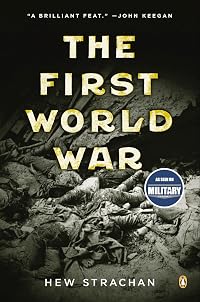
The First World War
by Hew Strachan
On This Page
Description
A century has passed since the outbreak of World War I, yet as military historian Hew Strachan argues in this brilliant and authoritative new book, the legacy of the "war to end all wars" is with us still. The First World War was a truly global conflict from the start, with many of the most decisive battles fought in or directly affecting the Balkans, Africa, and the Ottoman Empire. Even more than World War II, the First World War continues to shape the politics and international relations show more of our world. Strachan has done a masterful job of reexamining the causes, the major campaigns, and the consequences of the First World War, compressing a lifetime of knowledge into a single definitive volume tailored for the general reader. Written in crisp, compelling prose, The First World War re-creates this world-altering conflict both on and off the battlefield-the clash of ideologies between the colonial powers at the center of the war, the social and economic unrest that swept Europe both before and after, the military strategies employed with stunning success and tragic failure in the various theaters of war, the terms of peace and why it didn't last. show lessTags
Recommendations







Member Recommendations
Member Reviews
I searched Amazon for books in the category of history with a subject of World War I, and received over 30,000 results. Since I lack multiple lifetimes to devote to this subject, expert recommendations carry a lot of weight with me. Thus I took note when John R. Schindler, former professor at the Naval War College, recommended this as the war’s best one-volume introduction; and it did not disappoint.
This isn’t a lengthy book, so it can’t afford to sprawl into elaborate detail on any given theater, battle, or topic. What results is a tight roadmap of a conflict far more riveting than Hollywood can offer in the occasional two-hour movie about trenches in France. Sir Hew Strachan brings to this landmark volume the touch of a master show more painter who knows his subject and his craft so thoroughly that he can convey a landscape in a brushstroke.
I’m especially impressed with his interpretation of the causes of the war. His exposition is more convincing than the narrative you sometimes hear of leaders tripping over a web of treaties and falling accidentally into war. Strachan argues persuasively that each combatant believed itself to be waging a defensive war for undeniable national interests. No one stumbled helplessly into the Great War.
I also appreciate the attention given to theaters often neglected in the imagination of Western Europe and the United States. Austria-Hungary’s desperate attempt to subdue Serbia before the Russian bear could land its weight comes in for attention just as thoughtful as that given to the abortive Entente assault at Gallipoli or the killing fields of Verdun and Passchendaele. The campaigns in the African colonies get a whole chapter all to themselves.
Finally, I want to mention two highlights: the photographs and the maps. All the photos are great, providing visual context and breaking up the text without overwhelming it. But what I find unique and electrifying are the central panels of color photographs. Not colorized: reproductions of actual color photographs developed during the war by a French firm using experimental methods lost to time. These gorgeous prints bring liveliness and immediacy to a war that can seem remote and sterile simply because we usually see it in black and white.
Last but certainly not least, the maps are better than usual. I have a pet peeve with history books that either fail to provide maps, or provide maps that are cluttered beyond usefulness, or provide maps that connect poorly with the text. These maps are clean and easy to read, including almost every place of any importance in the book. All of them are collected conveniently in the front, so you don’t have to flip around trying to find that map of the Baltic front or that inset of Ypres.
Former Professor Schindler doesn’t need my vindication, but I can’t find a reason to disagree with him. This is a worthy introduction to the subject, and I can’t recommend it highly enough if you want a comprehensive primer on the War to End War. show less
This isn’t a lengthy book, so it can’t afford to sprawl into elaborate detail on any given theater, battle, or topic. What results is a tight roadmap of a conflict far more riveting than Hollywood can offer in the occasional two-hour movie about trenches in France. Sir Hew Strachan brings to this landmark volume the touch of a master show more painter who knows his subject and his craft so thoroughly that he can convey a landscape in a brushstroke.
I’m especially impressed with his interpretation of the causes of the war. His exposition is more convincing than the narrative you sometimes hear of leaders tripping over a web of treaties and falling accidentally into war. Strachan argues persuasively that each combatant believed itself to be waging a defensive war for undeniable national interests. No one stumbled helplessly into the Great War.
I also appreciate the attention given to theaters often neglected in the imagination of Western Europe and the United States. Austria-Hungary’s desperate attempt to subdue Serbia before the Russian bear could land its weight comes in for attention just as thoughtful as that given to the abortive Entente assault at Gallipoli or the killing fields of Verdun and Passchendaele. The campaigns in the African colonies get a whole chapter all to themselves.
Finally, I want to mention two highlights: the photographs and the maps. All the photos are great, providing visual context and breaking up the text without overwhelming it. But what I find unique and electrifying are the central panels of color photographs. Not colorized: reproductions of actual color photographs developed during the war by a French firm using experimental methods lost to time. These gorgeous prints bring liveliness and immediacy to a war that can seem remote and sterile simply because we usually see it in black and white.
Last but certainly not least, the maps are better than usual. I have a pet peeve with history books that either fail to provide maps, or provide maps that are cluttered beyond usefulness, or provide maps that connect poorly with the text. These maps are clean and easy to read, including almost every place of any importance in the book. All of them are collected conveniently in the front, so you don’t have to flip around trying to find that map of the Baltic front or that inset of Ypres.
Former Professor Schindler doesn’t need my vindication, but I can’t find a reason to disagree with him. This is a worthy introduction to the subject, and I can’t recommend it highly enough if you want a comprehensive primer on the War to End War. show less
Hew Strachan's The First World War is somewhat of a companion piece to the documentary series of the same name. It was interesting to read the book after watching the series, because the book preserves much of the thematic-vice chronological-approach of the series. While I thought that approach worked really well for tv, it made for slightly scattered reading and I was glad that I had already read a couple more straightforward histories of the war because the book, by necessity, jumped around in time and place quite a bit.
Highlights for me: Strachan's discussion of the development, refinement, and integration of new tactics and technologies of warfare (one of the reasons I find ww1 so fascinating in the first place), and his discussion show more in the final pages of the book about how the meaning and memories of the war changed over time-many participants in the war did not initially view it as the exercise in futility that they would later come to see it as. This latter point led Strachan, both in the book and in the documentary, to place a premium on using soldiers' contemporaneous reflections, rather than their later memories, when trying to capture the lived experience. show less
Highlights for me: Strachan's discussion of the development, refinement, and integration of new tactics and technologies of warfare (one of the reasons I find ww1 so fascinating in the first place), and his discussion show more in the final pages of the book about how the meaning and memories of the war changed over time-many participants in the war did not initially view it as the exercise in futility that they would later come to see it as. This latter point led Strachan, both in the book and in the documentary, to place a premium on using soldiers' contemporaneous reflections, rather than their later memories, when trying to capture the lived experience. show less
An interesting, but somewhat unsatisfactory, book. It has some keen arguments and insights, though the (deliberate, as acknowledged in the acknowledgments) refusal to engage with other views about aspects of WWI is somewhat infuriating. Furthermore, this book is somewhat disjointed, and one would have to say that the chapters, and their various sub-sections, do not give the impression that they naturally follow on from each other. This is probably linked to the fact that the book is a companion piece to a TV documentary series. One would assume that that documentary itself could use other media aside from words (images, etc.), as well as repetition (there is generally a week between episodes after all), to link different sections. Here, show more repetition has been understandably eschewed. Yet, no compensating means of linking different sections has been employed.
Despite these faults, there are notable merits. Hew Strachan clearly has great strategic and tactical insight, and can see the linkage between, to adapt the popular cliché for my purposes, both the big picture wood and the small detail trees. It is also a noticeably less anglo-centric history of the war than I am used to seeing in this part of the world, providing admirable insight into French, Balkan and German war experiences (though I have the nagging feeling that small countries and territories could be better served, even within the limits of a 1-volume treatment? For example, Belgium goes missing for 4 years between the war's beginning and end, while Ireland, despite being a large and difficult chunk of the UK at the time, and one greatly affected by the Great War to boot, goes unmentioned). The author also has both a remarkable breadth of knowledge and a gift for conveying it to the reader.
Overall, the book is worth reading, but the casual historian should not use it as his/her sole guide to the Great War. show less
Despite these faults, there are notable merits. Hew Strachan clearly has great strategic and tactical insight, and can see the linkage between, to adapt the popular cliché for my purposes, both the big picture wood and the small detail trees. It is also a noticeably less anglo-centric history of the war than I am used to seeing in this part of the world, providing admirable insight into French, Balkan and German war experiences (though I have the nagging feeling that small countries and territories could be better served, even within the limits of a 1-volume treatment? For example, Belgium goes missing for 4 years between the war's beginning and end, while Ireland, despite being a large and difficult chunk of the UK at the time, and one greatly affected by the Great War to boot, goes unmentioned). The author also has both a remarkable breadth of knowledge and a gift for conveying it to the reader.
Overall, the book is worth reading, but the casual historian should not use it as his/her sole guide to the Great War. show less
A good concise short history of this monumental event. And it was an monument to man's futility of imposing his will, costing millions of lives in the process. Strachan covers the key points and strategies of the events and people behind them. One hundred years are passing now and it is hard to see at times what we learned.
Companion to a TV documentary on the first world war. I found this book to be a great general overview of the first world war – not too detailed, not too scholarly but thoroughly researched and well written. The book is organized along themes, which mirror the structure of the documentary, and in this sense, the conflict is not treated in a strict chronological manner. Therein lies its strengths and weaknesses: for while it may lack clarity at times and jump ahead in the unfolding of events, the complexity and scale of the conflict perhaps calls for such a non-linear treatment. I was happy to see that the book did not exclusively focus on the western front and does show the worldwide dimension of the conflict. Color photos of the show more French colonial troops highlight that fact. The author also brings into play and adeptly illustrates some of the emerging trends: the clash of ideologies and civilizations, military strategies, the consolidation of nationalism in Europe and in its rise in the colonies, and the conflict’s consequences still reverberating to this day in the Balkans, Russia and the Middle East. Overall, an authoritative overview of the first world war, and a basis for further reading based on interests, perhaps time to tackle those histories the size of a telephone directory. show less
Great book. This is a good book if you don't really know how the first world war got started, who the players were, or how it ended. A very good introduction on the war to end all wars
An excellent, concise history of the First World War. It really explains how it wasn't just a European War and more importantly how it wasn't, for all those Powers involved, a needless or futile war, despite the fashionable notion held today that it was. Recommended.
Members
- Recently Added By
Lists

r/AskHistorians' Recommended Books
1,068 works; 19 members

r/History Recommended Reading List
603 works; 12 members

THE WAR ROOM
813 works; 24 members
Author Information

27+ Works 2,349 Members
Hew Strachan was born in in Edinburgh, Scotland on September 1, 1949. He is a historian who specializes in the British military and in World War I. He has written numerous books including The First World War, The First World War in Africa, The Politics of the British Army, and Carl von Clausewitz's On War. He received the Westminster Medal for The show more Politics of the British Army. He received the Pritzker Military Museum and Library Literature Award for Lifetime Achievement in Military Writing in 2016. (Bowker Author Biography) show less
Common Knowledge
- Canonical title
- The First World War
- Original title
- The First World War, A New Illustrated History
- Original publication date
- 2003
- Important places
- Europe
- Important events
- Battle of the Somme (1916); World War I (1914 | 1918)
- Dedication
- For Pamela and Mungo, who may not have lived through the First World War but have had to live with it.
- First words
- In Britain popular interest in the First World War runs at levels that surprise almost all other nations, with the possible exception of France.
- Blurbers
- Keegan, John; Showalter, Dennis; Johnson, Paul; Gopnik, Adam
- Original language
- English
Classifications
Statistics
- Members
- 1,150
- Popularity
- 21,936
- Reviews
- 21
- Rating
- (3.87)
- Languages
- 7 — Danish, Dutch, English, French, German, Italian, Spanish
- Media
- Paper, Audiobook, Ebook
- ISBNs
- 27
- UPCs
- 1
- ASINs
- 5