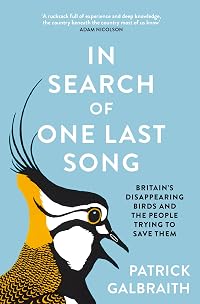
In Search of One Last Song: Britain’s disappearing birds and the people trying to save them
by Patrick Galbraith
On This Page
Description
'Wonderful and enriching' Adam Nicolson 'The best book on conservation and the countryside I have read in years' John Lewis-Stempel 'A modern pastoral written with intelligence, wit and lyricism' Cal Flyn Our wild places and wildlife are disappearing at a terrifying rate. This is a story about going in search of the people who are trying to save our birds, as well as confronting the enormity of what losing them would really mean. In this beautiful and thought-provoking blend of nature and show more travel writing Patrick Galbraith sets off across Britain on a journey that may well be his last chance to see some of our disappearing birds. Along the way, from Orkney to West Wales, from the wildest places to post-industrial towns, he meets a fascinatingly eclectic group of people who in very different ways are on the front line of conservation, tirelessly doing everything they can to save ten species teetering dangerously close to extinction. In Search of One Last Song mixes conservation, folklore, history, and art. Through talking to musicians, writers and poets, whose work is inspired by the birds he manages to see, such as the nightingale and the capercaillie, Galbraith creates a picture of the immense cultural void that would be left behind if these birds were gone. Among those he meets, there are feelings of great frustration. There are reed cutters and coppicers whose ancient crafts have long sustained vital habitats for some of our rarest birds but whose voices often go unheard. There are ornithologists who think their warnings are being ignored, and there are gamekeepers and animal rights activists who both feel they are on the right side of an increasingly ugly battle. Ultimately, it emerges that many of the birds Galbraith encounters could thrive, but it would require much better cooperation between those who are caught up in the struggle for their future. It also becomes clear that while losing birds like the turtle dove and black grouse will result in a paler country for all of us, for some of those who live alongside them, it will mean the bitterly painful end of so much more. show lessTags
Member Reviews
We are well on the way to losing far to many of our British bird species, in many cases birds that have been common, even over-abundant, for centuries. Galbraith takes ten of these species, and makes it his business to go to their favoured habitats, and find out why from the people who know, and have strong opinions. He talks to people from all parts of the environmental debate, whether experts in the academic sense, or experts because they've lived and worked in the area affected. He makes no judgements about the people with whom he spends time, and thereby demonstrates how very complex a subject conservation is. Are conservation efforts which are right for one species in some cases spelling danger for others?
I think this is a book I show more will feel more warmly towards as I distance myself from it. Galbraith presents the arguments, the complexities of the various debates well and fully. And while I appreciated the character sketches of the people whom he met, I sometimes found his anecdotes irritatingly inconsequential and meandering. Nevertheless, it's a book I am glad to have read, and it made me aware of how rarely conservation arguments can be presented in black and white. show less
I think this is a book I show more will feel more warmly towards as I distance myself from it. Galbraith presents the arguments, the complexities of the various debates well and fully. And while I appreciated the character sketches of the people whom he met, I sometimes found his anecdotes irritatingly inconsequential and meandering. Nevertheless, it's a book I am glad to have read, and it made me aware of how rarely conservation arguments can be presented in black and white. show less
Members
- Recently Added By
Lists

TLL Reading List
9 works; 1 member
Author Information
5 Works 44 Members
Classifications
Statistics
- Members
- 10
- Popularity
- 2,146,267
- Reviews
- 1
- Rating
- (3.00)
- Languages
- English
- Media
- Paper, Audiobook, Ebook
- ISBNs
- 4
- ASINs
- 1