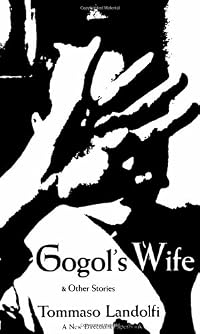
Gogol's Wife: & Other Stories
by Tommaso Landolfi
On This Page
Description
In 1964, with the stories ofGogol's Wife, New Directions introduced English language readers to the indelibly strange Italian master Tommaso Landolfi. Each tale is more astonishing than the next (what with a sacrilegious ape and an inflatable wife), though the stories are all delivered in a smooth and oddly decorous way. Casting its spell, this combination of the outré and the well-mannered unnerves the reader. The stories' duality is the stuff of nightmares, though the author's real show more nightmare, according to his champion Italo Calvino, is 'that nothingness does not exist.' show lessTags
Recommendations












Member Reviews
Religion in such a one is being certain that the last end of a bad thing will not come to such a one. — Gertrude Stein, The Making of Americans
"Everyone's Tattoo'd!"
Gogol has a written a very humorous story (The Overcoat) in which a meek clerk, because something very bad is done to him, has been granted reprieve from oblivion. He is later seen in ghostly form tugging the sleeve of a well-dressed pedestrian, uttering with characteristic circumspection: "I've come to you, Petrovitch, sort of . . ." It's a movement of great Bathos in which we recognize our clerk still pursuing his stolen overcoat from beyond the grave. Gogol is perhaps superior to other writers because he allows such moments to ferment back into Pathos. If death is not show more the end of experience (in the eschatological sense), why not grant this reprieve also to our little clerk, who is doing a labor of Orpheus for a Eurydice in the form of fine fabric. Every ghost story is a catasterism. (i.e. "The process by which a hero is turned into a constellation or celestial object; a placing among the stars," see the constellation Lyra.)
Landolfi has written a light satire (Gogol's Wife) in a style almost a precursor of the salacious mid-century form that would reach its apogee in Joseph Heller and Philip Roth (both already very tiresome). Though such work reads as quite tame in the modern age in which, beneath every fine overcoat, one already expects to meet a rubber spouse with a big tattoo. Though Gogol is perhaps suggesting a piece of eternity for the poorly clothed civil servant, Landolfi is working to redeem a class even meeker. His farce of the literary critic confronted with three poems written in a Borgesian "unknown language" presents an impasse that suggests an eternity of stagnation. This is a way of praising, indirectly, those contemporary literary critics ("old white haired [men] / insensate beyond belief") who have made it to the top of the small heap of the world of Criticism (no matter if filled with hot air to the point of bursting). For them, the impassible problem is a kind of divine providence that ensures their work, on things about which nothing more can be said, might endure a small eternity. We are beginning to understand why this collection comes so highly recommended by Harold Bloom. show less
"Everyone's Tattoo'd!"
Gogol has a written a very humorous story (The Overcoat) in which a meek clerk, because something very bad is done to him, has been granted reprieve from oblivion. He is later seen in ghostly form tugging the sleeve of a well-dressed pedestrian, uttering with characteristic circumspection: "I've come to you, Petrovitch, sort of . . ." It's a movement of great Bathos in which we recognize our clerk still pursuing his stolen overcoat from beyond the grave. Gogol is perhaps superior to other writers because he allows such moments to ferment back into Pathos. If death is not show more the end of experience (in the eschatological sense), why not grant this reprieve also to our little clerk, who is doing a labor of Orpheus for a Eurydice in the form of fine fabric. Every ghost story is a catasterism. (i.e. "The process by which a hero is turned into a constellation or celestial object; a placing among the stars," see the constellation Lyra.)
Landolfi has written a light satire (Gogol's Wife) in a style almost a precursor of the salacious mid-century form that would reach its apogee in Joseph Heller and Philip Roth (both already very tiresome). Though such work reads as quite tame in the modern age in which, beneath every fine overcoat, one already expects to meet a rubber spouse with a big tattoo. Though Gogol is perhaps suggesting a piece of eternity for the poorly clothed civil servant, Landolfi is working to redeem a class even meeker. His farce of the literary critic confronted with three poems written in a Borgesian "unknown language" presents an impasse that suggests an eternity of stagnation. This is a way of praising, indirectly, those contemporary literary critics ("old white haired [men] / insensate beyond belief") who have made it to the top of the small heap of the world of Criticism (no matter if filled with hot air to the point of bursting). For them, the impassible problem is a kind of divine providence that ensures their work, on things about which nothing more can be said, might endure a small eternity. We are beginning to understand why this collection comes so highly recommended by Harold Bloom. show less
This collection left me perplexed at first. The title story is extremely grotesque and absurd, almost to a point where it's too much. Landolfi's prose is very deliberate, and sometimes lugubrious (bit in a good way?) that I often found myself having to re-read certain sentences to understand them. The best stories are the longer ones which reach the fever pitch heights of grotesque absurdity, while the weakest at the short sketches that seem to amble along without much point. Apparently Landolfi later wrote a great deal of work that borders on speculative and even science fiction; this collection contains earlier stories, but in my curiosity I've ordered the later out-of-print collection, Words in Commotion.
1. Gogol’s Wife
Tommaso Landolfi’s story is written as a chapter of a biography on the famous Russian writer, Nikolai Gogol. In this chapter, the author explores the delicate matter of Gogol’s “wife.” It turns out that she is not a woman, but a balloon. A titilling conceit for horny teen-age boys of all ages, Landolfi develops the story into a humorous, but ultimately sad and disturbing fictionalization of Gogol’s self-destruction. The humorous satire is vibrant from beginning to end, while the sense of tragedy subtly builds beneath the surface. The ultimate effect is a potent sense of the pointlessness of Golgol’s demise.
“Gogol’s Wife” is reminiscent of Gogol stories such as “The Overcoat” and, far more, “The show more Nose.” The story is humorously absurd, tragic, and strangely touching. It is both a tribute to Gogol the writer and a scathing satire of Gogol the man.
2. Pastoral
3. Dialogue on the Greater Harmonies
4. The Two Old Maids
5. Wedding Night
6. The Death of the King of France
7. Giovanni and His Wife
8. Sunstroke
9. A Romantic’s Letter on Gambling show less
Tommaso Landolfi’s story is written as a chapter of a biography on the famous Russian writer, Nikolai Gogol. In this chapter, the author explores the delicate matter of Gogol’s “wife.” It turns out that she is not a woman, but a balloon. A titilling conceit for horny teen-age boys of all ages, Landolfi develops the story into a humorous, but ultimately sad and disturbing fictionalization of Gogol’s self-destruction. The humorous satire is vibrant from beginning to end, while the sense of tragedy subtly builds beneath the surface. The ultimate effect is a potent sense of the pointlessness of Golgol’s demise.
“Gogol’s Wife” is reminiscent of Gogol stories such as “The Overcoat” and, far more, “The show more Nose.” The story is humorously absurd, tragic, and strangely touching. It is both a tribute to Gogol the writer and a scathing satire of Gogol the man.
2. Pastoral
3. Dialogue on the Greater Harmonies
4. The Two Old Maids
5. Wedding Night
6. The Death of the King of France
7. Giovanni and His Wife
8. Sunstroke
9. A Romantic’s Letter on Gambling show less
I’m somewhat at a loss of what to say about Golgol’s Wife and Other Stories by Tommaso Landolfi.
In some respects, Landolfi’s stories have elements the bizarre. Landolfi’s writing is laudable, although I wonder once again what the genius behind the stories actually is. I think it is beyond me.
In some stories, Landolfi narrates incredibly unbelievable events as if they actually occurred. Other stories don’t have supernatural elements but have rather difficult personal subjects. Some stories weren’t disturbing and were short and easier to relate to.
In the end, it seems Landolfi’s stories ask questions attempting to define art, right and wrong, and acceptable relationships.
More detailed review on my blog
In some respects, Landolfi’s stories have elements the bizarre. Landolfi’s writing is laudable, although I wonder once again what the genius behind the stories actually is. I think it is beyond me.
In some stories, Landolfi narrates incredibly unbelievable events as if they actually occurred. Other stories don’t have supernatural elements but have rather difficult personal subjects. Some stories weren’t disturbing and were short and easier to relate to.
In the end, it seems Landolfi’s stories ask questions attempting to define art, right and wrong, and acceptable relationships.
More detailed review on my blog
Ratings
Members
- Recently Added By
Lists

Harold Bloom - The Western Canon: D. The Chaotic Age
833 works; 24 members
Author Information

75+ Works 1,137 Members
Series
Belongs to Publisher Series
New Directions Paperbook (155)
Grote ABC (660)
Work Relationships
Contains
Common Knowledge
- First words
- At this point, confronted with the whole complicated affair of Nikolai Vassilevitch’s wife, I am overcome by hesitation.
Classifications
Statistics
- Members
- 178
- Popularity
- 183,318
- Reviews
- 4
- Rating
- (3.85)
- Languages
- Dutch, English, French
- Media
- Paper, Ebook
- ISBNs
- 5
- ASINs
- 1