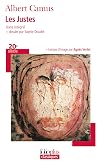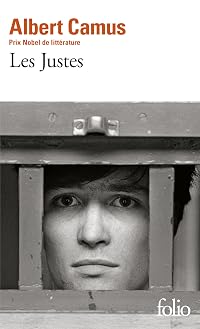
The Just
by Albert Camus
On This Page
Description
A daring critique of communism and how it had gone wrong behind the Iron Curtain, Camus' essay examines the revolutions in France and Russia, and argues that since they were both guilty of producing tyranny and corruption, hope for the future lies only in revolt without revolution. Throughout history, some books have changed the world. They have transformed the way we see ourselves - and each other. They have inspired debate, dissent, war and revolution. They have enlightened, outraged, show more provoked and comforted. They have enriched lives - and destroyed them. Now Penguin brings you the works of the great thinkers, pioneers, radicals and visionaries whose ideas shook civilization and helped make us who we are. show lessTags
Recommendations



















Member Reviews
Though easier to read and considerably more interesting than I had expected, this book left me slightly disappointed because of the simplicity of the plot. It reads more as a brief study of the characters, "Les Justes," and not their story. Overall, it was a very insightful glimpse of the minds behind the Russian Revolution.
“Those who rush blindly to history in the name of the irrational, proclaiming that it is meaningless, encounter servitude and terror and finally emerge into the universe of concentration camps. Those who launch themselves into it, preaching its absolute rationality, encounter servitude and terror and emerge into the universe of the concentration camps.” – Albert Camus
Camus’ critique on communism, slavery, and all tremendous failures in the previous rebels he studied leaves the reader no choice but to feel like a rebel, yes Camus, ‘I rebel therefore I exist’ however also leaves the rebel in angst as to how to go about doing so despite knowing that as Camus says, not in death but in knowing that there is life the rebel show more flourishes. Regardless, the first ¾ are brilliantly written in a way only Albert could write. show less
Camus’ critique on communism, slavery, and all tremendous failures in the previous rebels he studied leaves the reader no choice but to feel like a rebel, yes Camus, ‘I rebel therefore I exist’ however also leaves the rebel in angst as to how to go about doing so despite knowing that as Camus says, not in death but in knowing that there is life the rebel show more flourishes. Regardless, the first ¾ are brilliantly written in a way only Albert could write. show less
Directa y corta enfocada en el tema de si oprimes al opresor quiza eres igual que el.
Por otro lado hecho de menos que se diera un poco mas de profundidad y se estudiaran ramificaciones de ese tema.
Por otro lado hecho de menos que se diera un poco mas de profundidad y se estudiaran ramificaciones de ese tema.
The play is based on actual historical figures, in 1905, a terrorist group ( social revolutionaries )have attacked and assassinated the Russian Grand Duke.........
The main theme is hating violence , torture, assassination and getting lost in this strife...
And the question raised in this play is whether it is right to kill in the name of justice..?
Ivan Kaliayev, a protagonist of the play, fails in killing the Duke at his first attempt....
because the Duke is accompanied by small children. He refuses to deprive the Dukes relatives of their young lives.....
Returning to the terrorists cell,Kaliayev is involved with a harsh quarrel with his fellow members as to the justification of killing for the purpose of revolution ......
a quarrel show more concerning whether the end justifies the means.......
the debate centers around limit of violence, Can one kill in the
interests of the revolution........
"Children! That is all you know. Don't you understand that because he failed to kill these two, thousands of Russian children will die of hunger for many years to come? "
U can't decide.....
and u would be on neither side....
the oppressed with their miserable and humiliating condition and their desire of freedom., or the suppressing ......
as u believe If a man commits a murder,even if this victim deserve to be killed, that man must be killed...........
A continuous conflict and urging debate concerning justice and violence......
show less
The main theme is hating violence , torture, assassination and getting lost in this strife...
And the question raised in this play is whether it is right to kill in the name of justice..?
Ivan Kaliayev, a protagonist of the play, fails in killing the Duke at his first attempt....
because the Duke is accompanied by small children. He refuses to deprive the Dukes relatives of their young lives.....
Returning to the terrorists cell,Kaliayev is involved with a harsh quarrel with his fellow members as to the justification of killing for the purpose of revolution ......
a quarrel show more concerning whether the end justifies the means.......
the debate centers around limit of violence, Can one kill in the
interests of the revolution........
"Children! That is all you know. Don't you understand that because he failed to kill these two, thousands of Russian children will die of hunger for many years to come? "
U can't decide.....
and u would be on neither side....
the oppressed with their miserable and humiliating condition and their desire of freedom., or the suppressing ......
as u believe If a man commits a murder,even if this victim deserve to be killed, that man must be killed...........
A continuous conflict and urging debate concerning justice and violence......
show less
Directa y corta enfocada en el tema de si oprimes al opresor quiza eres igual que el.
Por otro lado hecho de menos que se diera un poco mas de profundidad y se estudiaran ramificaciones de ese tema.
Por otro lado hecho de menos que se diera un poco mas de profundidad y se estudiaran ramificaciones de ese tema.
Du Camus mais sans doute pas du tout grand Camus. J'ai déjà été plus enthousiaste. Peut-être son discours est-il plus propice à la prose qu'au théâtre. Mais le propos reste édifiant. Comme à l'accoutumée.
Jan 30, 2016French
Opera teatrale francese in lingua originale
Jul 23, 2015Italian
Members
- Recently Added By
Author Information

367+ Works 108,744 Members
Born in 1913 in Algeria, Albert Camus was a French novelist, dramatist, and essayist. He was deeply affected by the plight of the French during the Nazi occupation of World War II, who were subject to the military's arbitrary whims. He explored the existential human condition in such works as L'Etranger (The Outsider, 1942) and Le Mythe de Sisyphe show more (The Myth of Sisyphus, 1942), which propagated the philosophical notion of the "absurd" that was being given dramatic expression by other Theatre of the Absurd dramatists of the 1950s and 1960s. Camus also wrote a number of plays, including Caligula (1944). Much of his work was translated into English. He was awarded the Nobel Prize for Literature in 1957. Camus died in an automobile accident in 1960. (Bowker Author Biography) show less
Series
Belongs to Publisher Series
Work Relationships
Is contained in
Has as a student's study guide
Common Knowledge
- Canonical title
- The Just
- Original title
- Les justes
- Alternate titles
- The Just Assassins
- Original publication date
- 1950
- People/Characters
- Ivan Kalyayev
- Important places
- Moscow, Russia
- First words*
- C'est lui.
- Quotations*
- La liberté est un bagne aussi longtemps qu'un seul homme est asservi sur la terre.
Il dit que la poésie est révolutionnaire.
Tout le monde ment. Bien mentir, voilà ce qu'il faut.
Chacun sert la justice comme il peut. Il faut accepter que nous soyons différents. Il faut nous aimer, si nous le pouvons.
Et si l'humanité entière rejette la révolution ? Et si le peuple entier, pour qui tu luttes, refuse que ses enfants soient tués ? Faudra-t-il le frapper aussi ?
Alors choisissez la charité et guérissez seulement le mal de chaque jour, non la révolution qui veut guérir tous les maux, présents et à venir. (show all 14)
Même dans la destruction, il y a un ordre, il y a des limites.
Les hommes ne vivent pas que de justice.
L'honneur est un luxe réservé à ceux qui ont des calèches. – Non. Il est la dernière richesse du pauvre.
Pour nous qui ne croyons pas à Dieu, il faut toute la justice ou c'est le désespoir.
On commence par vouloir la justice et on finit par organiser une police.
La bonne voie est celle qui mène à la vie, au soleil.
L'amour plutôt que la justice !
Le bonheur ? – Sentir la main d'un homme avant de mourir. - Last words*
- (Click to show. Warning: May contain spoilers.)Yanek ! Une nuit froide, et la même corde ! Tout sera plus facile maintenant.
- Original language
- French
*Some information comes from Common Knowledge in other languages. Click "Edit" for more information.
Classifications
Statistics
- Members
- 739
- Popularity
- 38,294
- Reviews
- 8
- Rating
- (3.97)
- Languages
- 11 — Danish, Dutch, English, Esperanto, Finnish, French, German, Portuguese, Russian, Spanish, Turkish
- Media
- Paper, Audiobook, Ebook
- ISBNs
- 30
- ASINs
- 19