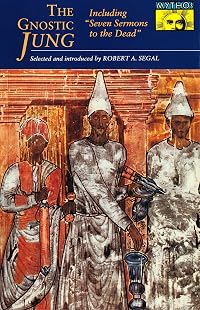
The Gnostic Jung
by C. G. Jung
On This Page
Description
Gnosticism was for C.G. jung the chief prefiguration of his analytical psychology. In this volume Robert Segal, an authority on theories of myth and Gnosticism, has searched the Jungian corpus for Jung's main discussions of this ancient form of spirituality. The progression in Gnosticism from sheer bodily existence to the release of the immaterial spark imprisoned in the body - and the reunion of that spark with the godhead - represents for Jung the psychological progression from ego show more consciousness to the ego's rediscovery of the unconscious, and the ego's integration with the unconscious to forge the self. Included in this volume are both Jung's sole work devoted entirely to Gnosticism, "Gnostic Symbols of the Self," and his own Gnostic myth, "Seven Sermons to the Dead." The book also contains key essays by Father Victor White and Gilles Quispel, whose "C.G. Jung und die Gnosis" is here translated for the first time. In his extensive introduction Segal discusses the parallel for Jung between ancient Gnostic and contemporary Jungian patients, the Jungian meaning of Gnostic myths and of the Seven Sermons, Jung's possible misinterpretation of Gnosticism, and the common characterization of Jung himself as a Gnostic. show lessTags
Recommendations














Member Reviews
Gnosticism was for C.G. jung the chief prefiguration of his analytical psychology. In this volume Robert Segal, an authority on theories of myth and Gnosticism, has searched the Jungian corpus for Jung's main discussions of this ancient form of spirituality. The progression in Gnosticism from sheer bodily existence to the release of the immaterial spark imprisoned in the body - and the reunion of that spark with the godhead - represents for Jung the psychological progression from ego consciousness to the ego's rediscovery of the unconscious, and the ego's integration with the unconscious to forge the self.
Included in this volume are both Jung's sole work devoted entirely to Gnosticism, "Gnostic Symbols of the Self," and his own Gnostic show more myth, "Seven Sermons to the Dead." The... Source: Publisher
FYI: The first 9 chapters of the book are the editor's selection from Jung's writings including those in prefaces to other author's books, letters, etc. Chapters 11, 12 and 13 are contributions to this text. show less
Included in this volume are both Jung's sole work devoted entirely to Gnosticism, "Gnostic Symbols of the Self," and his own Gnostic show more myth, "Seven Sermons to the Dead." The... Source: Publisher
FYI: The first 9 chapters of the book are the editor's selection from Jung's writings including those in prefaces to other author's books, letters, etc. Chapters 11, 12 and 13 are contributions to this text. show less
Ratings
Members
- Recently Added By
Author Information

902+ Works 42,880 Members
Carl Gustav Jung was born in Switzerland on July 26, 1875. He originally set out to study archaeology, but switched to medicine and began practicing psychiatry in Basel after receiving his degree from the University of Basel in 1902. He became one of the most famous of modern psychologists and psychiatrists. Jung first met Sigmund Freud in 1907 show more when he became his foremost associate and disciple. The break came with the publication of Jung's Psychology of the Unconscious (1912), which did not follow Freud's theories of the libido and the unconscious. Jung eventually rejected Freud's system of psychoanalysis for his own "analytic psychology." This emphasizes present conflicts rather than those from childhood; it also takes into account the conflict arising from what Jung called the "collective unconscious"---evolutionary and cultural factors determining individual development. Jung invented the association word test and contributed the word complex to psychology, and first described the "introvert" and "extrovert" types. His interest in the human psyche, past and present, led him to study mythology, alchemy, oriental religions and philosophies, and traditional peoples. Later he became interested in parapsychology and the occult. He thought that unidentified flying objects (UFOs) might be a psychological projection of modern people's anxieties. He wrote several books including Studies in Word Association, Flying Saucers: A Modern Myth of Things Seen in the Skies, and Psychology and Alchemy. He died on June 6, 1961 after a short illness. (Bowker Author Biography) show less
Work Relationships
Contains
Classifications
- Genres
- Nonfiction, Religion & Spirituality, General Nonfiction
- DDC/MDS
- 299.932 — Religion Other religions Shintoism/Taoism/Other Mythologies Religions of other origin Religions of eclectic and syncretistic origin Gnosticism
- LCC
- BF109 .J8 .A25 — Philosophy, Psychology and Religion Psychology Psychology
- BISAC
Statistics
- Members
- 109
- Popularity
- 298,899
- Reviews
- 1
- Rating
- (3.83)
- Languages
- English
- Media
- Paper, Ebook
- ISBNs
- 5
- ASINs
- 1