Lying: A Metaphorical Memoir
by Lauren Slater
On This Page
Description
Seizure chronicles the doctors, the tests, the seizures, the family embarrassments, even as it explores a sensitive child's illness as both metaphor and a means of attention-getting -- a human being's susceptibility to malady, and to storytelling as an act of healing and as part of the quest for love. This mesmerizing memoir openly questions the reliability of memoir itself, the trickiness of the mind in perceiving reality, the slippery nature of illness and diagnosis -- the shifting show more perceptions and images of who we are and what, for God's sake, is the matter with us. show lessTags
Recommendations









Member Reviews
There is no doubt that Lauren Slater is a gifted writer and storyteller. Lying: A Metaphorical Memoir is a frustrating yet beautifully written book. It's also a tricky book, difficult to pigeonhole (memoir? fiction?), and she makes it clear that it can be no other way. It centers mainly around the author's history of epilepsy, which was diagnosed when she was ten. However, this diagnosis, along with the author's very credibility, comes into question as inconsistencies are revealed - inconsistencies that Slater does not deny. Some readers will no doubt find the author's literary obfuscation maddening. Indeed, Slater challenges the reader with her wily and evasive style, but taken on its own terms, Lying raises crucial questions about show more personal truth and speaks to the healing capacity of storytelling. show less
Slater is controversial for her mixture of truth and fiction: this book is a memoir about her epilepsy, but apparently she did not have epilepsy; in another book, she has written novelized histories of actual psychological experiments. She also presents herself as a liar, saying at first it is a typical symptom of epilepsy, but then, when it emerges that she may not have been an epileptic, the lying becomes a narrative strategy for getting at underlying truths.
Slater has been reviewed and discussed widely, but mainly outside literary circles. I can think of several reasons why she hasn't been reviewed as a serious fiction writer:
1. Her strategy of "lying" is only controversial if the books are read as nonfiction or as historical show more scholarship. The blending of fiction and nonfiction "to get to the heart of things" (p. 219; cp. p. 192) is not at all controversial in the domain of writing. What novel isn't about "narrative truth"? What memoir isn't fiction? What history isn't narrated? What story isn't a lie? Slater's book is peppered with undergraduate-style allusions to "postmodernism," Heidegger, and others, as justifications for what she's doing: but the very presence of those gestures shows how far she is from literary practice. There are no references to Barth, Barthelme, Auster, Angela Carter, Muriel Spark, and others who have asked the same questions. (Not to mention Ali Smith: wonder if Slater has seen her speech at http://www.guardian.co.uk/books/2012/aug/18/ali-smith-novelists-approach-art?)
2. Her writing lacks nuance. It's all black and white, and the emotions and scenes are sensationalist. In one episode, her mother berates a hotel pianist for having "heavy hands," and he asks her to sit down and play in his place. Everyone watches as the narrator's mother sits at the piano with a great flourish, and then realizes she actually can't play anything except rudimentary melodies. Her mother retreats in silence. The next line in the book informs us that Slater had her first epileptic fit that night. There are few scenes in the book that end ambiguously. Slater doesn't evoke or suggest: she dramatizes. The emotional temperature is on high from the first page to the last.
3. She isn't especially reflective, even about the very ideas that are central to the book. There are a couple of pages in which deeper concerns are voiced, but they pass by quickly. In one scene her doctor is interested to learn that she has become interested in religious issues. She gets annoyed at being compared to Saint Teresa and others, because that would mean that her illness was creating her interest. Is religion itself a symptom? she asks. "Look," the doctor answers, "it's no an either/or thing. Who knows, maybe the disease is God's way of reaching certain people." (p. 201) His thoughts, and her reactions, go to the heart of difficult issues about faith and mental states, and they should be central for Slater, but she has nothing else to say about them. It's almost as if Slater can't keep her mind on the problem.
I wouldn't mind reading one of her books if it were about just one day, preferably an uneventful day, and her attempts to understand it. It is clear she has been struggling to understand her life, but what counts for her as understanding seems to me more a matter of coming to workable solutions to problems. Often, I think, that is what she has needed. But it's not what readers need, unless of course they are reading her books as self-help manuals -- in which case they will be annoyed, as they often have been, by her so-called "lying." show less
Slater has been reviewed and discussed widely, but mainly outside literary circles. I can think of several reasons why she hasn't been reviewed as a serious fiction writer:
1. Her strategy of "lying" is only controversial if the books are read as nonfiction or as historical show more scholarship. The blending of fiction and nonfiction "to get to the heart of things" (p. 219; cp. p. 192) is not at all controversial in the domain of writing. What novel isn't about "narrative truth"? What memoir isn't fiction? What history isn't narrated? What story isn't a lie? Slater's book is peppered with undergraduate-style allusions to "postmodernism," Heidegger, and others, as justifications for what she's doing: but the very presence of those gestures shows how far she is from literary practice. There are no references to Barth, Barthelme, Auster, Angela Carter, Muriel Spark, and others who have asked the same questions. (Not to mention Ali Smith: wonder if Slater has seen her speech at http://www.guardian.co.uk/books/2012/aug/18/ali-smith-novelists-approach-art?)
2. Her writing lacks nuance. It's all black and white, and the emotions and scenes are sensationalist. In one episode, her mother berates a hotel pianist for having "heavy hands," and he asks her to sit down and play in his place. Everyone watches as the narrator's mother sits at the piano with a great flourish, and then realizes she actually can't play anything except rudimentary melodies. Her mother retreats in silence. The next line in the book informs us that Slater had her first epileptic fit that night. There are few scenes in the book that end ambiguously. Slater doesn't evoke or suggest: she dramatizes. The emotional temperature is on high from the first page to the last.
3. She isn't especially reflective, even about the very ideas that are central to the book. There are a couple of pages in which deeper concerns are voiced, but they pass by quickly. In one scene her doctor is interested to learn that she has become interested in religious issues. She gets annoyed at being compared to Saint Teresa and others, because that would mean that her illness was creating her interest. Is religion itself a symptom? she asks. "Look," the doctor answers, "it's no an either/or thing. Who knows, maybe the disease is God's way of reaching certain people." (p. 201) His thoughts, and her reactions, go to the heart of difficult issues about faith and mental states, and they should be central for Slater, but she has nothing else to say about them. It's almost as if Slater can't keep her mind on the problem.
I wouldn't mind reading one of her books if it were about just one day, preferably an uneventful day, and her attempts to understand it. It is clear she has been struggling to understand her life, but what counts for her as understanding seems to me more a matter of coming to workable solutions to problems. Often, I think, that is what she has needed. But it's not what readers need, unless of course they are reading her books as self-help manuals -- in which case they will be annoyed, as they often have been, by her so-called "lying." show less
LYING is a stunning feat of postmodern nonfiction, professing itself in every page as being both true and untrue, fully metaphorical and essentially accurate. I don't know how much of it "actually happened," and really, I dot need to. Its composition alone is very impressive -- many memoirs are less than well-organized -- and the conversational writing pulls off the contradictory theme without a hitch. Highly recommended to anyone who doesn't require the truth, the whole truth, and nothing but the truth in their readings -- and recommended even more highly to those who do.
This book is pretty incredible. It's very far from an ordinary memoir, as the author makes clear from the beginning... yet even now, I'm still unsure exactly how far she strayed from some kind of objectively verifiable "truth". She's like James Frey turned upside down and inside out -- using "lies" to tell us much greater truths, if few facts. But besides engaging with Big Weighty Ideas, this book is also narratively compelling and filled with lush, intoxicating prose. And occasionally funny!
One major complaint... this memoir may be radical and challenging in many ways, but in one way it is fully conventional: it eagerly participates in the usual game of "Why My Mother Is the Worst Person Who Ever Lived," which might as well be this show more book's subtitle. It's just so easy and cliche and self-serving to blame one's mother for every problem a person faces, and I hate to see memoirists (or novelists) engage in this played-out trope. show less
One major complaint... this memoir may be radical and challenging in many ways, but in one way it is fully conventional: it eagerly participates in the usual game of "Why My Mother Is the Worst Person Who Ever Lived," which might as well be this show more book's subtitle. It's just so easy and cliche and self-serving to blame one's mother for every problem a person faces, and I hate to see memoirists (or novelists) engage in this played-out trope. show less
Slater stuns again with her gorgeous prose filled with contrasts and color, and yes, metaphor. In this book she claims epilepsy as a metaphor for her travails of mental illness throughout her life, and as a way to confront the difficulties of a narcissistic mother and passive father. Her explorations are sometimes fictional, though she refuses to reveal which sections and characters are metaphor and which are "real," and within that context she challenges the nature of what is real in writing, in memoir, and does it matter if the emotional truth is somehow conveyed? Structurally, Slater varies the content by innovative and effective means: a one-sentence chapter, a book ending that is somewhere in the first third, and two supposed show more documents: a letter to her publisher about how to market this book and a reprint of a scientific journal about creativity, and the personality traits of the epileptic, one of which is a tendency to lie. Fascinating. By the end, though the journey was one of intriguing and provocative twists and turns both in her psyche and through her manipulation of ours through this writing, the self-admitted and constant grasping need for attention, even through this beautifully written prose, made me sad. show less
This was a tricky book to read, because the author/narrator tells you right off the bat that maaaaaaybe she made some things up and maaaaaybe she didn't. Which is, I guess, the truth about most memoirs, but Slater likes to remind you now and then that what you just read might have only happened in her mind. Very tricksy, but not as off-putting as it might sound. This self-consciousness comes off less as po-mo defense tactics than honest representation, because central to the memoir is her seizure disorder, which, though a physiological condition, can deep affect perception and psychology. If you just let her tell the story the way she wants, you still perhaps better access her feelings, her insecurities, her personal truths. So in a way show more it's a memoir about memoir-writing.
I keep defending it because it is geniunely interesting, but sometimes it makes me batty trying to decide if it was freshman b.s. or genius. show less
I keep defending it because it is geniunely interesting, but sometimes it makes me batty trying to decide if it was freshman b.s. or genius. show less
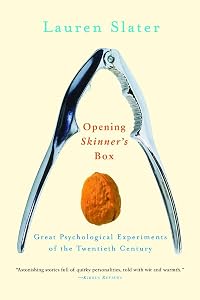
I couldn’t decide for a while whether I loved or hated Lauren Slater’s book Lying: A Metaphorical Memoir. Finally, maybe a quarter of the way into it, I decided I loved it and I never changed my mind again. But it’s the kind of book I would think carefully about before I recommended it to anyone, as it strikes me as potentially hateable. It seems that Slater has a talent for stirring up controversy (whether this is what she intends or not, I’m not sure). My first introduction to her was the 2006 edition of The Best American Essays where she was the year’s guest editor. Her introduction to the anthology told the story of how her book Opening Skinner’s Box provoked all kinds of anger from all kinds of people, but especially show more professional psychologists, of which she is one herself. Apparently, people didn’t like her portrayal of famous psychological experiments, and they disliked it enough to start an email listserve called “Slater-Hater,” which she followed for a while. The openness with which she discussed this episode, which surely was extremely painful, impressed me, and I’ve been intrigued by her ever since.
So, as you can guess from the title, Lying: A Metaphorical Memoir is no traditional memoir; instead, it’s a book where she claims to have epilepsy, but also refuses to tell you whether that’s actually true or not. It might just be a metaphor for something else she is trying to communicate about her life, something about mental illness. She describes the experience of epilepsy in great detail, though, telling about her first seizures and the process of figuring out the disease, describing the various forms of treatment she received, and describing the way she would pretend to have seizures or purposely induce seizures for dramatic effect. The most dramatic part of the book comes when she describes surgery to have her corpus callosum severed — the part of the brain that connects the right and left hemispheres. Her doctor believed that this wouldn’t cure her fully but would cut down dramatically on the number and severity of the seizures, which is did — or which she says it did. It also left her with some strange side effects, such as not being able to read with her left eye closed, since the right side of the brain processes language.
Read the rest of the review at show less
So, as you can guess from the title, Lying: A Metaphorical Memoir is no traditional memoir; instead, it’s a book where she claims to have epilepsy, but also refuses to tell you whether that’s actually true or not. It might just be a metaphor for something else she is trying to communicate about her life, something about mental illness. She describes the experience of epilepsy in great detail, though, telling about her first seizures and the process of figuring out the disease, describing the various forms of treatment she received, and describing the way she would pretend to have seizures or purposely induce seizures for dramatic effect. The most dramatic part of the book comes when she describes surgery to have her corpus callosum severed — the part of the brain that connects the right and left hemispheres. Her doctor believed that this wouldn’t cure her fully but would cut down dramatically on the number and severity of the seizures, which is did — or which she says it did. It also left her with some strange side effects, such as not being able to read with her left eye closed, since the right side of the brain processes language.
Read the rest of the review at show less
Members
- Recently Added By
Author Information

12+ Works 1,979 Members
Lauren Slater is a psychologist and the author of nine books, including Welcome to My Country, Prozac Diary, and Opening Skinner's Box, a finalist for the Los Angeles Times Book Prize. She has received numerous awards, including fellowships from the National Endowment for the Arts and the Knight Science Journalism program at MIT, and her work has show more often been reprinted in The Best American Essays. She lives in Fitchburg, Massachusetts. show less
Common Knowledge
- Original publication date
- 2000
- People/Characters
- Lauren Slater
Classifications
- Genres
- Biography & Memoir, Nonfiction, General Nonfiction
- DDC/MDS
- 362.1968530092 — Society, government, & culture Social problems and social services Social Welfare People with physical illnesses Services to people with specific conditions Diseases Diseases of nervous system and mental disorders Miscellaneous diseases of nervous system and mental disorders
- LCC
- RC372 .S576 — Medicine Internal medicine Internal medicine Neurosciences. Biological psychiatry. Neuropsychiatry Neurology. Diseases of the nervous system
- BISAC
Statistics
- Members
- 260
- Popularity
- 124,494
- Reviews
- 13
- Rating
- (3.53)
- Languages
- English
- Media
- Paper, Ebook
- ISBNs
- 4
- ASINs
- 1