On This Page
Description
Toloki, a professional mourner in South Africa, is reunited with a woman from his village.Tags
Recommendations










Member Reviews
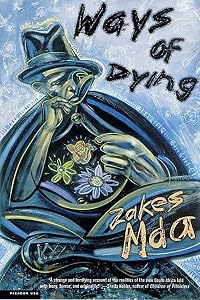
Told in the collective voice of "we," Ways of Dying unfolds the story of Toloki and Noria. The community owns the story, but keeps an emotionally safe distance. Toloki makes his living as a professional mourner. What an interesting vocation. Toloki will be there if you need someone to help carry a casket; he will wail as if he just lost his own best friend, or he can rescue a body from the morgue before officials dump it into a mass grave. Toloki's most important task is to attend funerals to comfort the mourners. It is at one such funeral that he reconnects with someone from his childhood. As children, Toloki was always jealous of the beautiful and mysterious Noria. No matter how hard he tried to please his father, Noria was the only show more one his father had eyes for. Noria acted as Toloki's father's artistic muse. Now, years later, Noria is a changed woman after suffering so much heartache and loss. Together, they forge a new friendship.
Confession: there was so much misery in Ways of Dying that I could not trust a happy ending. show less
Confession: there was so much misery in Ways of Dying that I could not trust a happy ending. show less
32/2021. This is a novel set in an unnamed city on the coast of South Africa, presumably based on Cape Town, in 1993-4, shortly before the transition to inclusive democracy. The protagonist is a professional mourner who meets a woman from his home village at the funeral of her son in the city about twenty years after he last saw her. Unusually the story has a third person plural narrator, a collective "we", the people of the city and the village who have individually witnessed events but are recounting them from a communal perspective (I think this is a nod towards collective oral traditions of narrative and also omniscient ancestors). Most published fiction of around 200 pages is stripped to essentials but this novel is full of the show more telling small details of ordinary people's lives.
The usual "ways of dying" for each age group - accidents, violence, and illness - occur as natural events in various characters' lives. The average age of death in South Africa was falling from a high of 63 in 1991 to only 53 in 2004 (the lowest since 1972, although by 2020 it had returned to 64) but people continue on with daily life: they grow up, go to school, work, form relationships, have children, and care for families. The story ought to be depressing but, despite being confronted with the inevitability of all our demises, I found it life-affirming. After all, each day means more when we understand we have so little time on this earth, and the saddest way of dying is giving up on life while you're still alive.
Those who profit from death:professional mourners, authors who make art about death, those who make money out of the business of death, and politicians.
Quotes
Sorry, but I collect tripe quotations: "The Archbishop earned his living during the week by selling tripe and other innards of animals in a trunk fastened to the carrier of his bicycle. He rode from one homestead to another through the village, shouting, 'Mala mogodu! Amathumbo!' in his godly baritone. This simply meant that he was touting his offal, encouraging people to buy."
Audiences on art: "As usual, they cannot say what the meaning is. It is not even necessary to say, or even to know, what the meaning is. It is enough only to know that there is a meaning, and it is a profound one." show less
The usual "ways of dying" for each age group - accidents, violence, and illness - occur as natural events in various characters' lives. The average age of death in South Africa was falling from a high of 63 in 1991 to only 53 in 2004 (the lowest since 1972, although by 2020 it had returned to 64) but people continue on with daily life: they grow up, go to school, work, form relationships, have children, and care for families. The story ought to be depressing but, despite being confronted with the inevitability of all our demises, I found it life-affirming. After all, each day means more when we understand we have so little time on this earth, and the saddest way of dying is giving up on life while you're still alive.
Those who profit from death:
Quotes
Sorry, but I collect tripe quotations: "The Archbishop earned his living during the week by selling tripe and other innards of animals in a trunk fastened to the carrier of his bicycle. He rode from one homestead to another through the village, shouting, 'Mala mogodu! Amathumbo!' in his godly baritone. This simply meant that he was touting his offal, encouraging people to buy."
Audiences on art: "As usual, they cannot say what the meaning is. It is not even necessary to say, or even to know, what the meaning is. It is enough only to know that there is a meaning, and it is a profound one." show less
The style is very unusual and I really enjoy it. The voice speaking changes, there is a magical and unreal quality at times, then the reality comes in. Beautifully written and very evocative.
Een door zijn jeugd getraumatiseerde zwarte Zuid-Afrikaanse man bezoekt als beroepsrouwklager begrafenissen van armoedzaaiers en van slachtoffers van rassenhaat en (politiek) geweld
Dec 27, 2009Dutch
Ratings
Members
- Recently Added By
Lists

"We" narration
49 works; 2 members

Speculative Fiction from around the World
610 works; 18 members
Author Information

26 Works 1,241 Members
Born Zakes Mda in 1948 in South Africa in the Eastern Cape, Mda spent his early childhood in Soweto, and finished his school education in Lesotho, where he had joined his father in exile. As a poet, he published in magazines such as Staffrider, The Voice, and Oduma, and in the anthologies New South African Writing in 1977, Summer Fires in 1982 and show more Soho Square in 1992. His first volume of poems, Bits of Debris, came out in 1986. In 1978 Mda's play We Shall Sing for the Fatherland, written in 1973, won the first Amstel Playwright of the Year Award. The following year he won this award again with The Hill, a play written in 1978. The publication of We Shall Sing for the Fatherland and Other Plays in 1980 enabled him to gain admission to Ohio University for a three-year Master's degree in theatre. His play The Road, written in 1982, won the Christina Crawford Award of American Theatre Association in 1984, by which time his plays were being performed in the USSR, the USA, and Scotland as well as in various parts of southern Africa. Mda returned from the USA in 1984, joining the University of Lesotho as lecturer in the Department of English in 1985. In 1989 he was awarded a Ph.D. by the University of Cape Town and his dissertation was later published as When People Play People in 1993, the same year as a collection of four plays, And the Girls in Their Sunday Dresses. In 1991 Mda was writer-in-residence at the University of Durham, where he wrote The Nun's Romantic Story; in 1992 as research fellow at Yale University he wrote The Dying Screams of the Moon, another play, and his first novel, Ways of Dying in 1995. By 1994 he was back in South Africa from exile in America, as visiting professor at the University of the Witwatersrand. He has since given up teaching African literature to write novels. (Bowker Author Biography) show less
Some Editions
Awards and Honors
Awards
Series

Belongs to Publisher Series
Common Knowledge
- Canonical title
- Ways of Dying
- Original publication date
- 1995
- Important places
- South Africa
- First words
- 'There are many ways of dying!', the Nurse shouts at us. Pain is etched in his voice and rage has mapped his face.
- Quotations
- The Archbishop earned his living during the week by selling tripe and other innards of animals in a trunk fastened to the carrier of his bicycle. He rode from one homestead to another through the village, shouting, 'Mala mogo... (show all)du! Amathumbo!' in his godly baritone. This simply meant that he was touting his offal, encouraging people to buy.
- Original language
- English
Classifications
Statistics
- Members
- 255
- Popularity
- 127,226
- Reviews
- 4
- Rating
- (3.74)
- Languages
- 7 — Dutch, English, Estonian, Italian, Norwegian (Bokmål), Slovenian, Spanish
- Media
- Paper, Ebook
- ISBNs
- 11
- ASINs
- 3