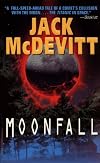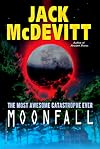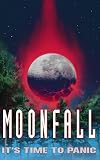
Moonfall
by Jack McDevitt
On This Page
Description
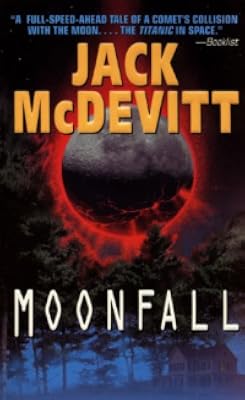
It's the 21st century, and all is right with the world. Or so it seems. Vice President Charlie Haskell, who will travel anywhere for a photo op, is about to cut the ribbon for the just-completed American Moonbase. The first Mars voyage is about to leave high orbit, with a woman at the helm. Below, the world is marveling at a rare solar eclipse. But all that is right is about to go disastrously wrong when an amateur astronomer discovers a new comet. Named for its discover, Tomikois a show more "sun-grazer," an interstellar wanderer with a hundred times the mass and ten times the speed of other comets. And it is headed straight for our moon. In less than five days, if scientists' predictions are right, Tomiko will crash into the moon, shattering it into a cloud of superheated gas, dust, and huge chunks of rock that will rain down on the earth, causing chaos and killer storms, possibly tidal waves inundating entire cities...or worse: a single apocalyptic worldwide "extinction event." In the meantime, the population of Moonbase must be evacuated by a hastily assembled fleet of shuttle rockets. There isn't room, or time enough, for everyone. And the vice president, who rashly promised to be last off ("I will lock the door and turn off the lights"), is trying to figure out how to get away without eating his words. In Moonfall, McDevitt has created a disaster thriller of truly epic proportions, featuring a cast of unforgettable characters: the reluctant Russian rocket jockey entrusted with the lives of squabbling refugees; the woman chosen to be first on the moon; the scientist who must deflect the "possum" (POSSible IMpactors) knocked from orbit or witness the end science itself. And at the center of it all is Charlie Haskell, the career politician who discovers his own unexpected reserves of only himself and his country, but for all humankind. Moonfall, is a spellbinding tale of heroism and hope, cowardice and passion played against the awesome spectacle of human history's darkest night. show lessTags
Recommendations






Member Reviews
This book was, in a word, chaotic. And in a second word, preachy. It's actually very difficult to determine which of those two descriptors was more upsetting, as I went through the book. Around three-quarters of the way through, I had had more than enough, and I only finished reading to give the book a fair shake.
In all honesty, I rather wish I hadn't.
Let's start with how it was chaotic. This issue should be relevant to any reader, regardless of your philosophical bent.
The chaos begins with simple organization. It seems Mr. McDevitt wanted to have titled sections, but he also wanted smaller breaks within the story. His choice on how to resolve this? Ten titled "chapters" with anywhere between 3 and 13 smaller, enumerated breaks in each. show more Except that those enumerations restarted with each chapter. So either you had to read eighty pages at a sitting or remember both chapter number and section number, at which point, it would be easier just to dog-ear the page and stop whenever you want. This might not matter at all to some, but it's hardly conducive to a good reading experience, in my opinion. It's just a little sloppy.
But that is probably the least of McDevitt's crimes against fiction in this work. He introduces - and kills off - more characters than most movies have extras. In fact, he introduces so many that it's almost impossible to keep up with them - which is proven by the fact that McDevitt in fact does not keep up with them all. There are a few characters, introduced sporadically, which he mentions again only once or twice, or perhaps never returns to. And he kills so many characters over the course of the book that he finds himself in need of new ones about halfway through, and starts introducing more. Not only does all this make the book a crowded mass of names, places, and biographies appropriate for a dating site, but it cheapens the characters that do survive. Since anyone could die at any moment, whether they had been a narrative influence, present from the beginning of the book, or seemed integral to the story, I quickly stopped caring for anyone. The romance in the book is irrelevant and emotionless, because one or both characters could die at any moment, with neither drama nor reflection.
Tangential to that point is this one: Mr. McDevitt begins the book with a small number of characters and a setting to which he only returns twice in the entire remainder of the book, and only for a paragraph each time. Perhaps I am alone in my thinking here, but I have always believed that the first chapter, the first paragraph, the first character in a story has either a pivotal role or thematic importance. The characters in Mr. McDevitt's opening scene have neither. They are, to put it bluntly, completely irrelevant to the entire book.
Finally, let us examine the prose. For the most part, the book is in third-person omniscient - presumably so we can relate to characters who will soon be dead. But Mr. McDevitt does not appear comfortable writing death scenes, so nearly every death in the book is from an observer's perspective: "So-and-so never saw it coming," "She was dead before she knew it," "He died in the middle of a sentence." If Mr. McDevitt wanted us to care about any of these characters, he should have made their deaths more interesting. Instead, much of the book reads like a historical account of the time when the moon was destroyed by a rogue comet, and this list of people died, and this list lived, and that other list should have been executed for their religious fanaticism.
Which brings me to my second primary point: how the book was preachy. Mr. McDevitt evidently lacks the capacity to understand the mind of a person who has religious faith. For one thing, he asserts that religious people live easier lives than the non-religious, that this ignorance (as McDevitt sees it) is bliss, and that the biggest challenge a Christian must face is explaining away bad events as divine providence. Churches are ridiculous, and things which must be escaped. (See pages 330-331 for these points.)
Furthermore, there can be no intelligent religious people. McDevitt cannot imagine someone being both intelligent and religious; the two descriptors mutually exclusive in his mind. After all, the one religious character who is neither a terrorist nor laughably short-lived is Chaplain Mark Pinnacle, who became a pastor not because he had faith, but because he was rebelling against his father, and Pinnacle had plenty of doubts about the truth of religion. (See pages 160-161.)
Perhaps most telling is how Mr. McDevitt concludes this little escapade. Almost every character in the book, even staunch agnostics (which seem to be the majority of the population for his characters; there are few staunch atheists and no staunch religious protagonists, in spite of every character's concerns about what the silly, religious voters would think), was praying in the final chapter that the mission would succeed... and yet, in the end, the important thing for Charlie Haskell (probably the primary protagonist of the book) to remember is that failure in the mission would mean going back to "inventing religions to give meaning to disease-ridden, violent, pointless lives, and then becoming subjugated by the religions," going back "to refight all the battles against war and disease and superstition," when, "finally, the common effort was bearing fruit." (See page 531.) And of course, success led to the formation of a universal bond among all humankind "that transcended national and religious identities," so much that "even in Jerusalem" (that wretched hive of warmongering, according to the underlying tone), "at long last, an accommodation seemed to have been reached." (See page 544.)
And what's the basic principle of all this? That religion is, at best, backwards, barbaric, ignorant, and foolish. And at worst, it's both malicious and evil, and it seeks to destroy humanity with wars and death, and we need a "common misfortune," brought about not by any god or religious cause, not by karma or dogmatic punishment, but by chance, by Lady Luck, so that we can all come together and achieve world peace.
See? Preachy. And chaotic.
Another humorous quibble is with Mr. McDevitt's ability to predict the future. Writing this book in 1998, he was four years late on his estimation of the first African-American President, and his view of the future of the Internet and other technologies is somewhat lacking... not to mention the sad issue of NASA's defunding, pressing, not the government, but a wide range of private companies into the reaches of space. But of course, he can't be faulted for any of that. It's just fun to note. show less
In all honesty, I rather wish I hadn't.
Let's start with how it was chaotic. This issue should be relevant to any reader, regardless of your philosophical bent.
The chaos begins with simple organization. It seems Mr. McDevitt wanted to have titled sections, but he also wanted smaller breaks within the story. His choice on how to resolve this? Ten titled "chapters" with anywhere between 3 and 13 smaller, enumerated breaks in each. show more Except that those enumerations restarted with each chapter. So either you had to read eighty pages at a sitting or remember both chapter number and section number, at which point, it would be easier just to dog-ear the page and stop whenever you want. This might not matter at all to some, but it's hardly conducive to a good reading experience, in my opinion. It's just a little sloppy.
But that is probably the least of McDevitt's crimes against fiction in this work. He introduces - and kills off - more characters than most movies have extras. In fact, he introduces so many that it's almost impossible to keep up with them - which is proven by the fact that McDevitt in fact does not keep up with them all. There are a few characters, introduced sporadically, which he mentions again only once or twice, or perhaps never returns to. And he kills so many characters over the course of the book that he finds himself in need of new ones about halfway through, and starts introducing more. Not only does all this make the book a crowded mass of names, places, and biographies appropriate for a dating site, but it cheapens the characters that do survive. Since anyone could die at any moment, whether they had been a narrative influence, present from the beginning of the book, or seemed integral to the story, I quickly stopped caring for anyone. The romance in the book is irrelevant and emotionless, because one or both characters could die at any moment, with neither drama nor reflection.
Tangential to that point is this one: Mr. McDevitt begins the book with a small number of characters and a setting to which he only returns twice in the entire remainder of the book, and only for a paragraph each time. Perhaps I am alone in my thinking here, but I have always believed that the first chapter, the first paragraph, the first character in a story has either a pivotal role or thematic importance. The characters in Mr. McDevitt's opening scene have neither. They are, to put it bluntly, completely irrelevant to the entire book.
Finally, let us examine the prose. For the most part, the book is in third-person omniscient - presumably so we can relate to characters who will soon be dead. But Mr. McDevitt does not appear comfortable writing death scenes, so nearly every death in the book is from an observer's perspective: "So-and-so never saw it coming," "She was dead before she knew it," "He died in the middle of a sentence." If Mr. McDevitt wanted us to care about any of these characters, he should have made their deaths more interesting. Instead, much of the book reads like a historical account of the time when the moon was destroyed by a rogue comet, and this list of people died, and this list lived, and that other list should have been executed for their religious fanaticism.
Which brings me to my second primary point: how the book was preachy. Mr. McDevitt evidently lacks the capacity to understand the mind of a person who has religious faith. For one thing, he asserts that religious people live easier lives than the non-religious, that this ignorance (as McDevitt sees it) is bliss, and that the biggest challenge a Christian must face is explaining away bad events as divine providence. Churches are ridiculous, and things which must be escaped. (See pages 330-331 for these points.)
Furthermore, there can be no intelligent religious people. McDevitt cannot imagine someone being both intelligent and religious; the two descriptors mutually exclusive in his mind. After all, the one religious character who is neither a terrorist nor laughably short-lived is Chaplain Mark Pinnacle, who became a pastor not because he had faith, but because he was rebelling against his father, and Pinnacle had plenty of doubts about the truth of religion. (See pages 160-161.)
Perhaps most telling is how Mr. McDevitt concludes this little escapade. Almost every character in the book, even staunch agnostics (which seem to be the majority of the population for his characters; there are few staunch atheists and no staunch religious protagonists, in spite of every character's concerns about what the silly, religious voters would think), was praying in the final chapter that the mission would succeed... and yet, in the end, the important thing for Charlie Haskell (probably the primary protagonist of the book) to remember is that failure in the mission would mean going back to "inventing religions to give meaning to disease-ridden, violent, pointless lives, and then becoming subjugated by the religions," going back "to refight all the battles against war and disease and superstition," when, "finally, the common effort was bearing fruit." (See page 531.) And of course, success led to the formation of a universal bond among all humankind "that transcended national and religious identities," so much that "even in Jerusalem" (that wretched hive of warmongering, according to the underlying tone), "at long last, an accommodation seemed to have been reached." (See page 544.)
And what's the basic principle of all this? That religion is, at best, backwards, barbaric, ignorant, and foolish. And at worst, it's both malicious and evil, and it seeks to destroy humanity with wars and death, and we need a "common misfortune," brought about not by any god or religious cause, not by karma or dogmatic punishment, but by chance, by Lady Luck, so that we can all come together and achieve world peace.
See? Preachy. And chaotic.
Another humorous quibble is with Mr. McDevitt's ability to predict the future. Writing this book in 1998, he was four years late on his estimation of the first African-American President, and his view of the future of the Internet and other technologies is somewhat lacking... not to mention the sad issue of NASA's defunding, pressing, not the government, but a wide range of private companies into the reaches of space. But of course, he can't be faulted for any of that. It's just fun to note. show less
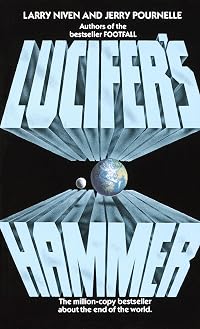
This surprised me. As far as I can see, it's unconnected to McDevitt's far future space opera series. It's set in (a now alternate timeline) 2024 with an active moonbase and space station. It's belongs alongside Leiber's The Wanderer, Pournelle and Niven's Lucifer's Hammer, and other cataclysmic epics. It follows the common pattern of such works, with multiple independent characters and plotlines, many scenes of unfortunate death, Inferno-style jabs at the author's pet peeves, and so on. It differs from the others that I can recall in not being completely Earthbound. The Moon, not the Earth, is the hapless victim of large fast-moving comet. A substantial portion of the action takes place in space and on the Moon, adding a greater SFnal show more aspect.
The surprising part was that, despite working off his turf in a somewhat cliched genre, this is probably my favorite McDevitt novel. The characterizations are stronger and more varied than is typical for him, and the action is more compelling. My one complaint is that there's one countdown to doom too many, but even that manages to tie up an earlier thread.
Recommended. show less
The surprising part was that, despite working off his turf in a somewhat cliched genre, this is probably my favorite McDevitt novel. The characterizations are stronger and more varied than is typical for him, and the action is more compelling. My one complaint is that there's one countdown to doom too many, but even that manages to tie up an earlier thread.
Recommended. show less
Moonfall
At first glance, Jack starts in by showing an eclipse, then we get a preview of an unknown comet from another galaxy, invisible except for the elclipse leads to its discovery. What follows is at first a bit of a slow tale with over explanation of vignettes and way too much minor detail, but ends up as a page turner that will grip you to the end.
This story is how people react to stress and unsolvable life threatening situations. A large rock is falling onto the planet from a broken Moon. How do you react?
Some rise to the occasion, some run in fear. Others threaten the discoverer of the comet, somehow blaming her. And some are heroic and pull out at the last minute a solution that saves the planet.
How would you respond to a show more major disaster? Would you help and rise to the occasion? Or take advantage and steal and try to take over and start a revolution?
It’s a good question and one not normally asked in disaster stories.
Recommended. Can’t wait for Jack’s last Academy book being released this April 2018. show less
At first glance, Jack starts in by showing an eclipse, then we get a preview of an unknown comet from another galaxy, invisible except for the elclipse leads to its discovery. What follows is at first a bit of a slow tale with over explanation of vignettes and way too much minor detail, but ends up as a page turner that will grip you to the end.
This story is how people react to stress and unsolvable life threatening situations. A large rock is falling onto the planet from a broken Moon. How do you react?
Some rise to the occasion, some run in fear. Others threaten the discoverer of the comet, somehow blaming her. And some are heroic and pull out at the last minute a solution that saves the planet.
How would you respond to a show more major disaster? Would you help and rise to the occasion? Or take advantage and steal and try to take over and start a revolution?
It’s a good question and one not normally asked in disaster stories.
Recommended. Can’t wait for Jack’s last Academy book being released this April 2018. show less
Rarely has a book scared the absolute crap outta me. This one gave me nightmares. I read it while on vacation in Europe and dreamed about it every night until I finished it -- in 3 days! This book will make you ponder the serious WHAT IF questions about the moon, the earth and the efficacy of the U.S. space program.
Moonfall certainly is a page turner that builds suspense effectively, although at times it becomes a bit predictable. In most of the McDevitt books I have read, politicians are bumbling or evil, so I was surprised that in this book the protagonist is the US vice-president, who just happens to be on the moon to open the new moon base when disaster looms. In this, as in other books, McDevitt is an author who brings together a group of truly diverse characters, who have to work together to accomplish a common goal. I think the obvious comparison is to Larry Niven's Lucifer's Hammer, although there are notable difference, not the least of which is that McDevitt's entire story takes place over the course of just a week or so. I'd have to say show more that I liked both books about the same; Niven's book is in some ways the more ambitious of the two, but certainly has its weaknesses. In any case, either is far superior to the story they used in the movies Armageddon or Deep Impact. show less
Jack McDevitt’s Moonfall, first published in 1998, takes place in the mid-2020s, when Earthlings have an active space program and have just finished construction of a large Moonbase that is being officially opened with the participation of dignitaries from many countries. Charles L. Haskell, the Vice President of the U.S. is representing President Henry Kolladner at the ceremony on the Moon. In addition to Moonbase, an interplanetary ship is scheduled to depart for Mars with a multinational crew aboard within days after the Moonbase opening. However, as the ribbon-cutting ceremony for the Moonbase is taking place, an amateur astronomer calls the attention of the world’s astronomical community to a strange object in space behind the show more moon. The object is quickly determined to be an “intersteller object”, i.e., a “cometary body” that originated in another star system. Unfortunately, it is a monster, which is moving at an extremely high velocity and will collide with the Moon in a few days. Scientists issue a warning to the World that the enormous size and extreme velocity of the object is likely to shatter the Moon, which could cause catastrophic damage to Earth. In fact, this may possibly cause an extinction event on Earth. McDevitt weaves a very complex story that unfolds through the struggles of many ordinary people on Earth, through the heroic actions of the pilots and crew of the space planes and other ships that try to evacuate people from the Moonbase, and the selfless and courageous actions of people (especially the Vice President) who barely evacuate the Moon before impact and remain in Earth orbit desperately trying to prevent the devastation of Earth. The story jumps between the perspectives of characters and news media reports of the unfolding crisis to engage the reader in the terror and hardship that ensues. Tension is also created through the unwise decisions of politicians during the crisis and the criminal behavior of those pursuing their own agendas. I thought Moonfall was an excellent science fiction book. The science in this book is well developed and presented in an understandable and satisfying manner. The suspense begins early in the book and continues to increase along with the reader’s anxiety. Likewise, there is plenty of action that continues to grow in intensity and forces the characters, including the Vice President, to endure life-threatening and painful experiences while they attempt to complete complicated unfamiliar operations in the unforgiving environment of space in an effort to save lives on Earth. In addition, the story is populated by a large number of very interesting characters. I believe Moonfall is a first-rate science fiction story and I recommend it to anyone who likes science fiction as well as others who enjoy apocalyptic tales or just exciting stories. show less
A Hollywood style disaster movie script turned into a novel. At least that's what it reads like :-)
Fun stuff, with a sci-fi flavour, just a bit too predictable to turn it into four star read. Don't take it too seriously and you' ll likely enjoy it.
Fun stuff, with a sci-fi flavour, just a bit too predictable to turn it into four star read. Don't take it too seriously and you' ll likely enjoy it.
Members
- Recently Added By
Author Information

124+ Works 20,937 Members
Jack McDevitt (born 1935) is an American science fiction author whose novels frequently deal with attempts to make contact with alien races, and with archaeology or xenoarchaeology. He attended La Salle University, where a short story of his won the annual Freshman Short Story Contest and was published in the school's literary magazine, Four show more Quarters. He received a Master's degree in literature from Wesleyan University in 1971. Before becoming a full-time author, he was an English teacher, naval officer, Philadelphia taxi driver, customs officer and motivational trainer. His first published story was The Emerson Effect in The Twilight Zone Magazine in 1981. Two years later, he published his first novel, The Hercules Text, which won the Philip K. Dick Special Award. He won the 2006 Nebula Award for Best Novel for Seeker, the UPC International Prize for his novella Ships in the Night in 1991, and the John W. Campbell Memorial Award for best SF novel for Omega in 2003. (Bowker Author Biography) show less
Some Editions
Awards and Honors
Awards
Notable Lists
Series
Belongs to Publisher Series
Bastei Science Fiction-Special (24268)
Common Knowledge
- Original publication date
- 1998
- Dedication
- For Fran and Brian Cole, the Clearwater Desperadoes
- First words
- The Merrivale was bound for Honolulu, four days out of Los Angeles, when the eclipse began.
- Last words
- (Click to show. Warning: May contain spoilers.)They'll be on their way to Mars.
Classifications
Statistics
- Members
- 848
- Popularity
- 32,305
- Reviews
- 13
- Rating
- (3.65)
- Languages
- Czech, English, German, Polish
- Media
- Paper, Ebook
- ISBNs
- 14
- ASINs
- 6